
Japanese tools
17 tools
Tools for Japanese text: kanji to hiragana, kanji to romaji, and more.
Tags:
Sort:
Per page:
All tools
17 / 17
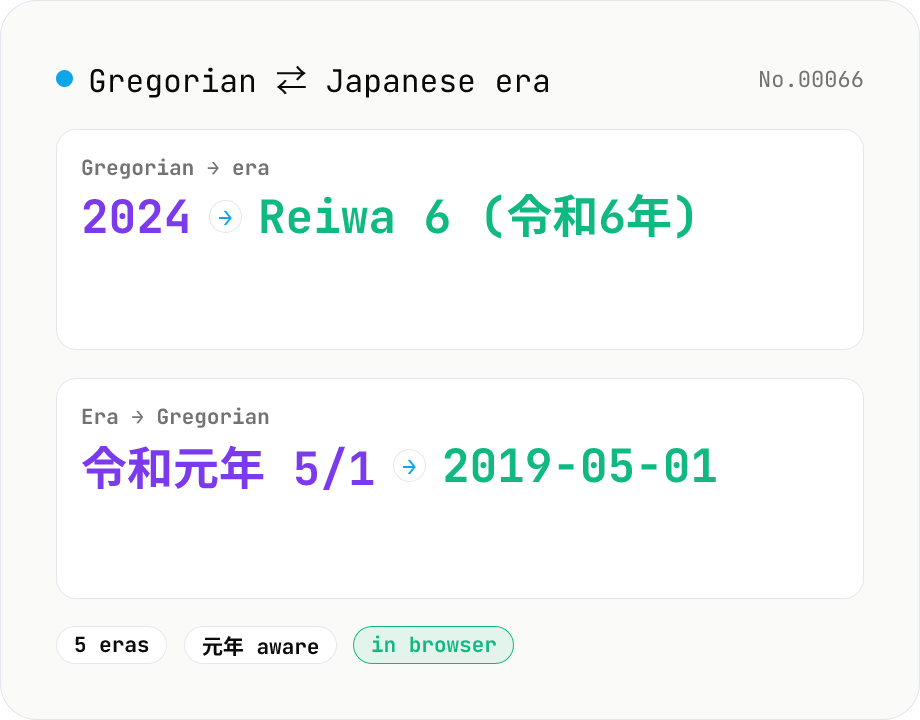
Japanese era ⇄ Gregorian year — Meiji to Reiwa converter
Convert between Gregorian years and Japanese eras (Meiji, Taishō, Shōwa, Heisei, Reiwa) with a mode toggle. Accepts year-only or full date input, handles 元年 (year 1) and era-boundary transitions like 2019-05-01 → Reiwa 1 (令和元年). No dictionary download required — runs entirely inside your browser.
japaneseconversiontime
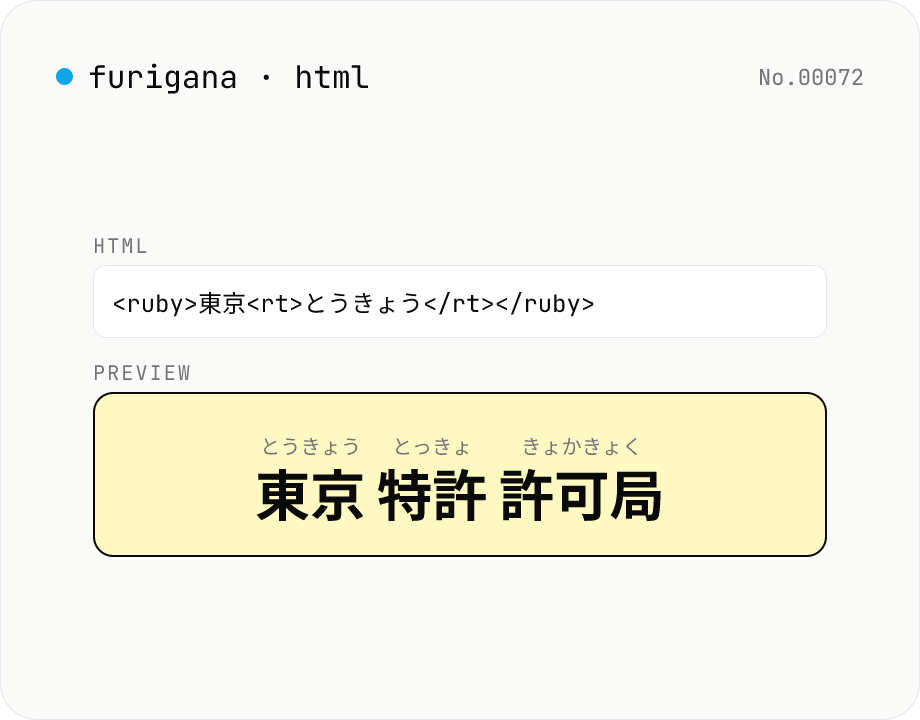
Furigana HTML generator — <ruby> ruby tags for kanji reading
Tokenises Japanese text with kuromoji and wraps each kanji token in `<ruby>漢字<rt>かんじ</rt></ruby>` markup. Copy the source and paste it into WordPress, any CMS, or a Markdown article. Furigana can be hiragana or katakana, with optional `<rp>` fallback for non-ruby browsers. Runs entirely in your browser.
japanesegenerate
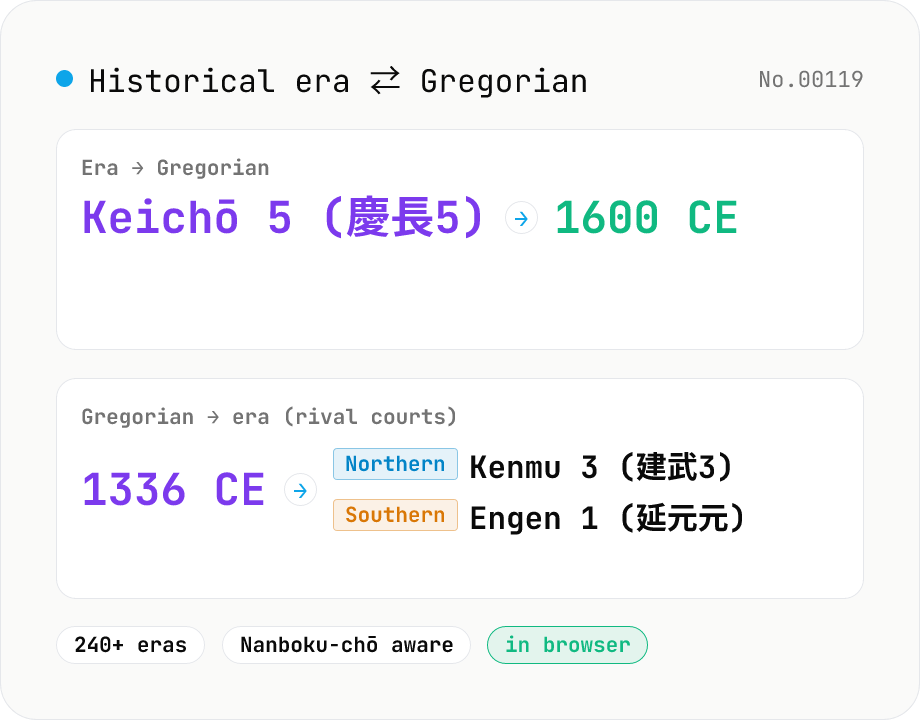
Historical Japanese era ⇄ Gregorian year — Taika 645 to Keiō 1868
Convert between historical Japanese eras (645 Taika through 1868 Keiō) and Gregorian years in both directions. Built-in dataset of 240+ pre-Meiji eras, including 元年 (year 1) and the rival Northern/Southern court eras of the Nanboku-chō schism (1331–1392). For Meiji onward use the era-convert tool. Year-level precision (the lunisolar calendar makes month/day mapping ambiguous). Runs entirely inside your browser — no dictionary download required.
japaneseconversiontime
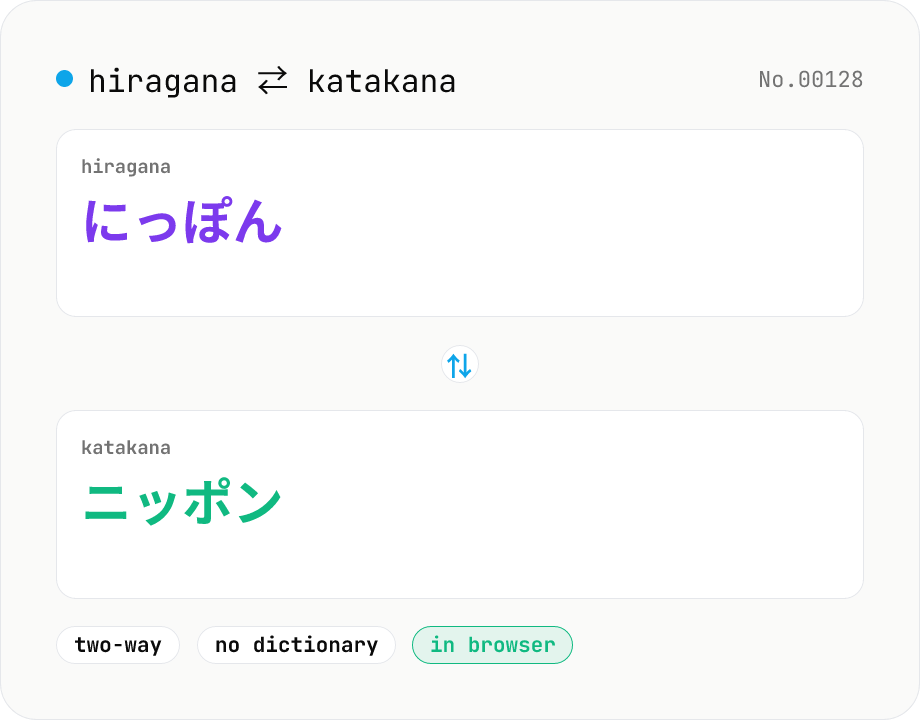
Hiragana ⇄ Katakana converter — bulk character mapping
Convert between hiragana and katakana with a single mode toggle. A purely mechanical per-character mapping — no dictionary download, instant conversion. Long-vowel mark, punctuation, kanji, and alphanumerics are preserved as-is. Runs entirely in your browser.
japaneseconversion
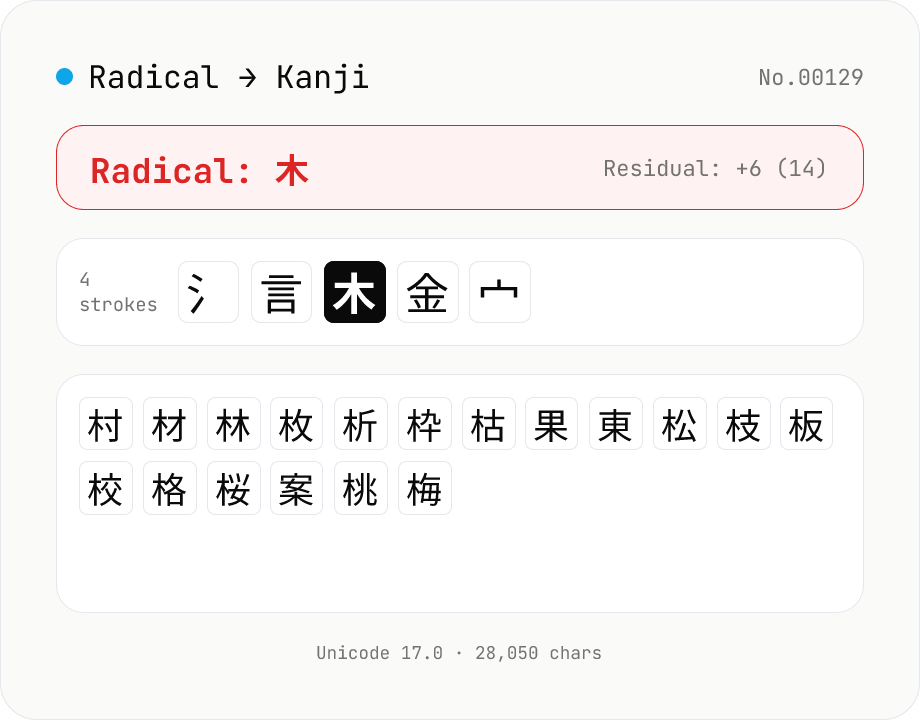
Kanji Radical Lookup
Reverse-lookup kanji by Kangxi radical (1–214) and residual stroke count, just like the radical index in a paper kanji dictionary. Pick a radical (一 / 人 / 木 / 氵 / 言 …) and a remaining-strokes filter to list every matching CJK ideograph from Unicode 17.0 (28,000+ characters). Click to copy; component variants (心→忄, 水→氵, 艸→艹) are noted under each radical. Runs entirely in your browser.
japaneseextract
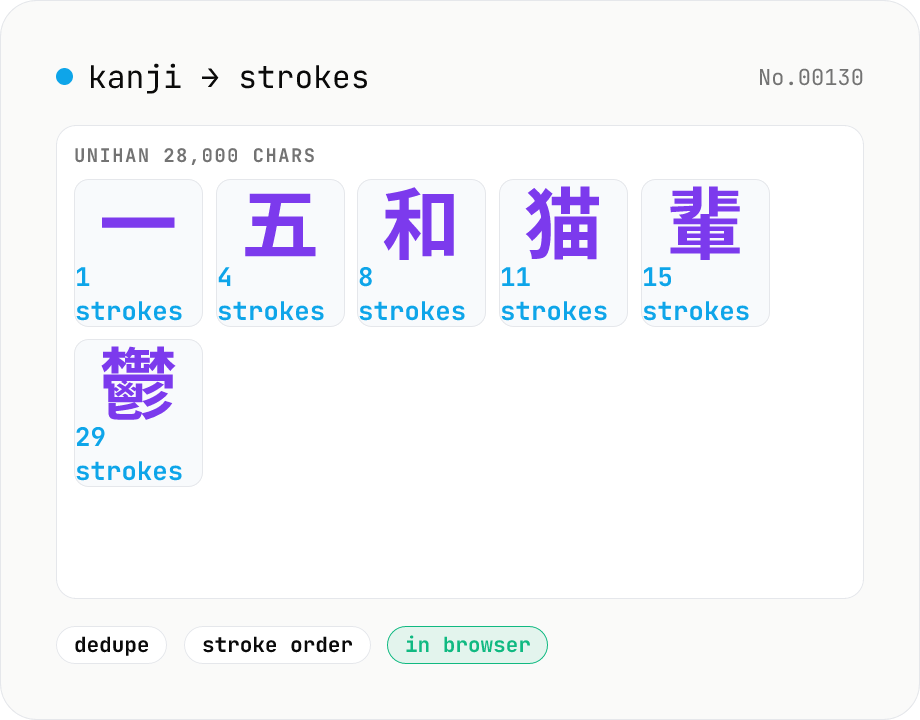
Kanji stroke count — bulk lookup / 28,000 characters
Extract every CJK ideograph from your input and look up its stroke count in a table. Backed by 28,000+ characters from Unicode 17's Unihan kTotalStrokes — covers all jōyō kanji, JIS X 0208 levels 1 & 2, and most of CJK Extension A and Compatibility. Optional dedupe and stroke-order sort, with running total. Useful for studying, name-stroke analysis, or just checking your kid's homework. Runs entirely in your browser.
japanesetextcount
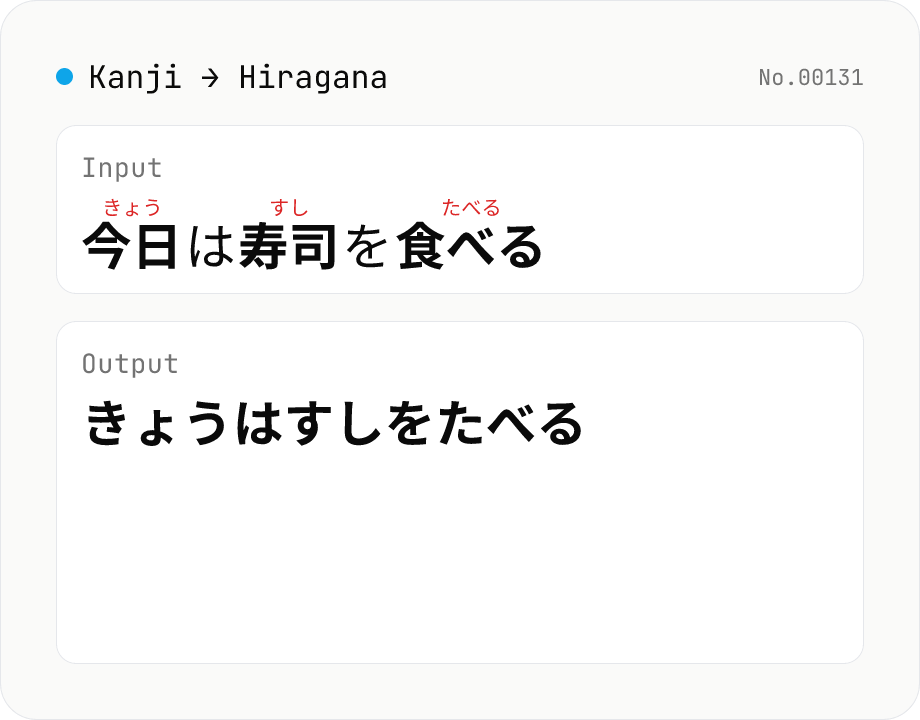
Kanji → Hiragana converter — kuromoji morphological reading
Convert Japanese text to hiragana using kuromoji morphological analysis. Choose between fully hiragana output, or a furigana mode that keeps kanji and adds hiragana ruby above. The dictionary downloads once and is then offline. Runs entirely in your browser.
japaneseconversion
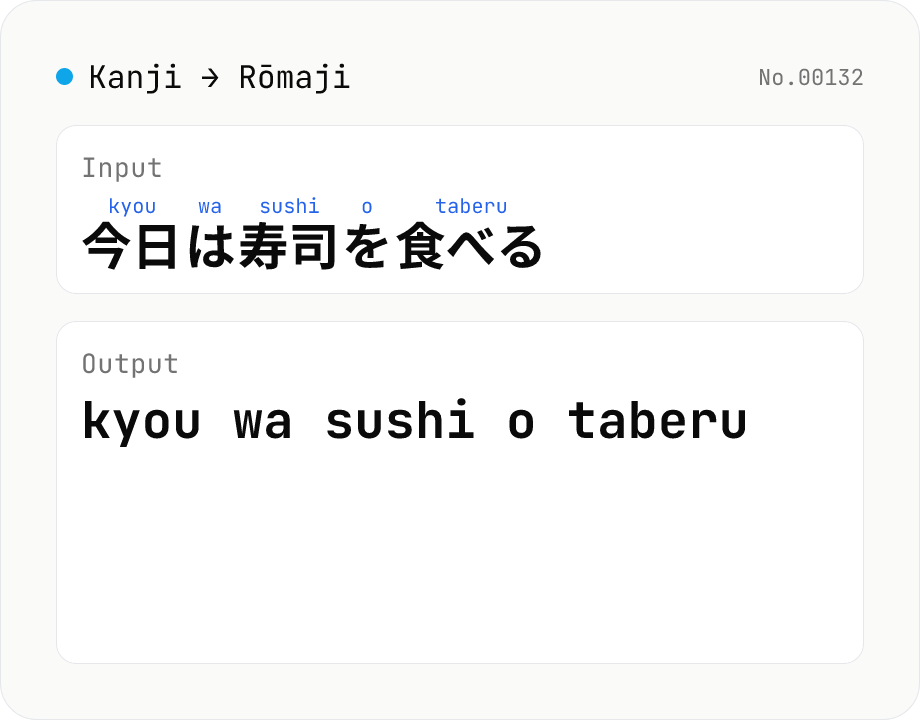
Kanji → Rōmaji converter — Hepburn / Kunrei-shiki / macron
Convert Japanese text to Hepburn romaji using kuromoji morphological analysis. Switch between full romaji and a ruby view, and choose macron long vowels (ō, ū) or literal doubled vowels (ou, uu). The dictionary downloads once and is then offline. Runs entirely in your browser.
japaneseconversion
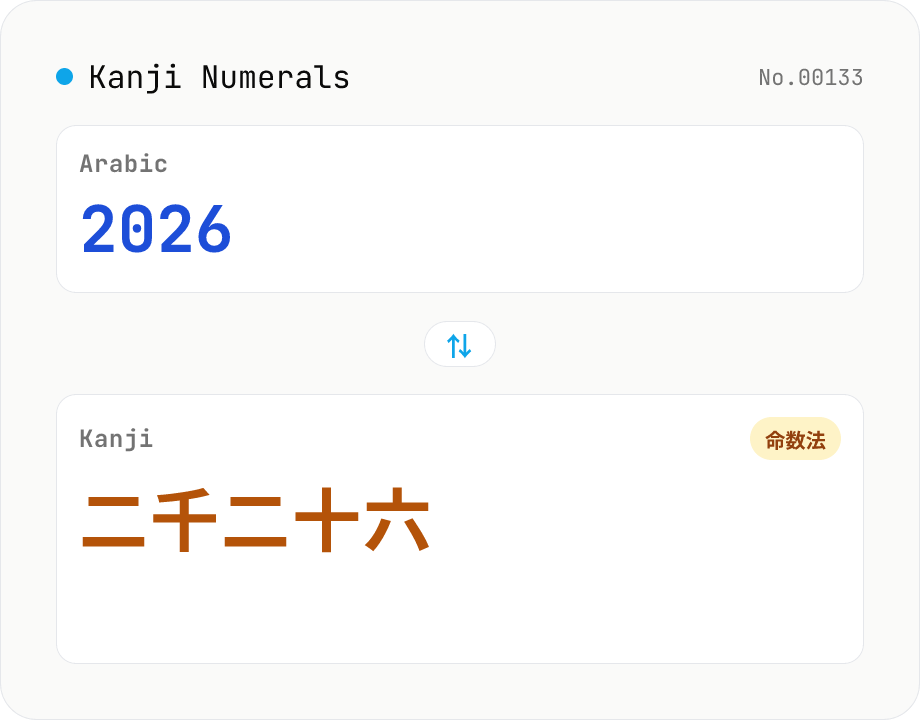
Kanji Numeral Converter
Convert between kanji numerals and Arabic digits. Supports place-value form (千二百三十四), daiji (壱弐参拾 — the tamper-resistant form used on contracts and promissory notes), and positional form (二〇二六). Handles up to 垓 (10^20), recognizes daiji, full-width digits, and thousands commas. Runs entirely in your browser — no uploads.
japaneseconversiontext
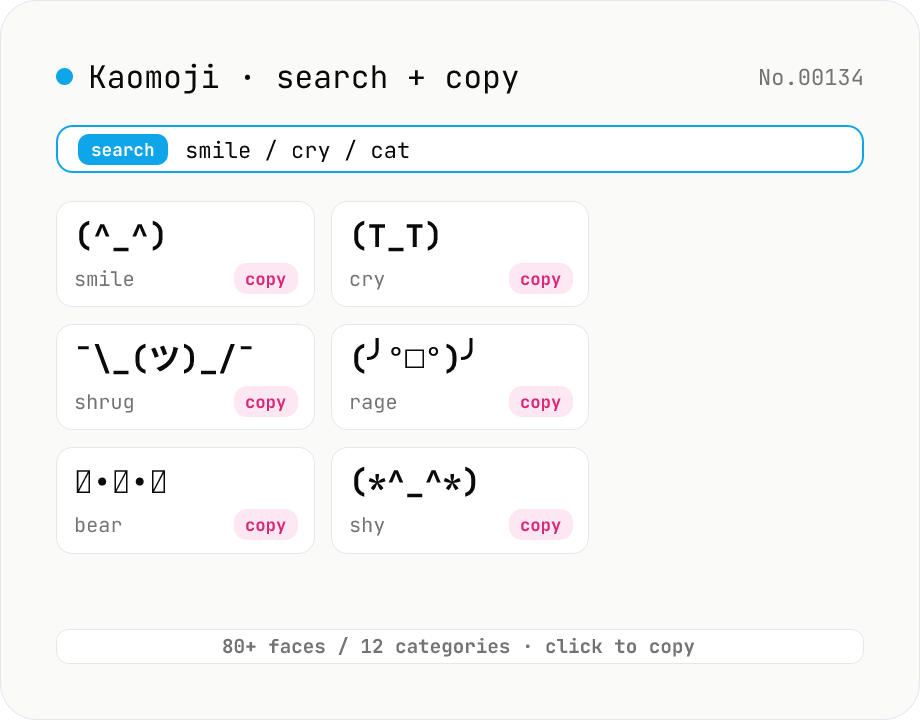
Kaomoji finder — copy (^_^) ¯\_(ツ)_/¯ and 80+ classic faces
Search 80+ classic kaomoji (text emoticons) across 12 categories — happy, sad, angry, surprise, love, confused, shrug, table flip, animal, music, and more — by face, tag, or category, then copy with one click. Unlike emoji, kaomoji render identically on Slack, Discord, LINE, GitHub, and email regardless of fonts or platforms, so you can express emotion without worrying about Unicode compatibility. All data ships with the tool; no network, no upload — everything happens in your browser.
japanesetext
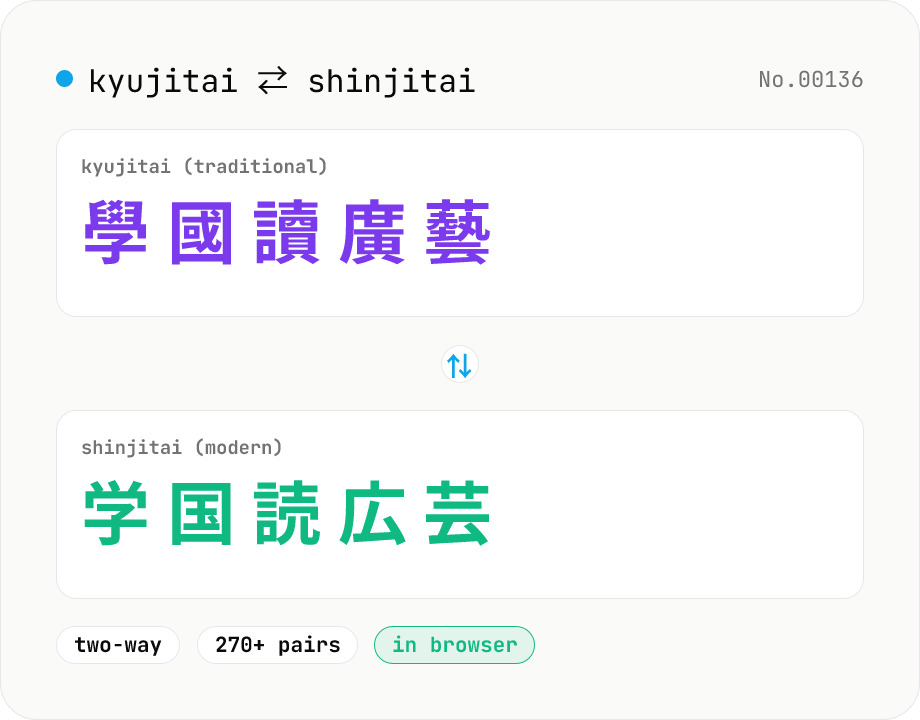
Kyujitai ⇄ Shinjitai converter — traditional ↔ modern Japanese kanji
Convert between pre-war kyujitai (traditional kanji) and post-war shinjitai (modern Joyo Kanji) with a single mode toggle. Backed by 270+ pairs from the Joyo Kanji list (1981 / 2010 revision) and JIS X 0213 variant tables — 學↔学, 國↔国, 讀↔読, 廣↔広. Runs entirely in your browser.
japaneseconversion
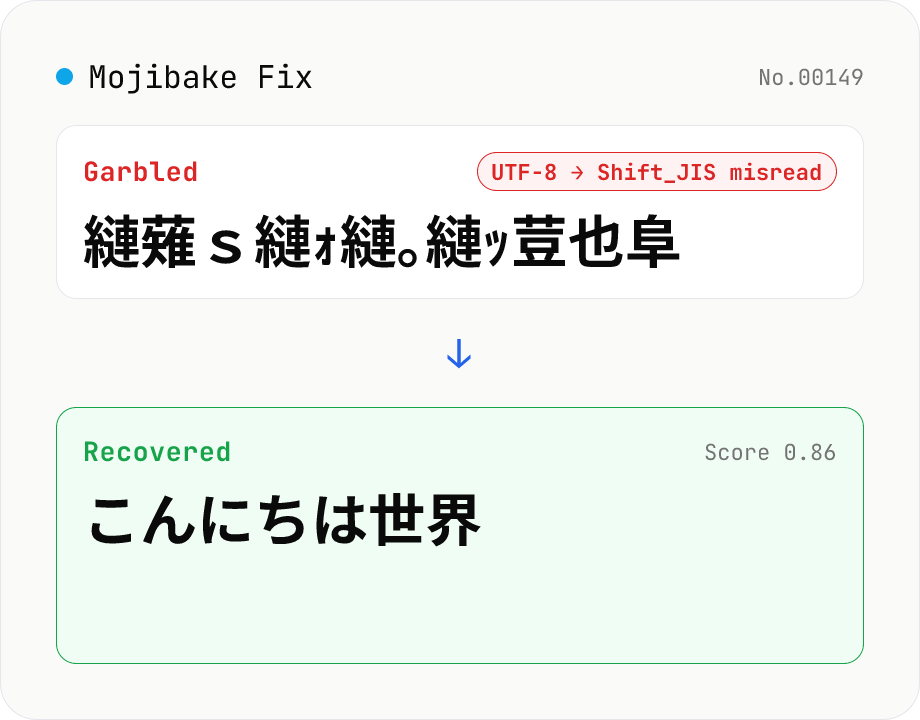
Mojibake Fix
Paste garbled Japanese text and recover the original. Tries every (source → misread) encoding pair (Shift_JIS / EUC-JP / UTF-8 / Latin-1), ranks candidates by Japanese-likeness score. Runs entirely in your browser.
japanesetextconversion
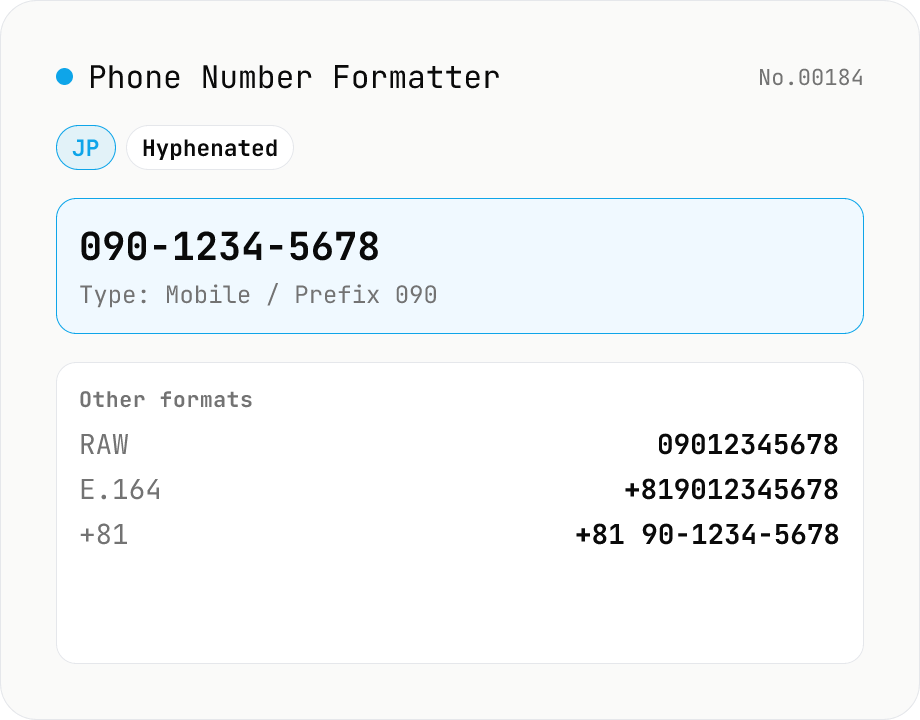
Japanese Phone Number Formatter (hyphenated / E.164)
Format a Japanese phone number (mobile 070/080/090, landline, toll-free 0120/0800, navi-dial 0570, IP 050, premium 0990) into four shapes at once: domestic hyphenated, digits only, compact E.164, and pretty +81. Accepts any common input shape — full-width digits, +81 international, 0081, mixed dashes / spaces / parentheses — and uses the hyphen positions you typed to disambiguate area codes that share a prefix (046 vs 0463 etc.). Ships with a built-in table of ~50 major 3-digit area codes (011 / 022 / 045 / 052 / 075 / 078 / 092 …). Runs entirely in your browser — no uploads.
formattext
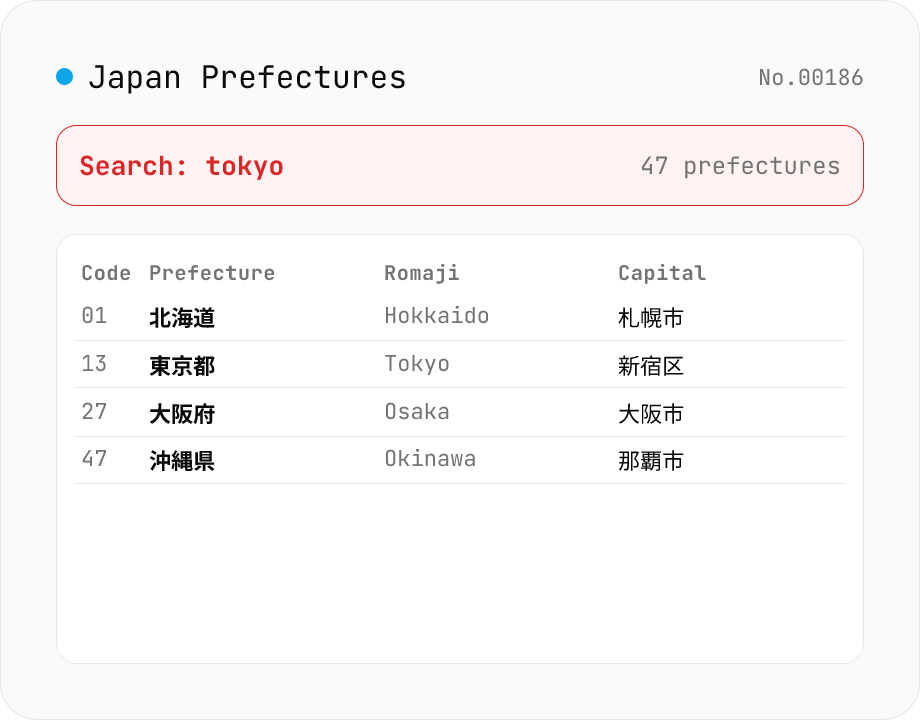
Japan Prefectures Lookup
Search all 47 Japanese prefectures by kanji / hiragana / romaji / JIS code / ISO 3166-2:JP / capital city. Filter by region (Hokkaido / Tohoku / Kanto / Chubu / Kinki / Chugoku / Shikoku / Kyushu-Okinawa). Useful for address validation, form helpers, and learning. Pure static data — instant, runs entirely in your browser.
japaneseextract
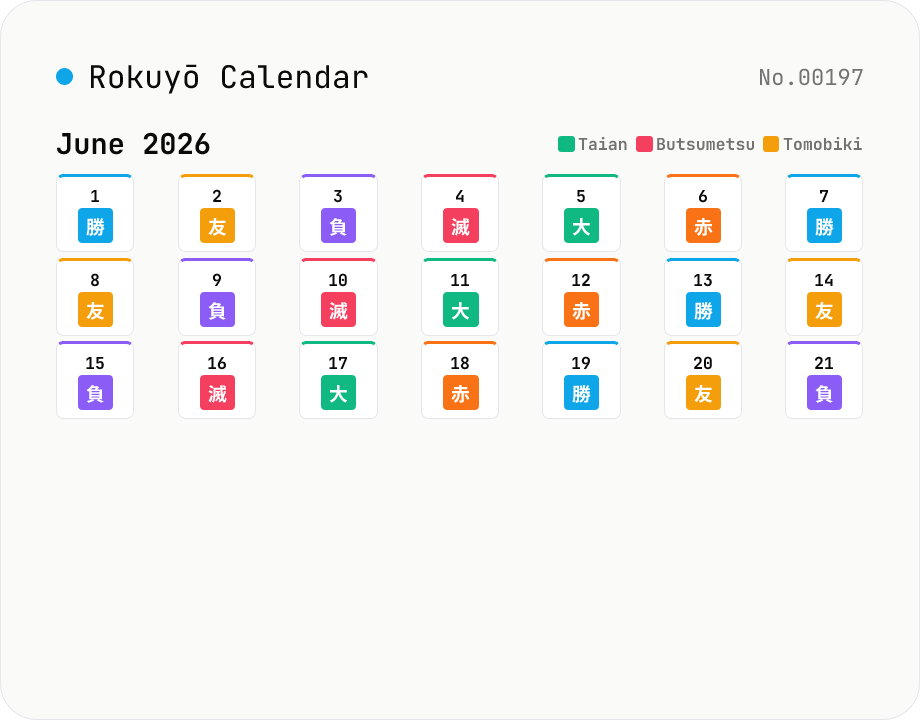
Rokuyō (Japanese 6-day calendar) — Taian / Butsumetsu lookup
Look up the Rokuyō (六曜) of any date — Sensho / Tomobiki / Senbu / Butsumetsu / Taian / Shakkō — and view a full month at a glance. Rokuyō is the traditional 6-day cycle used in Japan for picking auspicious days for weddings, funerals, moves, and store openings. Lunar conversion uses solarlunar (ISC); Rokuyō is computed as (lunar month + lunar day) mod 6. Includes month navigation and a per-Rokuyō meaning (Taian = all-day lucky, Butsumetsu = all-day unlucky, Tomobiki = 'pulls a friend' so funerals are avoided, etc.). Covers 1900-2099. Everything runs in your browser; no date information is uploaded.
japanesetimecalculator
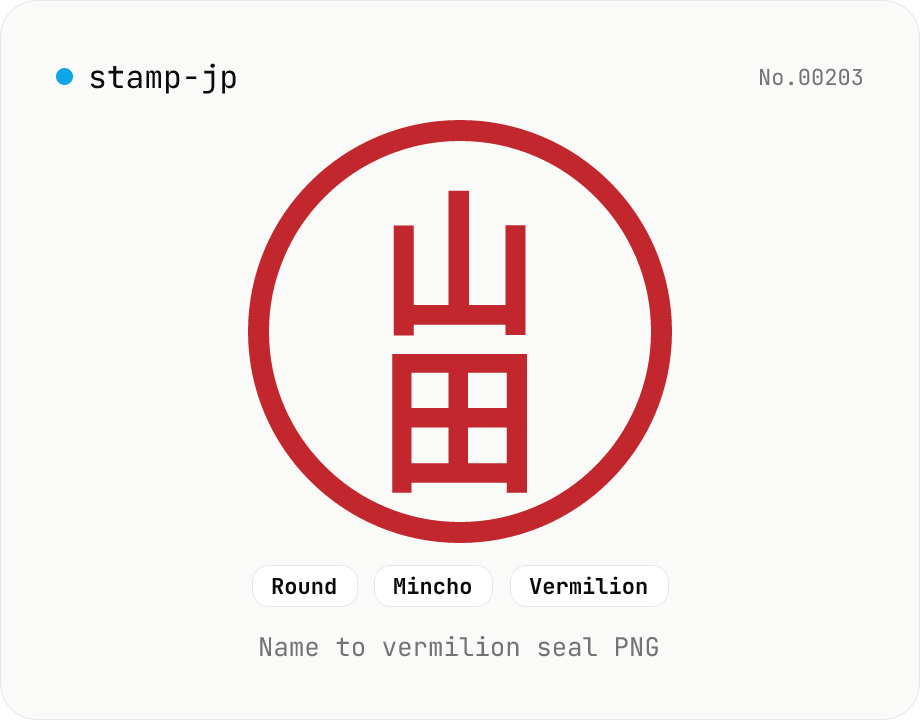
Hanko / Japanese seal generator — name to 朱印-style PNG
Type a name (1–4 Japanese characters) and generate a 朱印 (Japanese name-seal) style PNG with Canvas. Choose a round / square / oval shape, a font (mincho / gothic / round-gothic), and a color (vermilion / black / navy). Transparent PNG works as a placeholder signature for e-documents, a casual avatar, or a heading flourish. Four-character names use the traditional 田 layout (top-right → top-left → bottom-right → bottom-left). Note: this is a decorative image — it does not replace a real hanko for legal contracts. Everything is rendered in your browser.
japanesegenerate
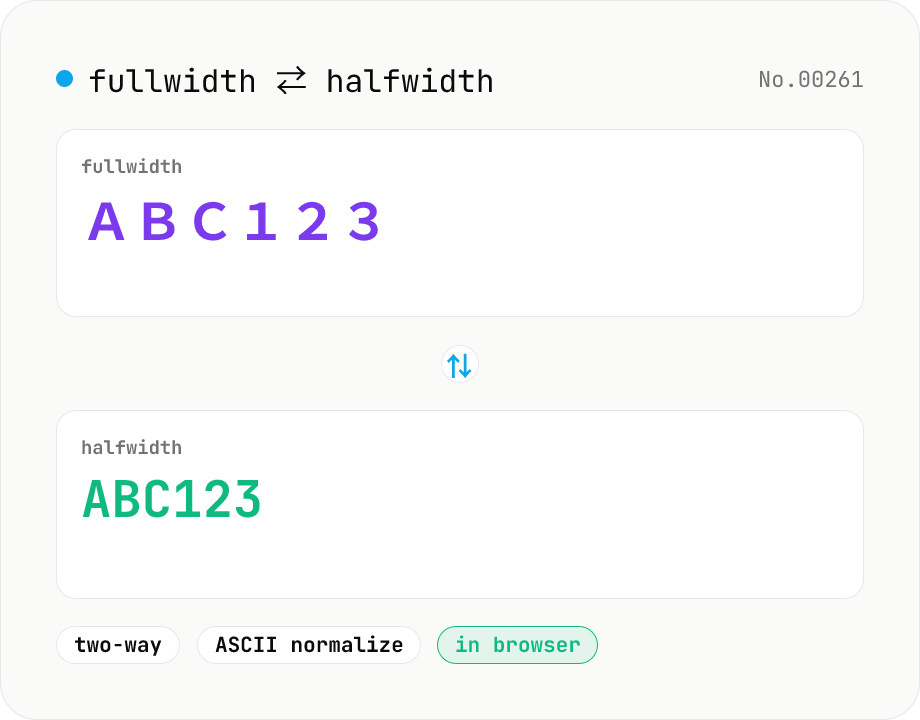
Fullwidth ⇄ Halfwidth converter — alphanumerics, kana, symbols
Convert between fullwidth ASCII (letters, digits, symbols) and halfwidth ASCII with a single mode toggle. Covers U+FF01–U+FF5E ⇄ U+0021–U+007E, plus the ideographic space U+3000 ⇄ ASCII space U+0020. Hiragana, katakana, and kanji are kept untouched. Runs entirely in your browser.
japaneseconversion
About this category
Convert, analyze, and clean up Japanese text — all inside your browser. Convert kanji to hiragana / katakana / romaji, count kanji strokes, convert between Japanese eras and the Gregorian calendar, convert kanji numerals and Arabic numerals, switch between modern and traditional forms (新字体 / 旧字体), between hiragana and katakana, between full-width and half-width, and recover from mojibake.
Dictionary data (kuromoji and friends) loads into your browser via WebAssembly, so internal documents and text containing personal information can be processed without ever leaving your device.
What you can do
- Add furigana (ruby) HTML to a whole block of kanji text
- Convert kanji to hiragana / katakana / romaji in bulk
- Convert Japanese eras to the Gregorian calendar, and back
- Turn kanji-numeral amounts (「五百万円」) into 5000000
- Convert between modern 「学」 and traditional 「學」
- Switch between full-width and half-width alphanumerics / kana
- Look up prefectures, romaji spellings, codes, etc.
- Recover from mojibake (encoding-corrupted text)
Category FAQ
- How accurate is furigana generation?
- It uses kuromoji morphological analysis, which is good enough for ordinary prose. Proper nouns and rare readings can be wrong, so a final human pass is recommended.
- Where does the dictionary data come from?
- The kuromoji dictionary (about 12 MB) is hosted on this site and downloaded once. After that it is cached, and your text never leaves your browser.
- How wide a range of mojibake can be recovered?
- Classic cases — Shift_JIS read as UTF-8 and vice versa — recover quite reliably. Text that has already been replaced character-by-character or truncated cannot be recovered.
- Is historical kana orthography supported?
- kana-convert focuses on hiragana ↔ katakana, not historical orthography (characters like ゐ / ゑ). Modern ↔ traditional kanji conversion is handled by kyujitai-shinjitai.