
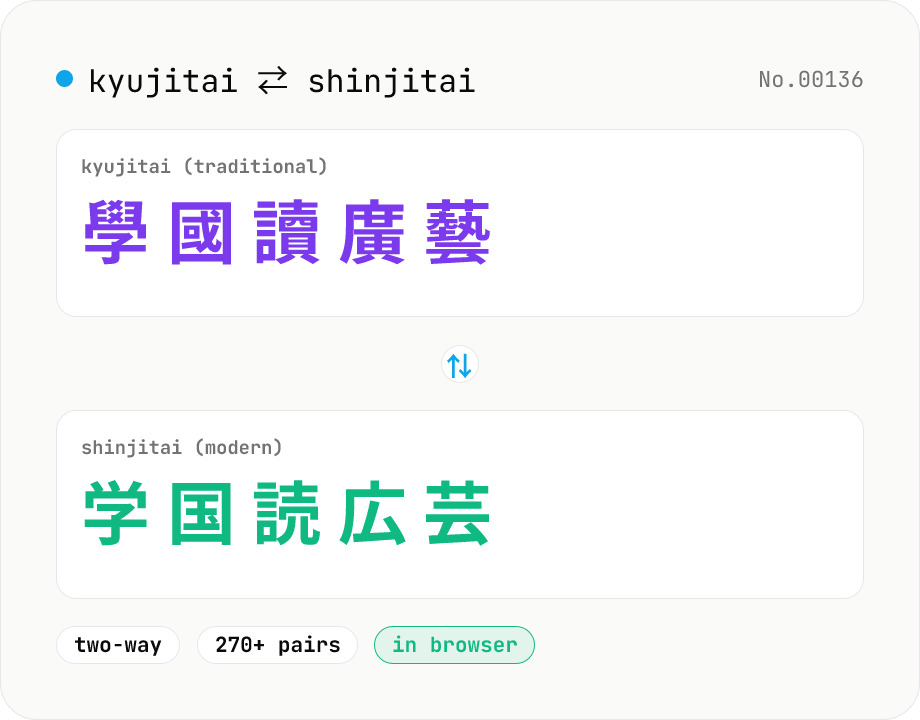
Kyujitai ⇄ Shinjitai converter — traditional ↔ modern Japanese kanji
Convert between pre-war kyujitai (traditional kanji) and post-war shinjitai (modern Joyo Kanji) with a single mode toggle. Backed by 270+ pairs from the Joyo Kanji list (1981 / 2010 revision) and JIS X 0213 variant tables — 學↔学, 國↔国, 讀↔読, 廣↔広. Runs entirely in your browser.
How to use
Paste text, choose a direction (Kyujitai → Shinjitai or Shinjitai → Kyujitai), then click Run. The tool replaces 270+ paired characters using the Joyo Kanji list (1981 announcement, 2010 revision) and JIS X 0213 variant correspondence — 學↔学, 國↔国, 讀↔読, 廣↔広, 藝↔芸, and many more. Characters outside the table pass through unchanged. Copy the result or download as .txt.
FAQ
- Is text uploaded?
- No. Conversion is a pure table lookup with no network calls — input and output stay inside your browser.
- What pairs are included?
- Over 270 pairs sourced from the Cabinet's Joyo Kanji list (announced 1981, revised 2010) and the JIS X 0213 variant correspondence. Examples: 學↔学, 國↔国, 讀↔読, 廣↔広, 藝↔芸, 醫↔医, 鐵↔鉄, 聲↔声, 眞↔真, 體↔体, 舊↔旧, 萬↔万, 來↔来, 亂↔乱.
- What about shinjitai that have several kyujitai counterparts?
- For the Shinjitai → Kyujitai direction we pick a single representative. For example 弁 historically corresponds to 辨 / 瓣 / 辯 / 辮 / 辧, but the tool always emits 辨. Edit the output manually if your context requires a different variant.
- Are jinmeiyo / hyogai kanji covered?
- Only when the pair appears in our table (Joyo Kanji + commonly referenced JIS X 0213 variants). The tool does not aim for full hyogai coverage. Characters without a registered pair pass through unchanged.
- Does this also produce reading / furigana?
- No. This tool only swaps the glyph form. Use kanji-to-hiragana, kanji-to-romaji, or furigana-html for reading conversion.
Related tools
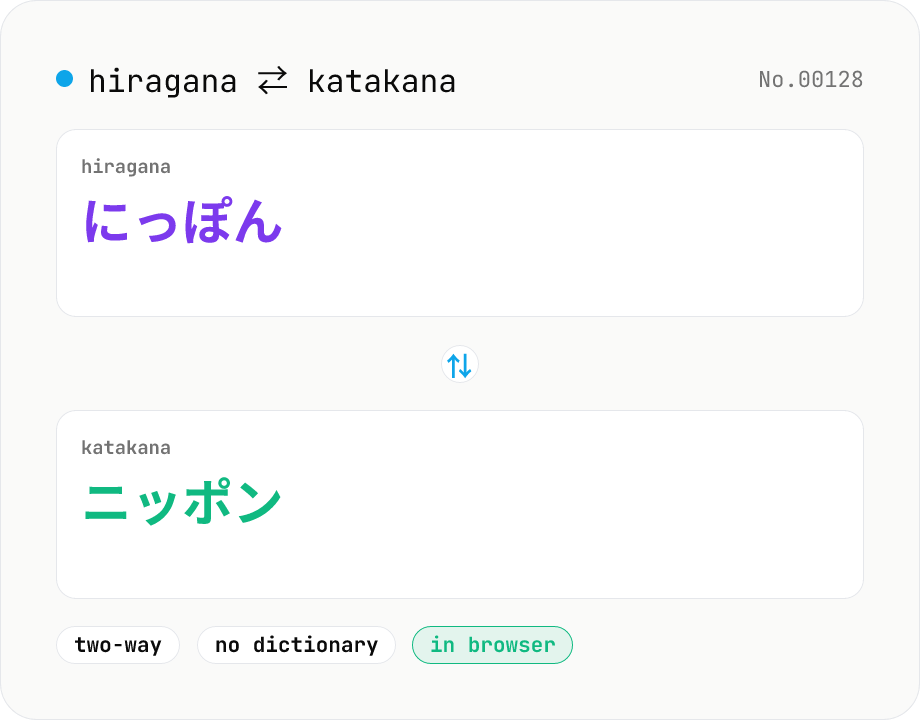
Hiragana ⇄ Katakana converter — bulk character mapping
Convert between hiragana and katakana with a single mode toggle. A purely mechanical per-character mapping — no dictionary download, instant conversion. Long-vowel mark, punctuation, kanji, and alphanumerics are preserved as-is. Runs entirely in your browser.
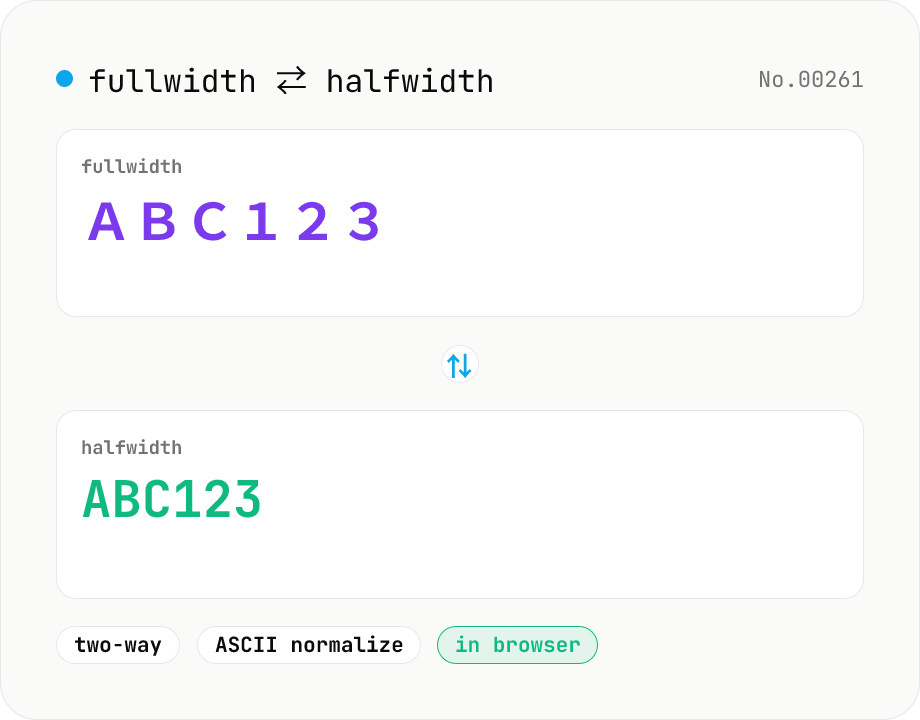
Fullwidth ⇄ Halfwidth converter — alphanumerics, kana, symbols
Convert between fullwidth ASCII (letters, digits, symbols) and halfwidth ASCII with a single mode toggle. Covers U+FF01–U+FF5E ⇄ U+0021–U+007E, plus the ideographic space U+3000 ⇄ ASCII space U+0020. Hiragana, katakana, and kanji are kept untouched. Runs entirely in your browser.
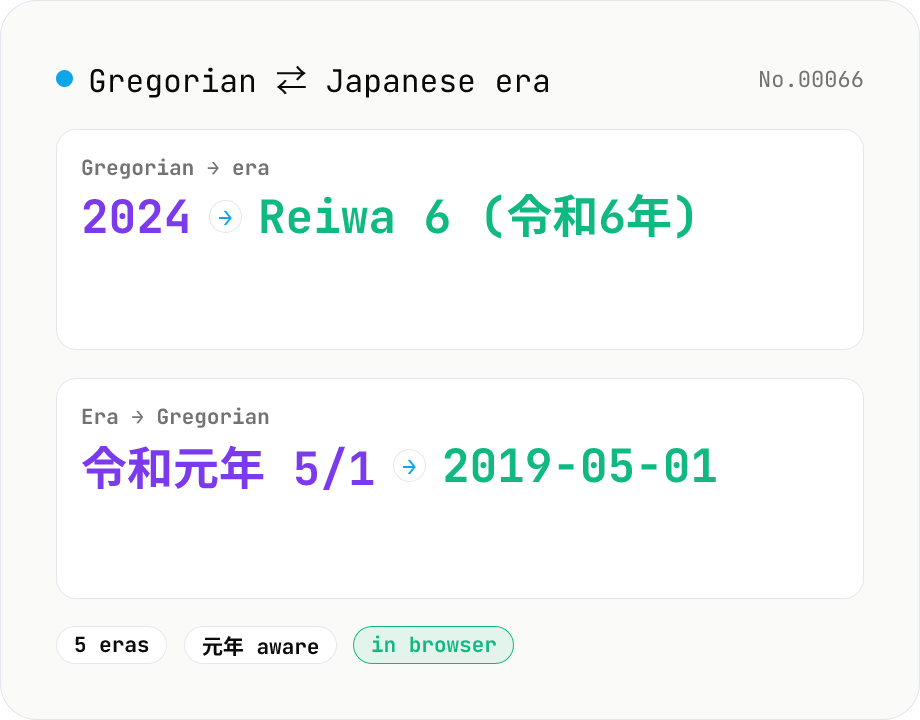
Japanese era ⇄ Gregorian year — Meiji to Reiwa converter
Convert between Gregorian years and Japanese eras (Meiji, Taishō, Shōwa, Heisei, Reiwa) with a mode toggle. Accepts year-only or full date input, handles 元年 (year 1) and era-boundary transitions like 2019-05-01 → Reiwa 1 (令和元年). No dictionary download required — runs entirely inside your browser.
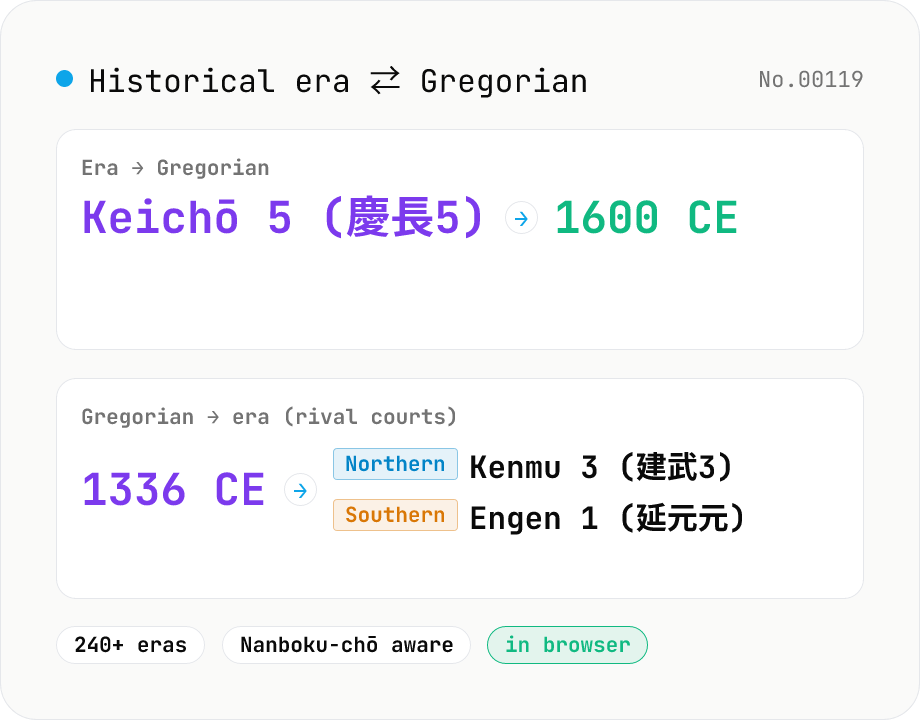
Historical Japanese era ⇄ Gregorian year — Taika 645 to Keiō 1868
Convert between historical Japanese eras (645 Taika through 1868 Keiō) and Gregorian years in both directions. Built-in dataset of 240+ pre-Meiji eras, including 元年 (year 1) and the rival Northern/Southern court eras of the Nanboku-chō schism (1331–1392). For Meiji onward use the era-convert tool. Year-level precision (the lunisolar calendar makes month/day mapping ambiguous). Runs entirely inside your browser — no dictionary download required.