
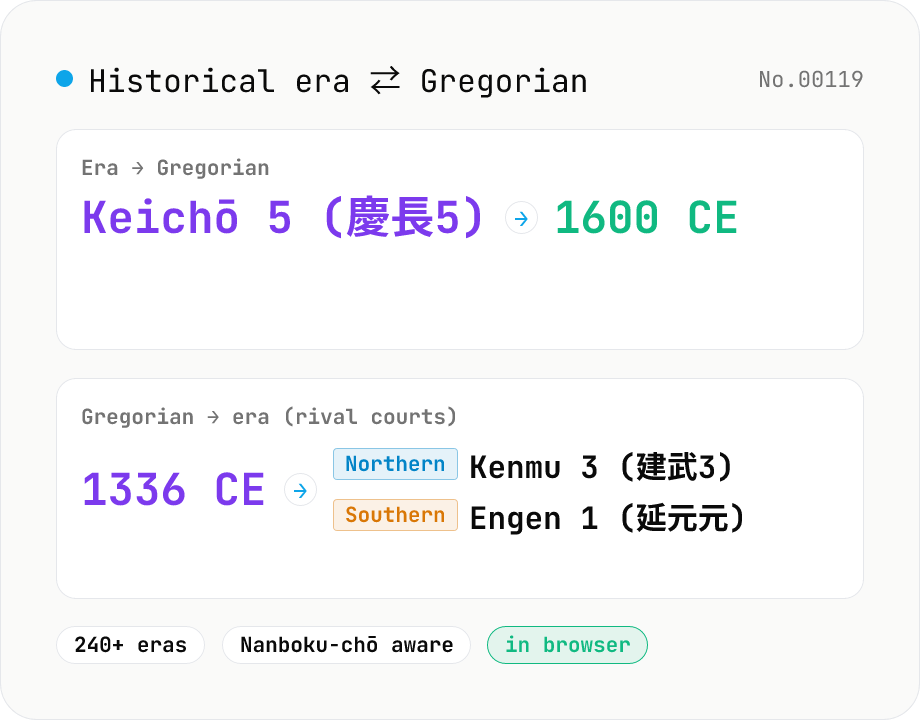
Historical Japanese era ⇄ Gregorian year — Taika 645 to Keiō 1868
Convert between historical Japanese eras (645 Taika through 1868 Keiō) and Gregorian years in both directions. Built-in dataset of 240+ pre-Meiji eras, including 元年 (year 1) and the rival Northern/Southern court eras of the Nanboku-chō schism (1331–1392). For Meiji onward use the era-convert tool. Year-level precision (the lunisolar calendar makes month/day mapping ambiguous). Runs entirely inside your browser — no dictionary download required.
How to use
To go from a historical Japanese era to the Gregorian year, switch the mode to 'Historical era → Gregorian' and enter the era name followed by a year, e.g. 慶長5, 元禄元, or 天正10. Spaces and the trailing 年 are optional; type 元 or 1 for year 1 (元年). For the reverse, pick 'Gregorian → historical era' and enter a year between 645 and 1868. Transition years return both adjacent eras, and during the Nanboku-chō schism (1331–1392) both Northern and Southern court eras are listed side by side. For Meiji onward (1868–), use the dedicated 'Gregorian ⇄ Japanese era' tool. Because pre-Meiji eras follow the lunisolar calendar, this tool intentionally works at year-level precision only.
FAQ
- Which eras are supported?
- 240+ pre-Meiji eras from Taika (645) through Keiō (1868), including the rival Northern and Southern court eras of the Nanboku-chō schism (1331–1392).
- Why no month/day support?
- Pre-Meiji Japan used the lunisolar calendar, so old-calendar dates do not map cleanly onto Gregorian dates. For example Keiō 4 / 9 / 8 (old calendar) is 1868-10-23 Gregorian. To avoid ambiguity this tool stays at year-level precision.
- Is 1868 Keiō or Meiji?
- Both. The era changed in autumn 1868 (lunisolar 9/8, Gregorian 10/23). This tool is year-based, so it returns both Keiō 4 and Meiji 1. For month/day precision use the Gregorian ⇄ Japanese-era converter.
- How are the Nanboku-chō rival courts handled?
- Between 1331 and 1392 the Northern Court (in Kyoto, backed by the Ashikaga shogunate) and the Southern Court (in Yoshino) declared separate eras. The tool lists both when a Gregorian year falls inside the schism — e.g. 1336 returns Kenmu (Northern) and Engen (Southern).
- Can I write '天保10年'?
- Yes. Both '天保10' and '天保10年' work. Spaces between the era name and the year number are optional.
- Is my input uploaded?
- No. All conversion runs inside your browser with no network calls.
Related tools
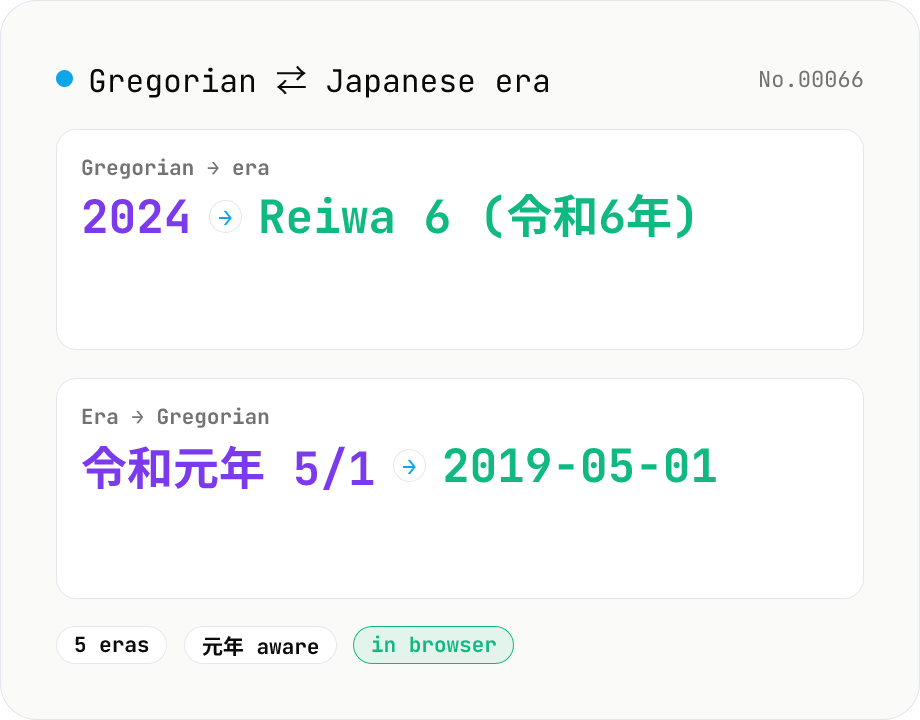
Japanese era ⇄ Gregorian year — Meiji to Reiwa converter
Convert between Gregorian years and Japanese eras (Meiji, Taishō, Shōwa, Heisei, Reiwa) with a mode toggle. Accepts year-only or full date input, handles 元年 (year 1) and era-boundary transitions like 2019-05-01 → Reiwa 1 (令和元年). No dictionary download required — runs entirely inside your browser.
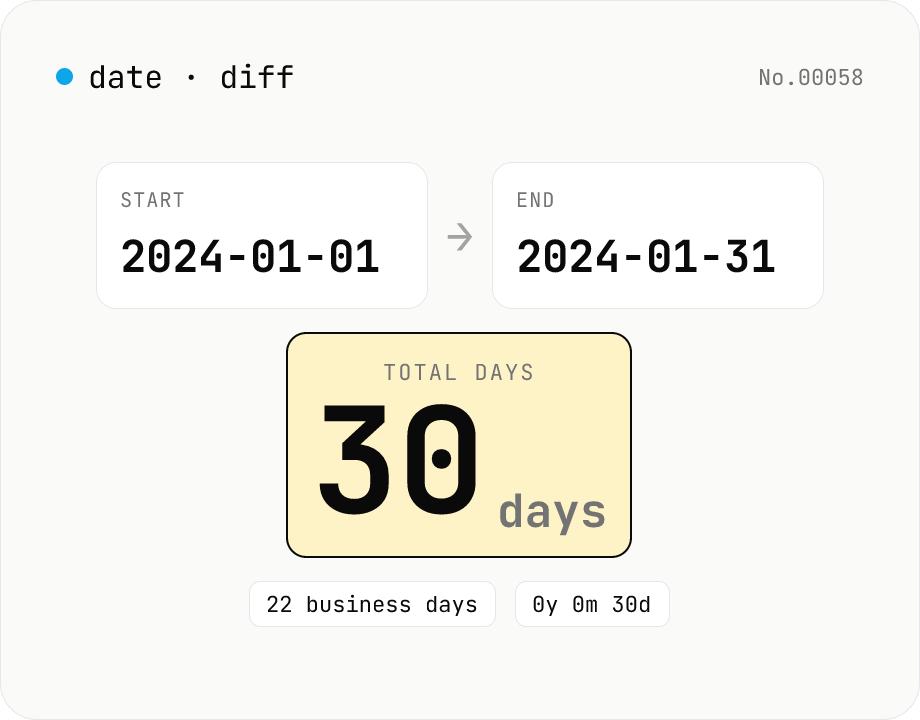
Date difference calculator — days / weeks / months / years
Compute the gap between two dates in days, weeks, business days, a years-months-days breakdown, and (optionally) hours/minutes/seconds. Toggle inclusivity and time-of-day with a checkbox. Everything runs inside your browser.
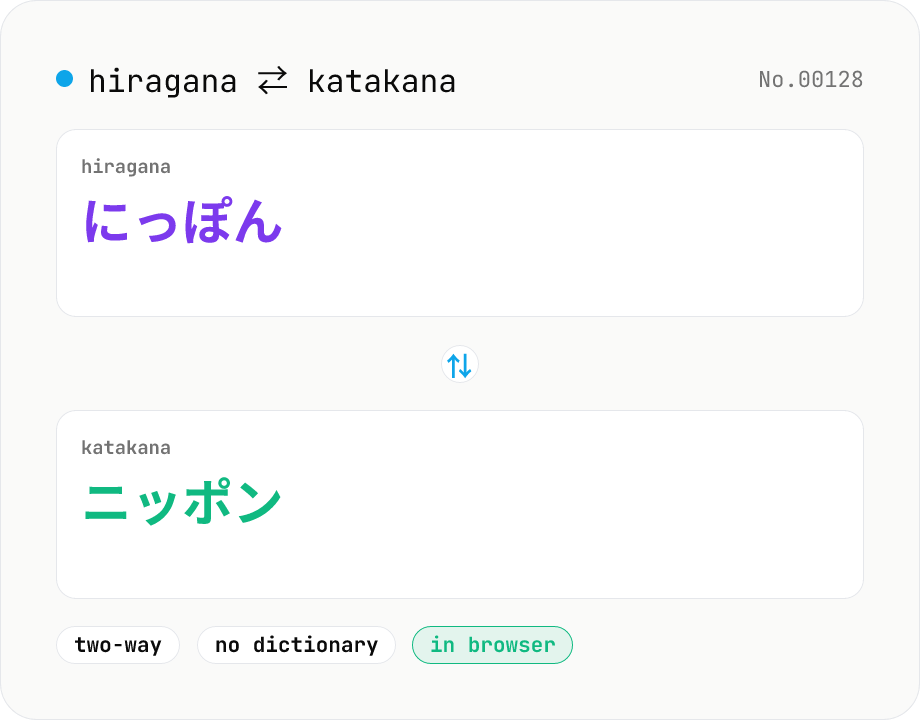
Hiragana ⇄ Katakana converter — bulk character mapping
Convert between hiragana and katakana with a single mode toggle. A purely mechanical per-character mapping — no dictionary download, instant conversion. Long-vowel mark, punctuation, kanji, and alphanumerics are preserved as-is. Runs entirely in your browser.
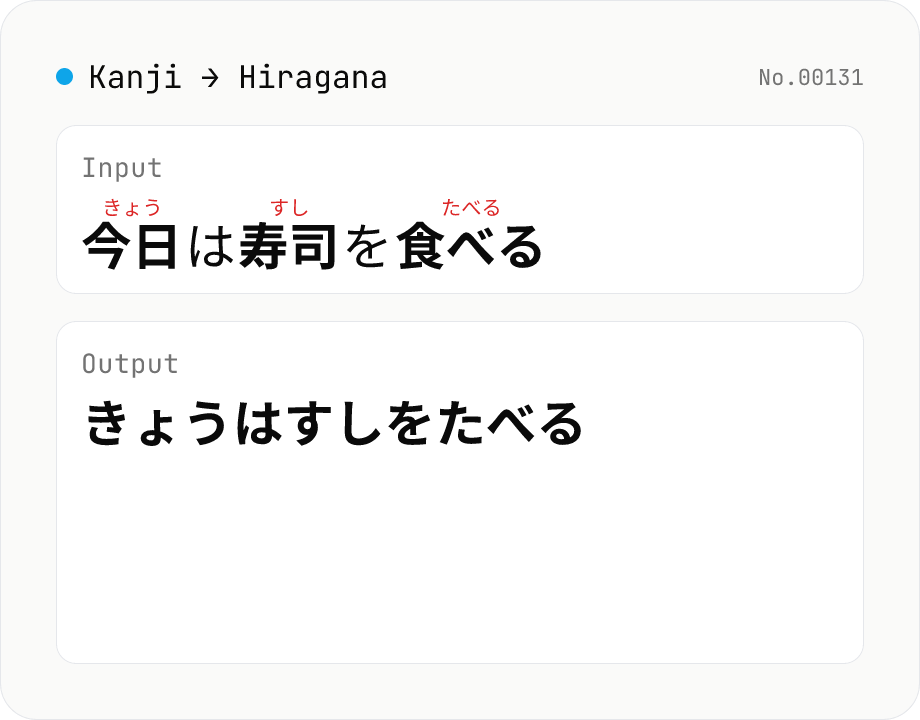
Kanji → Hiragana converter — kuromoji morphological reading
Convert Japanese text to hiragana using kuromoji morphological analysis. Choose between fully hiragana output, or a furigana mode that keeps kanji and adds hiragana ruby above. The dictionary downloads once and is then offline. Runs entirely in your browser.