
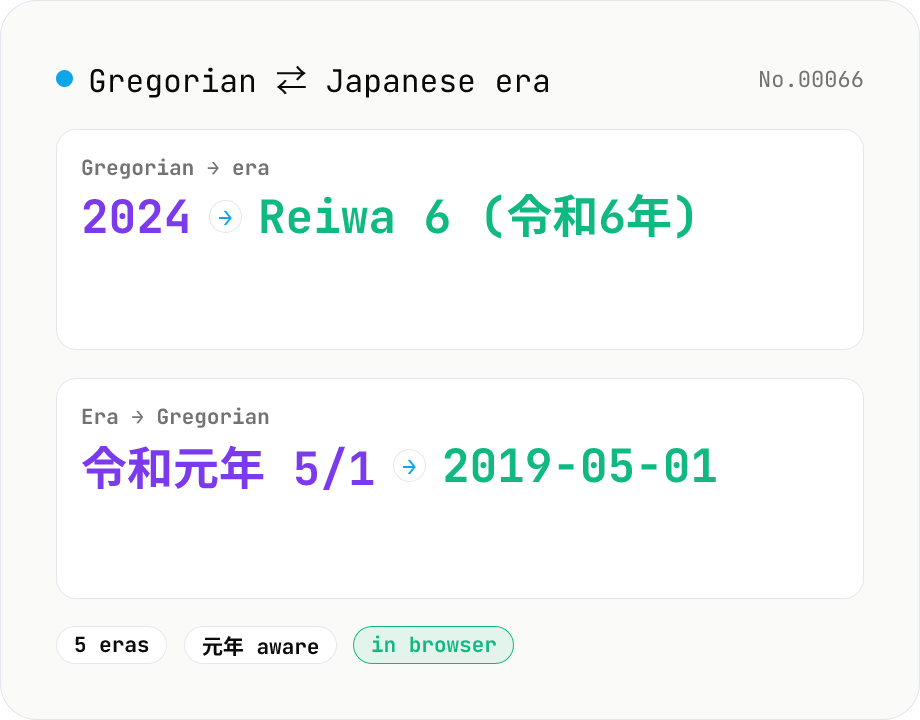
Japanese era ⇄ Gregorian year — Meiji to Reiwa converter
Convert between Gregorian years and Japanese eras (Meiji, Taishō, Shōwa, Heisei, Reiwa) with a mode toggle. Accepts year-only or full date input, handles 元年 (year 1) and era-boundary transitions like 2019-05-01 → Reiwa 1 (令和元年). No dictionary download required — runs entirely inside your browser.
How to use
To go from Gregorian to Japanese era, switch the mode to 'Gregorian → Japanese era' and enter a year (e.g. 2024) or a full date (e.g. 2019-05-01 or 2019/05/01). A year alone is treated as January 1 and resolves to whichever era was active. To go the other way, pick an era (Meiji, Taishō, Shōwa, Heisei, Reiwa) and a year; add month/day to get YYYY-MM-DD, omit them to get just the year. Year 1 of an era is conventionally written 元年, so the year input accepts both 1 and the kanji 元. Era boundaries are handled exactly: 2019-04-30 → Heisei 31 (平成31年) 4 月 30 日 and 2019-05-01 → Reiwa 1 (令和元年) 5 月 1 日. Dates before 1868-09-08 (the start of Meiji) are not supported.
FAQ
- Which eras are supported?
- Meiji (1868-09-08 to 1912-07-29), Taishō (1912-07-30 to 1926-12-24), Shōwa (1926-12-25 to 1989-01-07), Heisei (1989-01-08 to 2019-04-30), and Reiwa (2019-05-01 onwards).
- What Gregorian year is Reiwa 1?
- Reiwa 1 (令和元年) is 2019. The era began on 2019-05-01; dates earlier in 2019 (up to April 30) still belong to Heisei 31.
- Should I type 元 or 1 for year 1?
- Either works. The year input accepts both the digit 1 and the kanji 元 (gan). Output always renders year 1 as 元年, matching common usage.
- What happens if I enter Heisei 32?
- Heisei ended at year 31 when the era changed to Reiwa, so Heisei 32 does not exist. You'll get an error — use Reiwa 2 (2020) instead.
- Is my input uploaded?
- No. All conversion runs inside your browser with no network calls.
Related tools
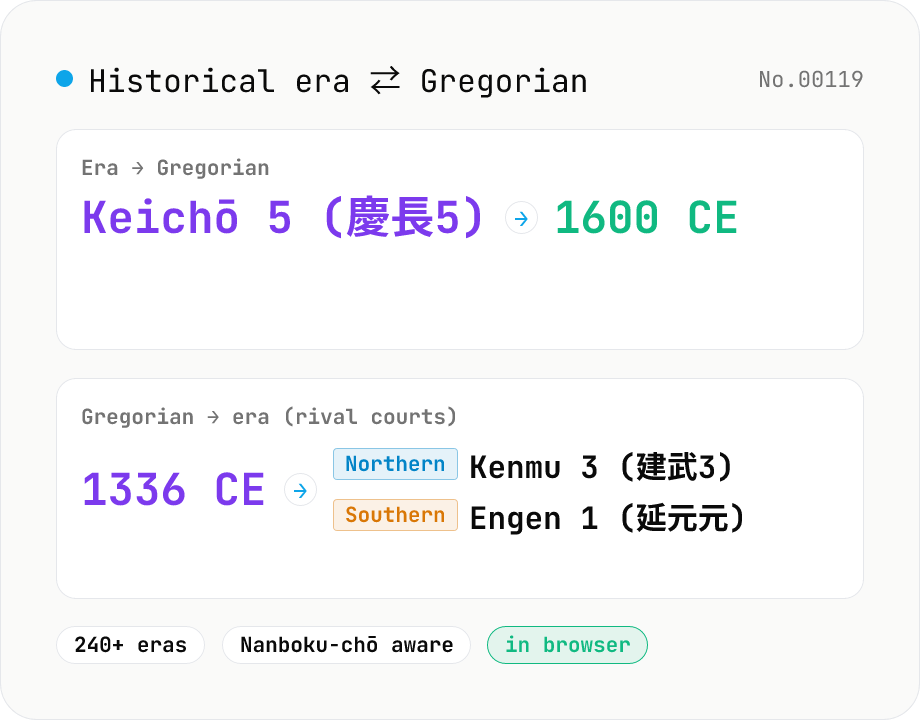
Historical Japanese era ⇄ Gregorian year — Taika 645 to Keiō 1868
Convert between historical Japanese eras (645 Taika through 1868 Keiō) and Gregorian years in both directions. Built-in dataset of 240+ pre-Meiji eras, including 元年 (year 1) and the rival Northern/Southern court eras of the Nanboku-chō schism (1331–1392). For Meiji onward use the era-convert tool. Year-level precision (the lunisolar calendar makes month/day mapping ambiguous). Runs entirely inside your browser — no dictionary download required.
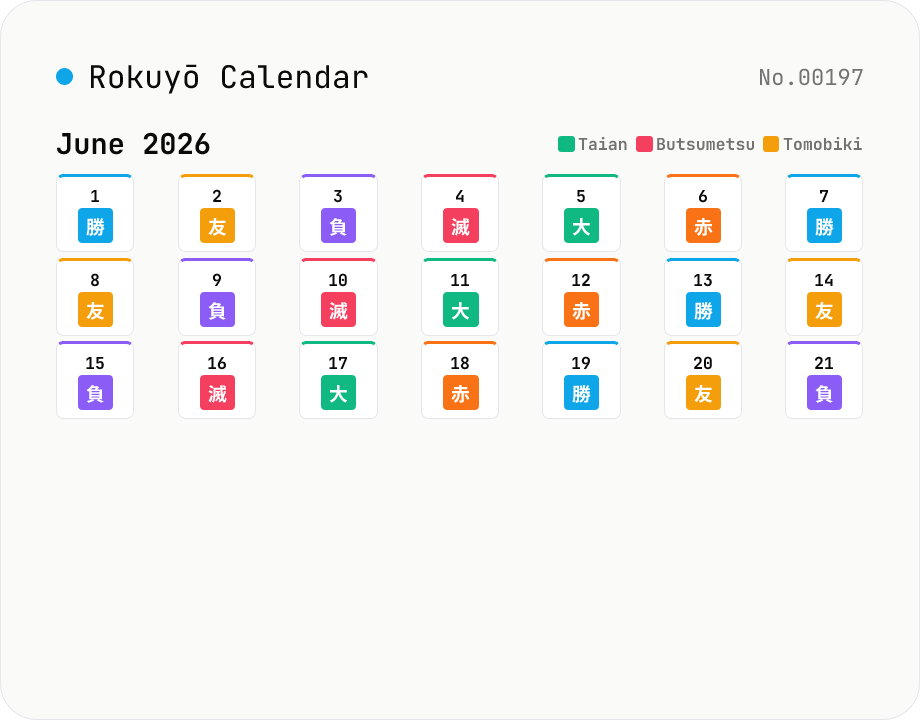
Rokuyō (Japanese 6-day calendar) — Taian / Butsumetsu lookup
Look up the Rokuyō (六曜) of any date — Sensho / Tomobiki / Senbu / Butsumetsu / Taian / Shakkō — and view a full month at a glance. Rokuyō is the traditional 6-day cycle used in Japan for picking auspicious days for weddings, funerals, moves, and store openings. Lunar conversion uses solarlunar (ISC); Rokuyō is computed as (lunar month + lunar day) mod 6. Includes month navigation and a per-Rokuyō meaning (Taian = all-day lucky, Butsumetsu = all-day unlucky, Tomobiki = 'pulls a friend' so funerals are avoided, etc.). Covers 1900-2099. Everything runs in your browser; no date information is uploaded.
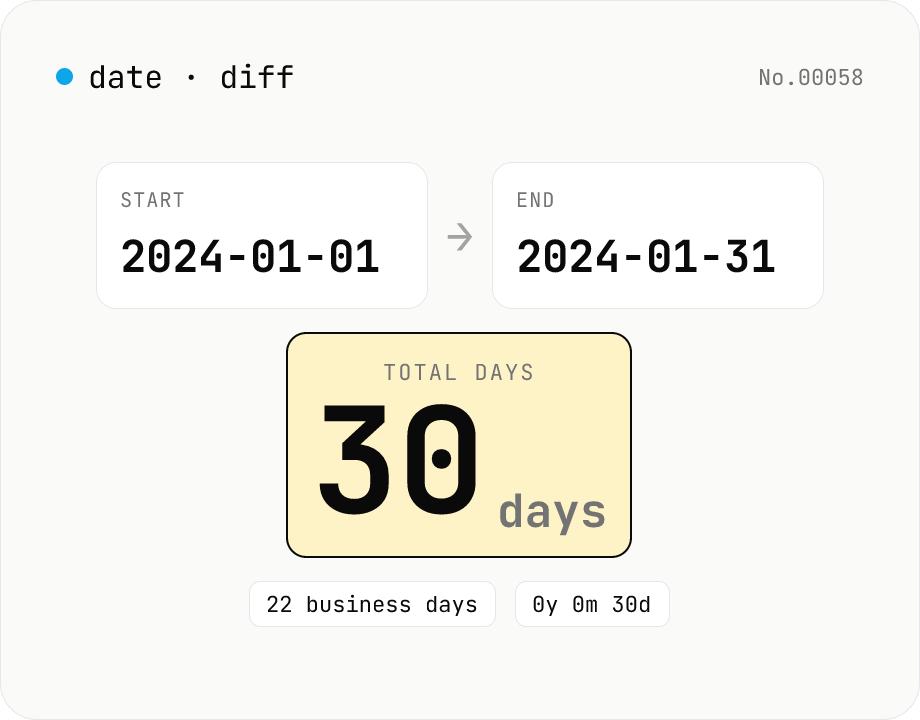
Date difference calculator — days / weeks / months / years
Compute the gap between two dates in days, weeks, business days, a years-months-days breakdown, and (optionally) hours/minutes/seconds. Toggle inclusivity and time-of-day with a checkbox. Everything runs inside your browser.
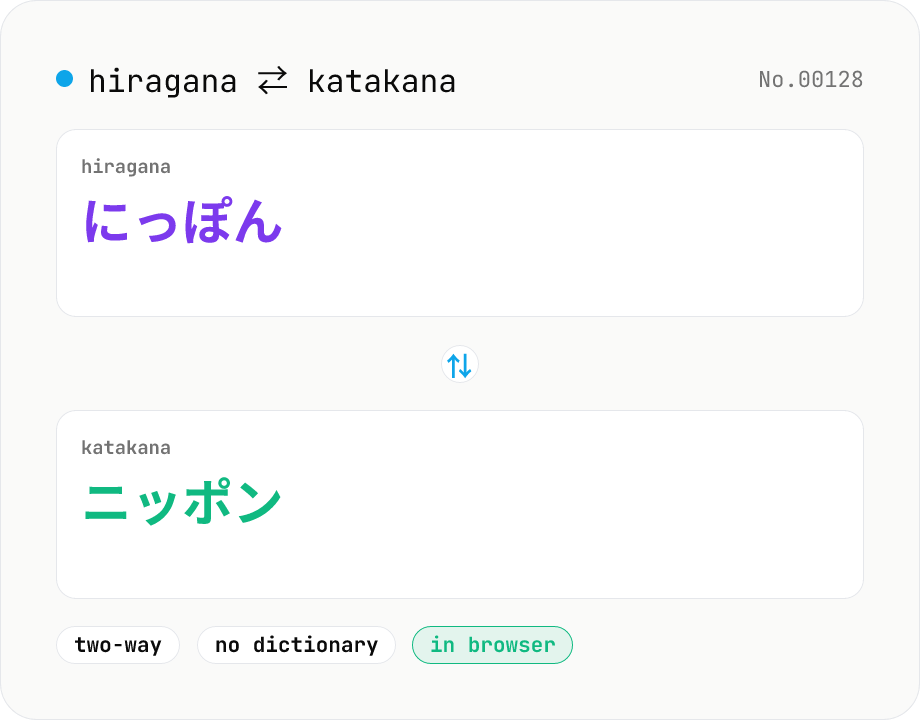
Hiragana ⇄ Katakana converter — bulk character mapping
Convert between hiragana and katakana with a single mode toggle. A purely mechanical per-character mapping — no dictionary download, instant conversion. Long-vowel mark, punctuation, kanji, and alphanumerics are preserved as-is. Runs entirely in your browser.