
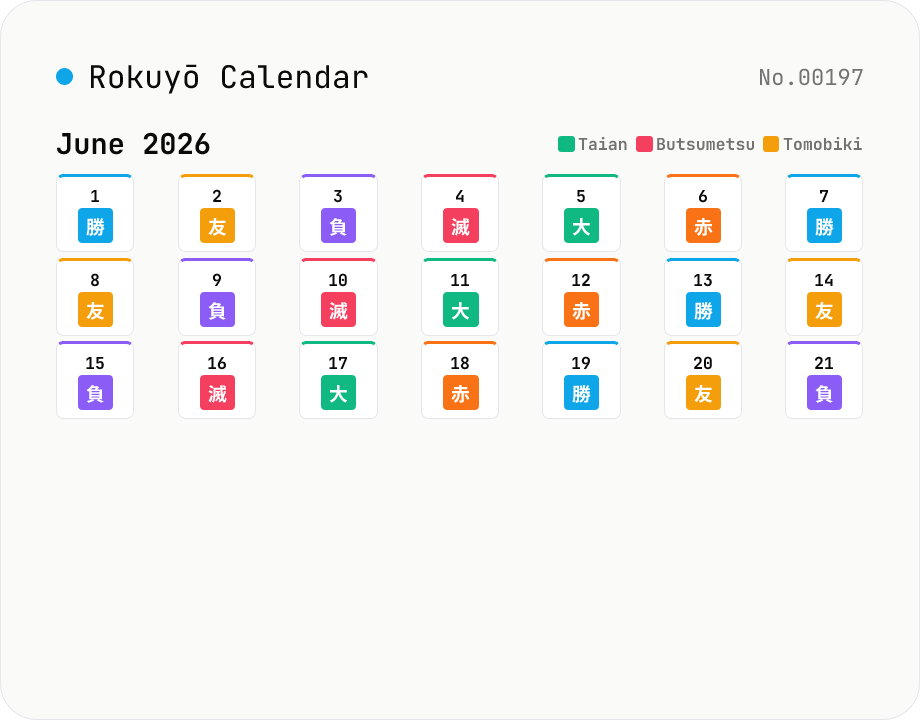
Rokuyō (Japanese 6-day calendar) — Taian / Butsumetsu lookup
Look up the Rokuyō (六曜) of any date — Sensho / Tomobiki / Senbu / Butsumetsu / Taian / Shakkō — and view a full month at a glance. Rokuyō is the traditional 6-day cycle used in Japan for picking auspicious days for weddings, funerals, moves, and store openings. Lunar conversion uses solarlunar (ISC); Rokuyō is computed as (lunar month + lunar day) mod 6. Includes month navigation and a per-Rokuyō meaning (Taian = all-day lucky, Butsumetsu = all-day unlucky, Tomobiki = 'pulls a friend' so funerals are avoided, etc.). Covers 1900-2099. Everything runs in your browser; no date information is uploaded.
How to use
1) Pick a date with the picker (defaults to today). 2) The selected date's Rokuyō (Taian / Butsumetsu / Tomobiki / Sensho / Senbu / Shakkō) and meaning / suitability are shown. 3) The month calendar lets you scan neighbouring dates — each cell shows the solar day + lunar day + Rokuyō. 4) Use Prev/Next month to navigate. Supported range: 1900-2099.
FAQ
- What is Rokuyō (六曜)?
- A six-day fortune cycle originating in China and adopted in Japan in the late Kamakura era (~14th century), popularised among commoners in the Edo period. The six days are: Sensho → Tomobiki → Senbu → Butsumetsu → Taian → Shakkō, repeating in that order. Still widely consulted today when scheduling weddings, funerals, moves, and shop openings.
- How is Rokuyō computed?
- From the lunar (旧暦) calendar by the formula `(lunar month + lunar day) mod 6`, mapped 0=Taian, 1=Shakkō, 2=Sensho, 3=Tomobiki, 4=Senbu, 5=Butsumetsu. The first day of each lunar month thus has a fixed Rokuyō (month 1 → Sensho, month 2 → Tomobiki, …, month 6 → Shakkō, month 7 → Sensho again).
- How does solar ↔ lunar conversion work?
- We use solarlunar (ISC license, in-browser) for years 1900-2099. The Japanese 旧暦 is a lunisolar calendar — new moons mark the first of each month, months are 29 or 30 days, and about 7 leap months are inserted every 19 years to keep the calendar aligned with the seasons. Leap months are shown as 'leap-month N'.
- Which day is best for a wedding?
- Taian has been the most popular by far, followed by Tomobiki (lucky morning/evening) and Sensho (lucky morning). Butsumetsu and Shakkō are typically avoided. Wedding venues often charge a premium on Taian and offer discounts on Butsumetsu, so couples not bound by tradition can save money by booking those days. This tool only reports the cycle — it doesn't tell you what to believe.
- Why are funerals avoided on Tomobiki?
- The characters 友引 read literally as 'pulls a friend' (to the next world), so funerals are traditionally avoided. Many crematoria in Japan are closed on Tomobiki for this reason. The original Chinese meaning (共引 = a draw, no winner) is unrelated, but the modern Japanese association is strong — worth checking when scheduling a funeral.
- Does Rokuyō have a religious basis?
- No. It's a folk belief, not part of Buddhist, Shinto, or any other doctrine. The Meiji government even banned it as superstition for a time, but it persisted. Whether to follow it is personal — but it's worth knowing because relatives and venue staff often do.
- Why only 1900-2099?
- solarlunar (the lunar conversion library) ships a precomputed table covering 1900-2099. Dates outside this range trigger an 'out of range' error. The range is more than sufficient for practical wedding / funeral planning.
- Is any data uploaded?
- No. Date entry, lunar conversion, and Rokuyō calculation all run in your browser using the bundled table — nothing is sent to a server.
Related tools
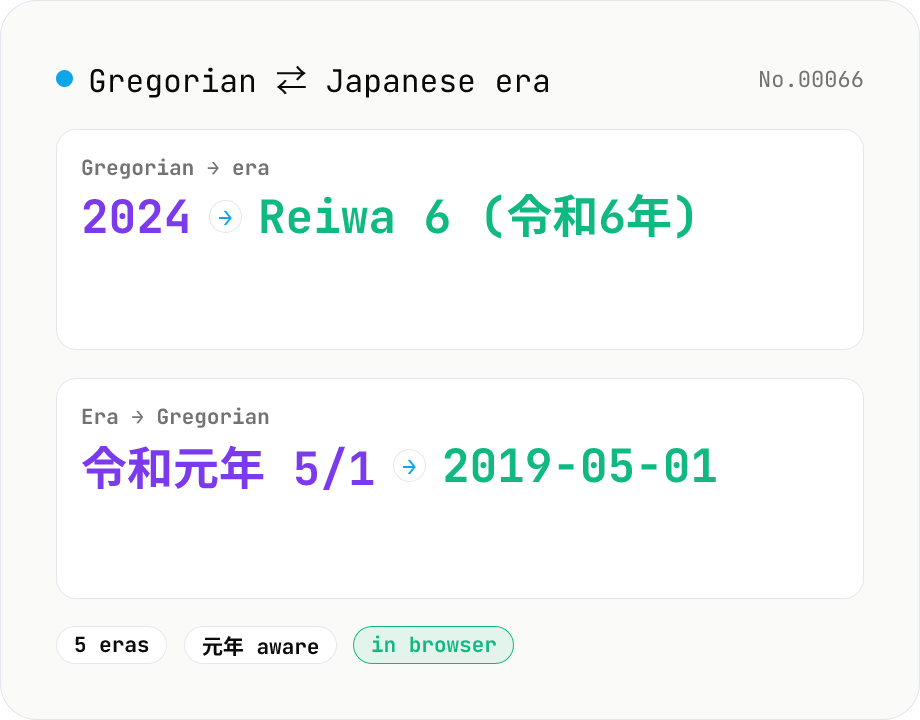
Japanese era ⇄ Gregorian year — Meiji to Reiwa converter
Convert between Gregorian years and Japanese eras (Meiji, Taishō, Shōwa, Heisei, Reiwa) with a mode toggle. Accepts year-only or full date input, handles 元年 (year 1) and era-boundary transitions like 2019-05-01 → Reiwa 1 (令和元年). No dictionary download required — runs entirely inside your browser.
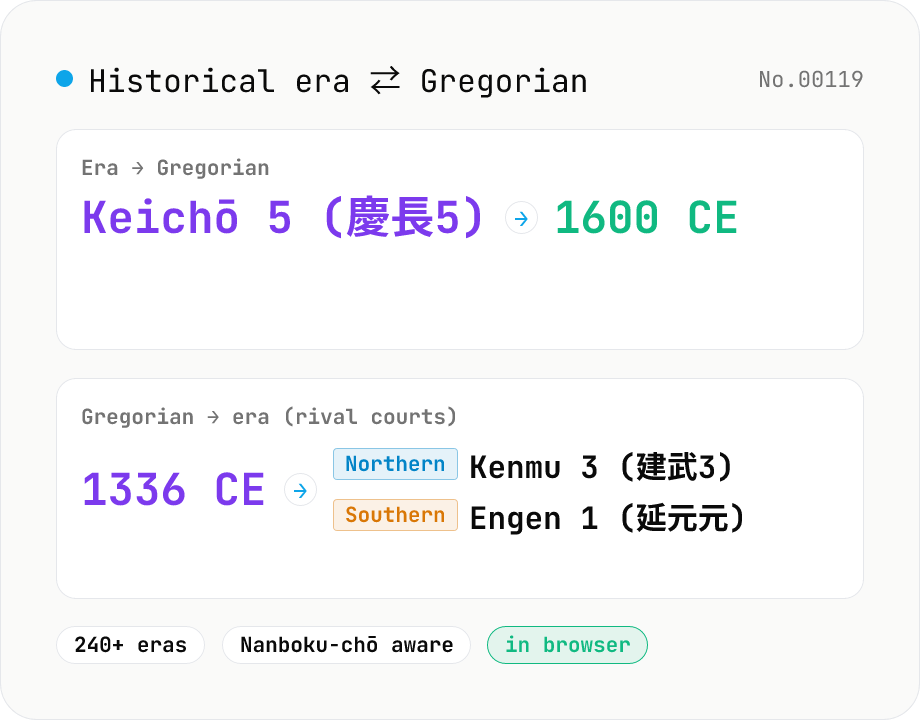
Historical Japanese era ⇄ Gregorian year — Taika 645 to Keiō 1868
Convert between historical Japanese eras (645 Taika through 1868 Keiō) and Gregorian years in both directions. Built-in dataset of 240+ pre-Meiji eras, including 元年 (year 1) and the rival Northern/Southern court eras of the Nanboku-chō schism (1331–1392). For Meiji onward use the era-convert tool. Year-level precision (the lunisolar calendar makes month/day mapping ambiguous). Runs entirely inside your browser — no dictionary download required.
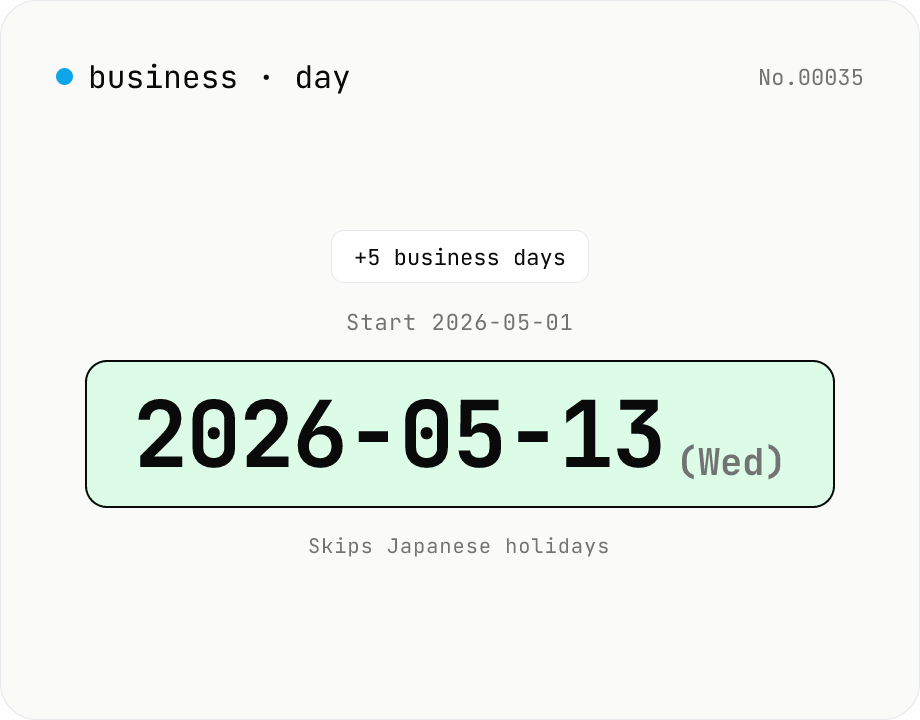
JP business-day calculator — count workdays excluding holidays
Compute the date that is N business days before or after a given date, skipping Japanese national holidays plus weekends. Handles substitute holidays, citizen's holidays, and vernal/autumnal equinoxes (1955-2099). Useful for due dates, settlement dates, and Japan-side delivery scheduling. Runs entirely in your browser.
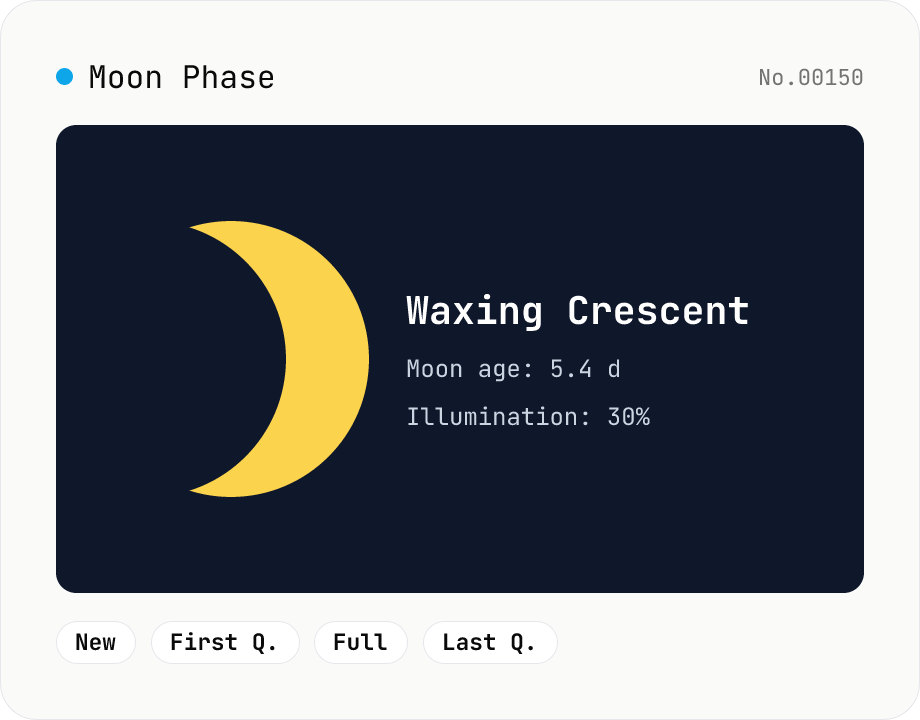
Moon Phase & Moon Age Calculator
Calculate the moon age, phase (new / first quarter / full / last quarter) and illuminated fraction for any date and time, shown as a moon diagram. Also finds the next new, first-quarter, full, and last-quarter moments. A mean synodic-month approximation that runs entirely in your browser.