
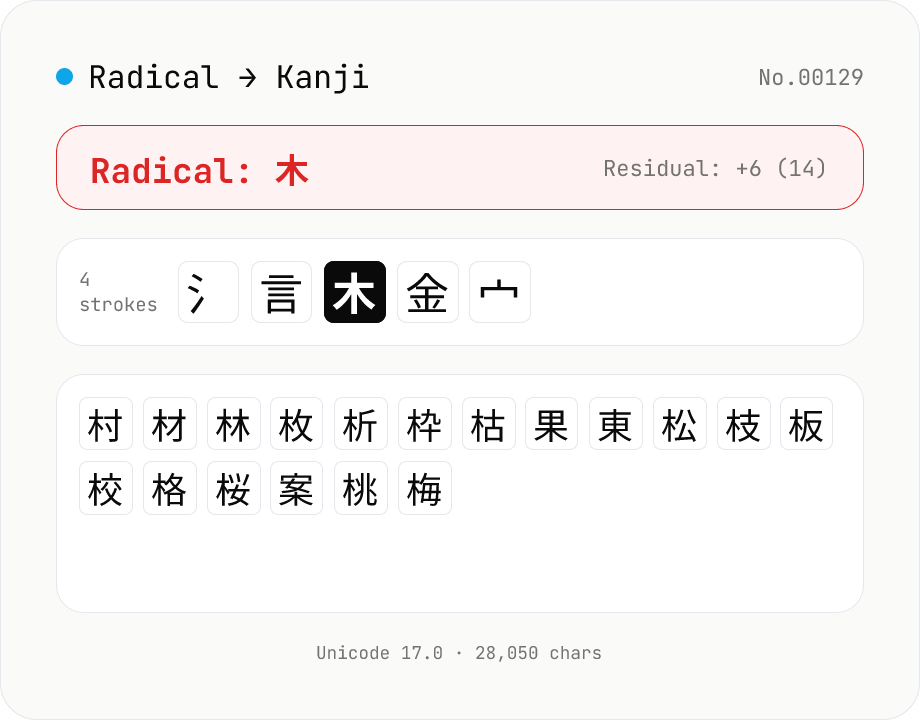
Kanji Radical Lookup
Reverse-lookup kanji by Kangxi radical (1–214) and residual stroke count, just like the radical index in a paper kanji dictionary. Pick a radical (一 / 人 / 木 / 氵 / 言 …) and a remaining-strokes filter to list every matching CJK ideograph from Unicode 17.0 (28,000+ characters). Click to copy; component variants (心→忄, 水→氵, 艸→艹) are noted under each radical. Runs entirely in your browser.
How to use
Pick one of the 214 Kangxi radicals from the top panel (grouped by radical stroke count, 1–17). Matching kanji appear below, grouped by residual strokes (the strokes not in the radical). Use the residual filter to narrow further. Click any kanji to copy it. The flow mirrors the radical index in a paper kanji dictionary, useful when you can read neither the on- nor kun-yomi. Data is Unicode 17.0 Unihan kRSUnicode bundled with the page (28,000+ characters), runs entirely in your browser.
FAQ
- What does "residual strokes" mean?
- The total strokes of a kanji minus the strokes of its radical. For instance 漢 (13 strokes) has the radical 氵 (a 3-stroke variant of 水, radical 85), so its residual is 10. Unihan classifies every CJK ideograph as (radical, residual), and this tool exposes that classification directly.
- Why don't variant components (氵 / 忄 / 艹) appear as separate radicals?
- Unicode treats variants as their own characters, but Unihan's kRSUnicode classifies kanji under the parent radical (氵 → 水/85, 忄 → 心/61, 艹 → 艸/140). The selection UI only lists parents, but variants are shown next to the selected radical so you can recognise either form inside a kanji.
- What character range is covered?
- Unicode 17.0 CJK Unified Ideographs (U+4E00–U+9FFF), CJK Extension A (U+3400–U+4DBF), and CJK Compatibility Ideographs (U+F900–U+FAFF) — about 28,050 characters in total. Extensions B and beyond (U+20000+) are excluded to keep the bundle small.
- How are simplified / traditional / new-form / old-form variants handled?
- They are distinct Unicode characters and listed separately. Under radical 213 (龜/亀) you will see traditional 龜, simplified 龟, and Japanese shinjitai 亀 all in the same residual-strokes bucket. Pair this tool with kanji-stroke-count and kyujitai-shinjitai for richer lookups.
- Which Unicode field is used?
- `kRSUnicode` from Unihan_IRGSources.txt (Kangxi Radical-Stroke). Apostrophe variant markers (e.g. `120'.3`) are stripped to the parent radical, and when multiple values are given the first (radical, residual) pair is used.
Related tools
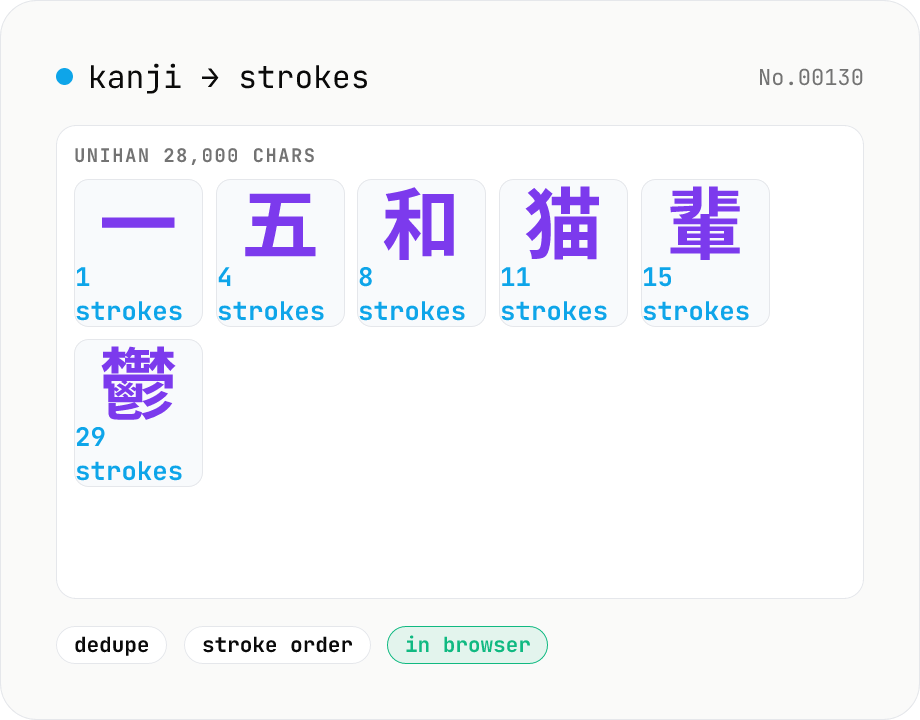
Kanji stroke count — bulk lookup / 28,000 characters
Extract every CJK ideograph from your input and look up its stroke count in a table. Backed by 28,000+ characters from Unicode 17's Unihan kTotalStrokes — covers all jōyō kanji, JIS X 0208 levels 1 & 2, and most of CJK Extension A and Compatibility. Optional dedupe and stroke-order sort, with running total. Useful for studying, name-stroke analysis, or just checking your kid's homework. Runs entirely in your browser.
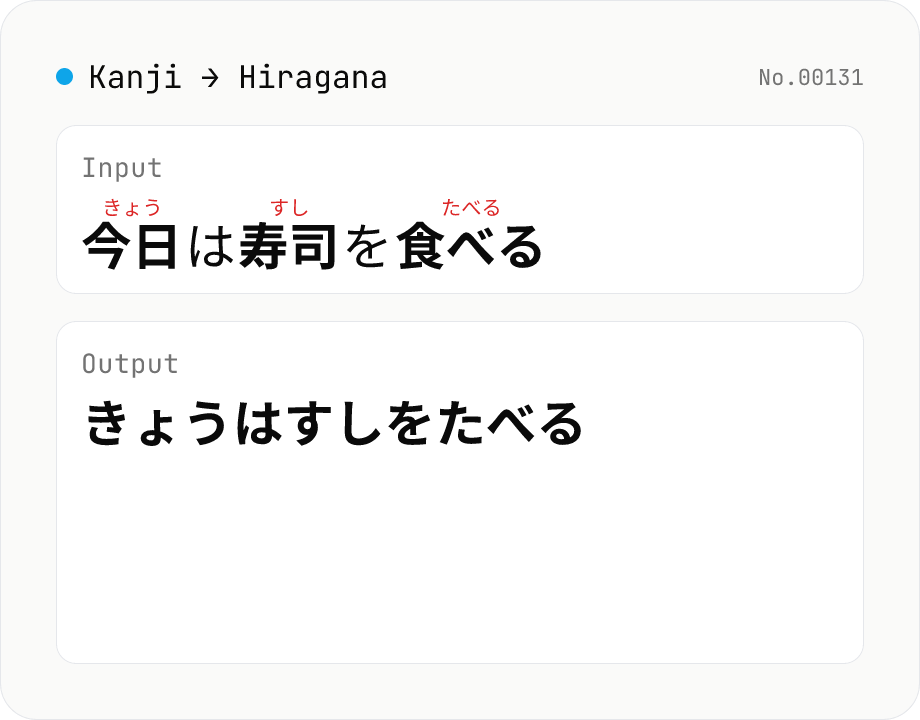
Kanji → Hiragana converter — kuromoji morphological reading
Convert Japanese text to hiragana using kuromoji morphological analysis. Choose between fully hiragana output, or a furigana mode that keeps kanji and adds hiragana ruby above. The dictionary downloads once and is then offline. Runs entirely in your browser.
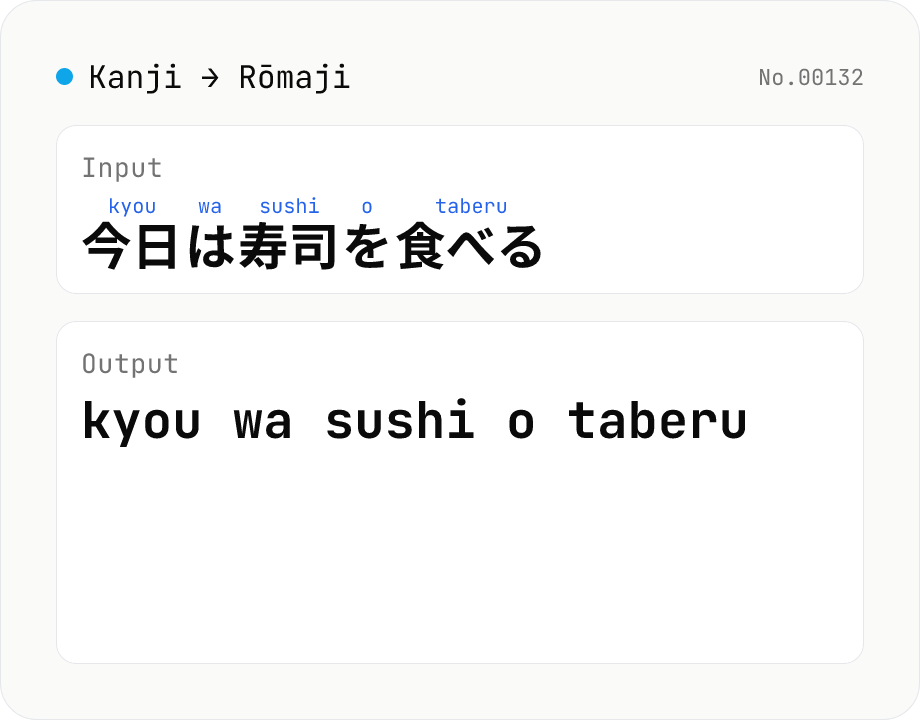
Kanji → Rōmaji converter — Hepburn / Kunrei-shiki / macron
Convert Japanese text to Hepburn romaji using kuromoji morphological analysis. Switch between full romaji and a ruby view, and choose macron long vowels (ō, ū) or literal doubled vowels (ou, uu). The dictionary downloads once and is then offline. Runs entirely in your browser.
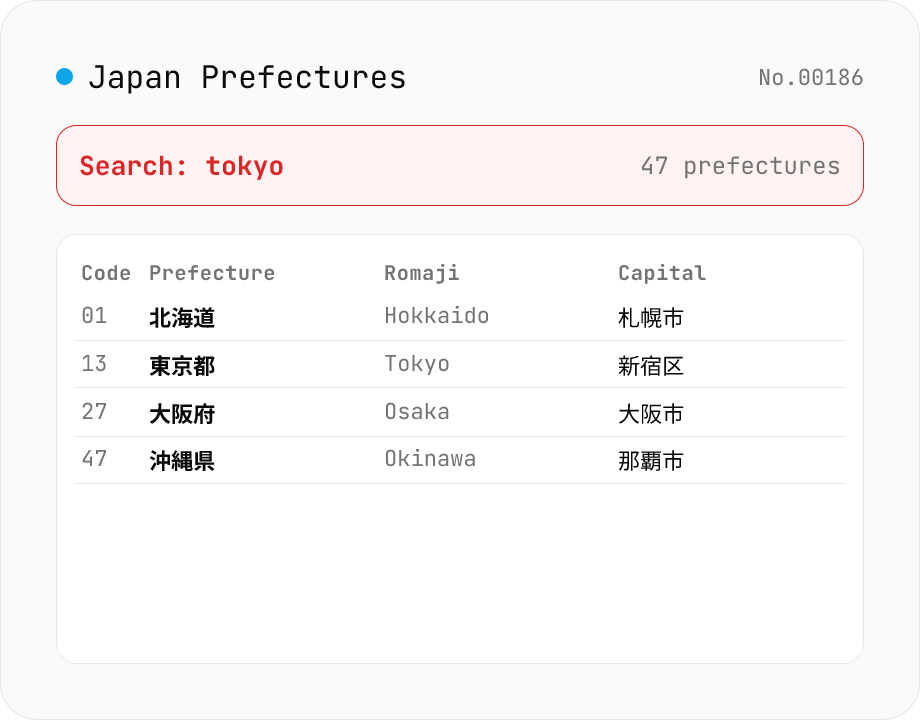
Japan Prefectures Lookup
Search all 47 Japanese prefectures by kanji / hiragana / romaji / JIS code / ISO 3166-2:JP / capital city. Filter by region (Hokkaido / Tohoku / Kanto / Chubu / Kinki / Chugoku / Shikoku / Kyushu-Okinawa). Useful for address validation, form helpers, and learning. Pure static data — instant, runs entirely in your browser.