
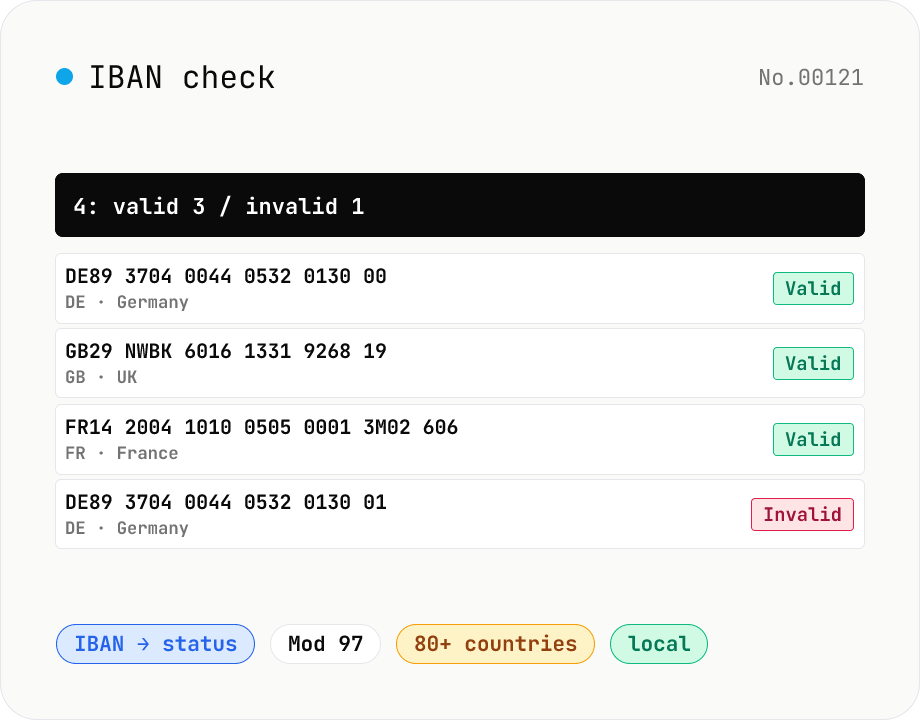
IBAN check — ISO 13616 Mod 97 international bank account validator
Validate IBANs (International Bank Account Numbers) per ISO 13616. We check the country prefix, the expected length (80+ countries built in — DE 22 chars, GB 22, FR 27, IT 27, NL 18, …), perform the Mod 97 checksum (letters A–Z mapped to 10–35), and surface the BBAN body. Paste multiple lines for bulk validation, copy valid / invalid separately, or export a CSV. Handy for B2B payments, SEPA transfers, data migrations, and form-input hygiene. IBANs stay in your browser.
How to use
Paste IBANs one per line — spaces, dashes, and case are normalised automatically. Press Validate to run the structure check, length check, and Mod 97 checksum. Each row reports the country name, BBAN, and (if invalid) the failure reason. Copy valid / invalid separately, or grab a CSV.
In depth
What IBAN numbers actually reveal
An IBAN (International Bank Account Number) uniquely identifies a bank account: country code, check digits, and the BBAN (Basic Bank Account Number) including branch and account identifiers. Alone it locates an account precisely enough to receive a transfer. Combined with a name or address, it becomes usable material for social engineering, fraudulent payment instructions, and account impersonation.
In fintech, e-commerce back-ends, and accounting systems, IBANs are collected in bulk from customers and suppliers. Sending those lists to an external validation endpoint in order to check their format hands account numbers to a third party — which is an unusual risk for a task that is pure arithmetic.
The structural problem with online IBAN validation APIs
Many IBAN validation APIs log each request for a retention window. Some terms of service grant the operator rights to use submitted data for analytics or model training. If your application pipes IBANs through a validation API without telling account holders, that transmission may conflict with data-minimisation requirements under GDPR or similar frameworks.
The mismatch is worth pausing on: you are sending sensitive financial identifiers to an external server to verify a checksum that requires no external knowledge. The Mod 97 calculation and the country-length table are both fully public — there is no reason the validation has to leave your machine.
How BigInt arithmetic keeps everything in the browser
IBAN validation is two steps: compare the length against a per-country table (80+ countries are bundled as static data), then run the Mod 97 checksum — move the country code and check digits to the end, convert letters A–Z to 10–35, treat the result as one large integer, and confirm it is divisible by 97. This tool performs both steps with JavaScript’s BigInt inside your browser.
After the initial page load, no further network requests are made. You can verify this by opening DevTools Network while running a batch of IBANs — the tab stays quiet. Internal account lists and customer data stay on your device throughout.
Cleaning a supplier or customer list before payment runs
The most common workflow is validating a list received from a supplier or exported from a registration form. Formatting noise (spaces, dashes, lowercase) is stripped automatically, so no preprocessing is needed. Each invalid row shows a specific failure reason — wrong length, Mod 97 failure, or unrecognised country prefix — so you can triage before the payment run rather than after. Downloading the results as CSV lets you cross-reference against your source data and resolve issues upstream of your bank, avoiding return-payment fees and delays.
The math behind ISO 13616 / Mod 97-10
IBAN’s checksum derives from the Mod 97-10 algorithm in ISO/IEC 7064. The procedure: (a) move the first four characters — two-letter country code plus two check digits — to the end; (b) convert all letters to numbers (A=10, B=11, …, Z=35) and concatenate to form one large integer; (c) divide by 97 and confirm the remainder is 1. For DE89370400440532013000, that becomes 370400440532013000DE89 → 370400440532013000131489, which mod 97 equals 1.
The choice of 97 is intentional: it is prime, and Mod 97-10 catches 100% of single-digit transcription errors and roughly 99.99% of adjacent digit transpositions — the two most common human mistakes when copying a long number. That detection rate is materially better than the luhn-check algorithm (Mod 10) used for credit-card numbers, at the cost of arithmetic over larger integers. This tool uses JavaScript BigInt because IBANs reach 30+ digits, far beyond the safe-integer range of the Number type.
SEPA, SWIFT/BIC, and per-country BBAN structures
IBAN was created by the European Banking Association and is now standardised as ISO 13616. SEPA (Single Euro Payments Area) requires IBAN for all cross-border euro payments. The United States, Canada, and Japan do not use IBAN; payments to those countries combine SWIFT/BIC with a separate, country-specific account number format.
BBAN (Basic Bank Account Number) layouts vary completely across countries. Germany’s BBAN is an 8-digit bank code plus 10-digit account number; the UK uses a 4-character bank code, 6-digit sort code, and 8-digit account number; France adds a 2-digit RIB key to the bank and branch codes. Reading those internals correctly requires per-country specifications. This tool validates the IBAN’s length and Mod 97 checksum, but it does not decompose the BBAN into bank and branch components or look up the institution name. For that, a country-specific bank registry such as ibantools is a useful next step. Pairing the IBAN list with billing-contact checks via email-validate is a complementary hygiene pass.
FAQ
- What is the Mod 97 check?
- ISO 13616's IBAN checksum: move country prefix + check digits to the end, map letters A–Z to 10–35, treat the whole string as a giant integer, and require `mod 97 == 1`. Catches typos and random input almost certainly.
- Does Valid mean the account is real?
- No — this is structural only. The account might not exist, the balance might be zero, the bank might have closed it. Use an Open Banking API for real existence + balance checks.
- Which countries are supported?
- 80+ countries including all of Europe (DE, GB, FR, IT, ES, NL, BE, …), parts of MENA, and Latin America. JP / US / CA don't use IBAN, so they're not included.
- How does this relate to SEPA?
- SEPA (Single Euro Payments Area) requires IBAN as the account identifier. Every SEPA country is in our table — this tool is handy for sanitising before SEPA transfers.
- Is anything uploaded?
- No. All checking runs locally with BigInt + a built-in country table.
How to verify nothing is uploaded
This tool never sends your input outside your browser. The pages below explain how it works, how to audit it, and how the site is run.
Related tools
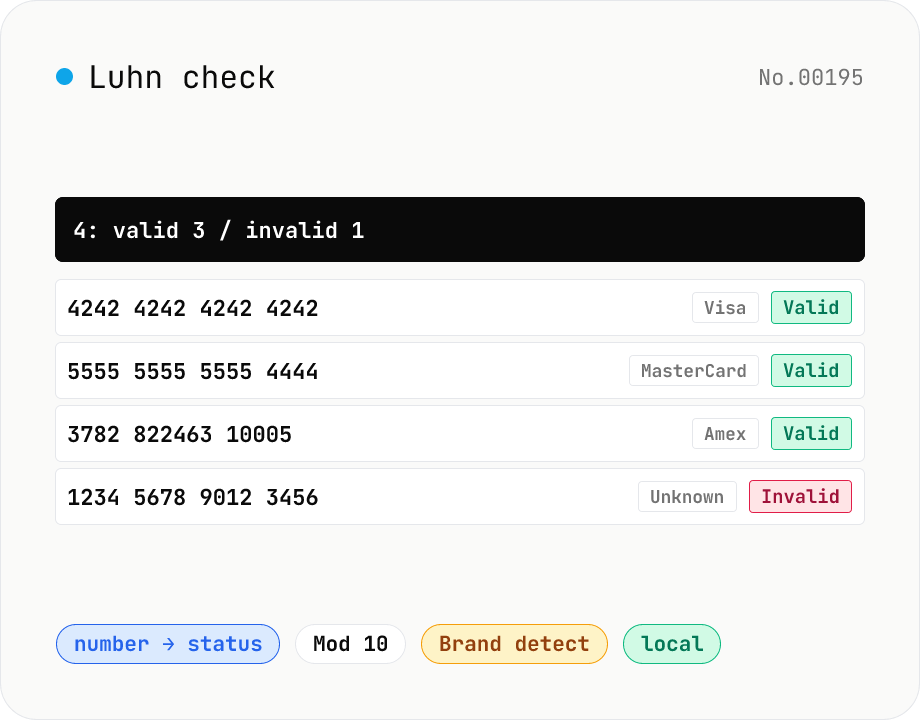
Luhn check — credit card / IMEI validator
Validate numbers with the Luhn (Mod 10) algorithm — credit cards (Visa / MasterCard / Amex / Discover / JCB / Diners / UnionPay), IMEI (mobile device IDs), Canadian SIN, and other Luhn-protected identifiers. Paste multiple lines, get bulk validation, auto-detect card brand by IIN prefix, and inspect the checksum trace (double-each-even-digit, digit-sum, total). Useful for test-data generation, form-input sanitisation, data migration QA, and bulk validation before a CSV import. Numbers stay in your browser.
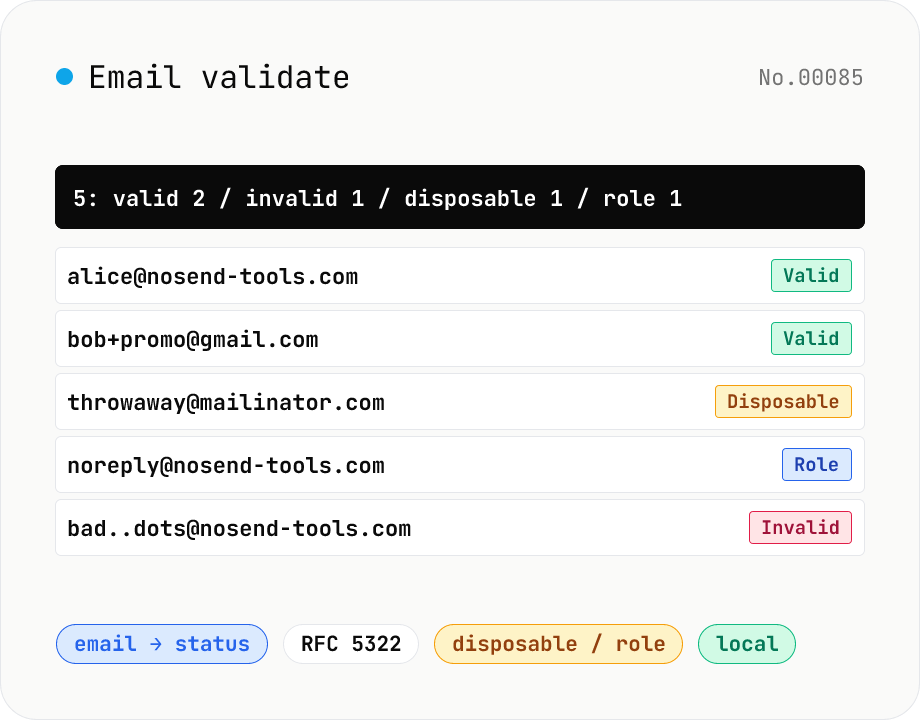
Email validate — RFC 5322 / disposable detection / role detection
Paste email addresses (one per line) to run RFC 5322-style syntax validation (local / domain / TLD / length limits), disposable-provider detection (mailinator / 10minutemail / guerrillamail and 100+ others built in), role-address detection (admin / support / postmaster / no-reply, etc.) and Gmail dot/+ tag normalisation — all in one pass. Results display as a table and export to CSV. Useful for sanitising lists before MailChimp / Stripe import, cleaning form-collected addresses, and predicting bounces before sending. Addresses stay in your browser — no upload.
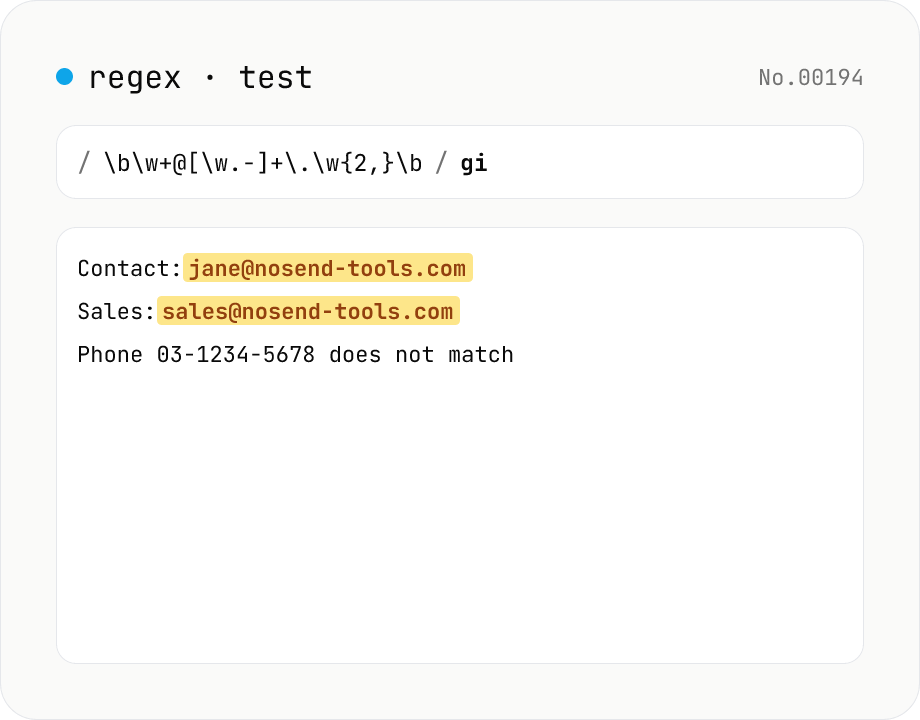
Regex tester — live match & replace preview
Type a pattern and flags to highlight matches in the test string in real time. Capture groups and named groups are listed for every match, and there's a replace preview using $1 etc. Runs entirely in your browser.
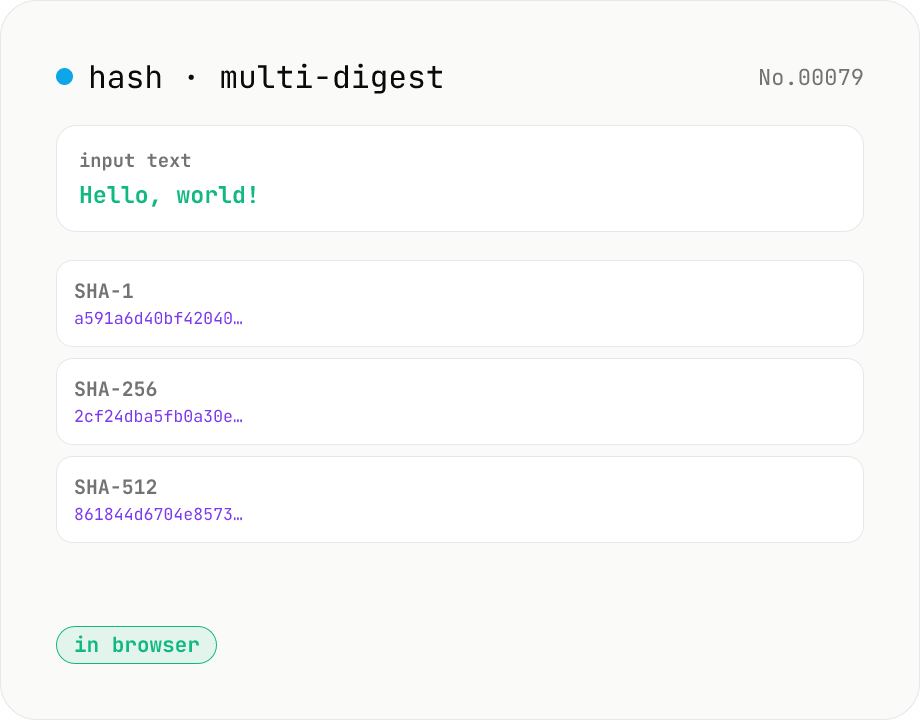
Hash generator — SHA-1 / 256 / 384 / 512
Generate SHA-1, SHA-256, SHA-384, and SHA-512 digests from text in parallel. Powered by the Web Crypto API and runs entirely in your browser.