
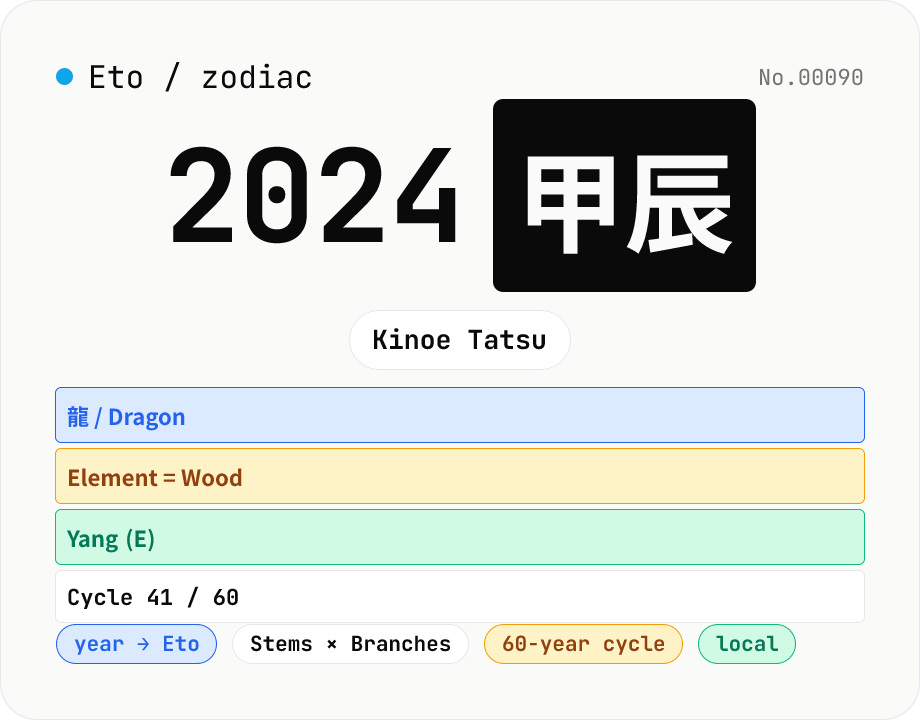
Japanese zodiac (Eto) — animal, element, and reading from a year
Enter a year to see its full Eto (Sexagenary cycle of 10 Heavenly Stems × 12 Earthly Branches), the Earthly Branch + matching animal (Rat / Ox / Tiger / Rabbit / Dragon / Snake / Horse / Goat / Monkey / Rooster / Dog / Boar), the Heavenly Stem with its Five Element (Wood / Fire / Earth / Metal / Water) and Yin / Yang polarity (E / To), plus on'yomi and kun'yomi readings. We also list the 60-year and 12-year matches. Useful for New Year's cards, classical text reading, calendar lookup, and zodiac-based personality references. Covers 1900–2099 in your browser.
How to use
Enter a year (defaults to the current year). See the full Eto, the Earthly Branch + animal, the Heavenly Stem + Five Element / Yin-Yang, and the readings. Lists of years sharing the same branch (±60) and the same stem (±50) help you scan generations at a glance. The 1-of-60 cycle position shows why kanreki (60th birthday celebration in Japan) happens — the Eto returns to its start.
In depth
What a birth-year lookup reveals
Entering a year to find an Eto reading is most often an act of looking up one’s own birth year, or the birth year of a family member or partner. A birth year is part of a date of birth — PII when combined with name and address. Confirming that someone born in 1965 reaches kanreki in 2025 is, from a data perspective, telling an external service that a specific person was born in 1965.
Wedding planning, gift selection, and New Year’s card writing all involve checking zodiac years for real individuals. Search logs that capture which years are queried and in what sequence can sketch a picture of upcoming life events — a granularity of behavioural data that most users would not expect from a calendar tool.
Behavioural observation risk in zodiac lookup services
Online services that offer Eto lookups can log which years users search. Aggregate patterns — a spike in 1965 queries every January as the kanreki cohort checks their milestone, or 2023 queries from parents confirming their newborn’s zodiac — translate into life-stage signals that are valuable for ad targeting. Even without any personal identifiers, a server-side query log builds an audience profile over time.
The asymmetry is worth naming: to the user, this is a quick calendar lookup; to a data-collecting service, it is a timestamped signal that someone in a household just checked a particular birth year.
Pre-bundled tables and no-network computation
This tool bundles the complete 60-cycle Eto table, the 12 Earthly Branches (animal assignments), and the 10 Heavenly Stem mappings (Five Elements, Yin/Yang) as static data inside the JavaScript that ships with the page. The calculation is simple integer arithmetic — (year − base year) mod 60 — with an array lookup. No server is involved. Enter any year and watch DevTools Network: nothing is sent.
The same static approach handles the lists of same-branch years (±60) and same-stem years (±50). All of that data is already on the page when it loads, so browsing through different years creates no network activity at all.
Using it before writing New Year’s cards or planning a celebration
In practice, Eto lookups cluster around two moments: writing New Year’s cards (confirming next year’s zodiac animal) and preparing milestone birthdays (kanreki at 60, koki at 70, and beyond). Both situations involve real people and real dates. Running those checks in a browser-local tool means the birth years you enter never leave the page.
The cycle-position display (1 of 60) is useful for understanding why kanreki is celebrated specifically at age 60 — the Eto returns to its starting combination. It’s also an efficient way to check which past and future years share the same zodiac sign, without querying a remote calendar API.
The arithmetic of the 60-cycle and the year-start problem
The Sexagenary cycle pairs the 10 Heavenly Stems with the 12 Earthly Branches, giving a 60-year cycle whose position is computed as (year - 4) mod 60 (because year 4 CE was 甲子, position 1). Each Stem decomposes into a Five Element (Wood / Fire / Earth / Metal / Water) and a Yin/Yang polarity (兄 / 弟), so 甲 = Wood-elder and 乙 = Wood-younger. The tool computes all three views — full Sexagenary, Branch only, Stem only — from the year input using these mod operations.
There is a subtler issue: when does a year “begin” for Eto purposes? Traditional Chinese and Japanese calendars place the boundary at the lunar new year or at 立春 (around February 4), not the Gregorian January 1. Someone born on 2024-02-03 reads as the 甲辰 year by Gregorian count but the previous year 癸卯 by 立春 reckoning. This tool uses the Gregorian boundary for simplicity and consistency, but practitioners of Four Pillars of Destiny (四柱推命) or formal naming divination apply the 立春 cutoff — so for births in early January through early February, factor in the offset before treating the displayed Eto as authoritative. To convert the same birth year into wareki (Meiji/Taishō/Shōwa/Heisei/Reiwa), pair this with era-convert.
Animal variations across cultures and modern longevity milestones
The 12 animals (子 Rat, 丑 Ox, 寅 Tiger, …) originate in China but differ across cultures. Japan uses 卯 Rabbit and 亥 Boar (wild pig). China uses 卯 Rabbit and 亥 Pig (domestic). Vietnam famously substitutes 卯 Cat for Rabbit. Thailand keeps 卯 Rabbit but renders 辰 as Nāga, the Buddhist serpent deity. Year-of-the-Boar New Year cards designed for Japan typically show a wild boar, while the same year for a Chinese audience needs a domestic pig — a real consideration in commercial illustration work for international audiences.
Beyond kanreki at 60, Japanese tradition marks several longevity milestones based on kanji shape rather than the Eto cycle: 古希 (70), 喜寿 (77, because 喜 decomposes into 七十七), 傘寿 (80), 米寿 (88, 米 into 八十八), 卒寿 (90), 白寿 (99, 白 = 百 − 一), and 百寿 / 紀寿 (100). These run independently of the 60-cycle but are part of the same overall reverence-for-age framework. When planning a celebration, cross-checking the Eto position alongside the kanji-derived milestone tells you whether someone is approaching multiple meaningful markers in the same year. To pick an auspicious date for the party itself, rokuyou-jp shows the Taian / Butsumetsu cycle for any month.
FAQ
- What is Eto?
- Eto (干支) is the Sino-Japanese 60-year cycle pairing 10 Heavenly Stems (十干, Jikkan) with 12 Earthly Branches (十二支, Junishi). 2024 = 甲辰 (Kōshin in on'yomi, Kinoe-Tatsu in kun'yomi). Historically used for years, days, hours, and directions.
- What is kanreki (還暦)?
- After 60 years the Eto returns to the same combination, so the 60th birthday is celebrated as 'kanreki' (returning calendar). E.g. a person born in 1965 (Otsumi / Kinoto-Mi) sees Otsumi return in 2025 for their kanreki.
- How do the stems relate to Five Elements and Yin / Yang?
- Each Heavenly Stem is one of the Five Elements (Wood / Fire / Earth / Metal / Water) paired with Yin or Yang (called E / To in Japanese). E.g. Kō (甲) = Wood + Yang = Kinoe; Otsu (乙) = Wood + Yin = Kinoto.
- Why 1900–2099 only?
- The math is open-ended, but we cap the input to the years most commonly needed (New Year's cards, family registry, calendar lookups). Edit the source to broaden the range.
- Is anything uploaded?
- No — the Eto tables are bundled and looked up locally.
How to verify nothing is uploaded
This tool never sends your input outside your browser. The pages below explain how it works, how to audit it, and how the site is run.
Related tools
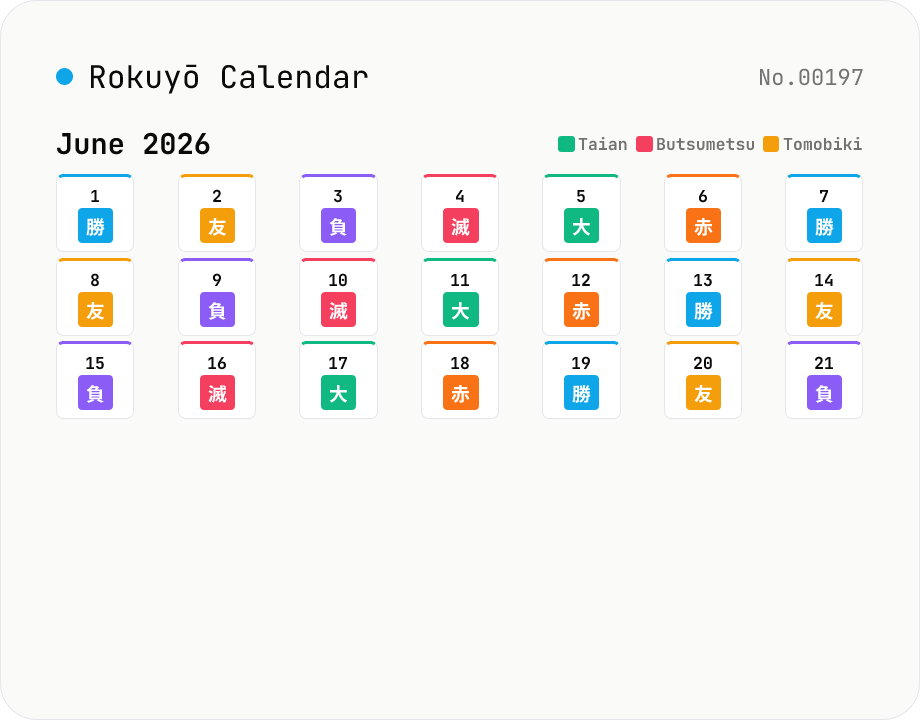
Rokuyō (Japanese 6-day calendar) — Taian / Butsumetsu lookup
Look up the Rokuyō (六曜) of any date — Sensho / Tomobiki / Senbu / Butsumetsu / Taian / Shakkō — and view a full month at a glance. Rokuyō is the traditional 6-day cycle used in Japan for picking auspicious days for weddings, funerals, moves, and store openings. Lunar conversion uses solarlunar (ISC); Rokuyō is computed as (lunar month + lunar day) mod 6. Includes month navigation and a per-Rokuyō meaning (Taian = all-day lucky, Butsumetsu = all-day unlucky, Tomobiki = 'pulls a friend' so funerals are avoided, etc.). Covers 1900-2099. Everything runs in your browser; no date information is uploaded.
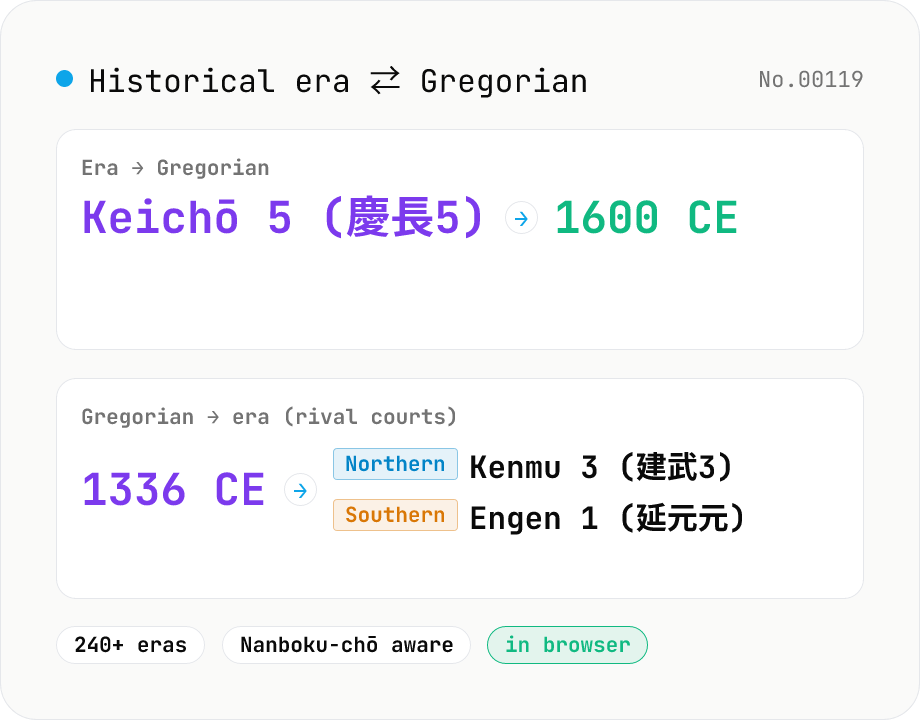
Historical Japanese era ⇄ Gregorian year — Taika 645 to Keiō 1868
Convert between historical Japanese eras (645 Taika through 1868 Keiō) and Gregorian years in both directions. Built-in dataset of 240+ pre-Meiji eras, including 元年 (year 1) and the rival Northern/Southern court eras of the Nanboku-chō schism (1331–1392). For Meiji onward use the era-convert tool. Year-level precision (the lunisolar calendar makes month/day mapping ambiguous). Runs entirely inside your browser — no dictionary download required.
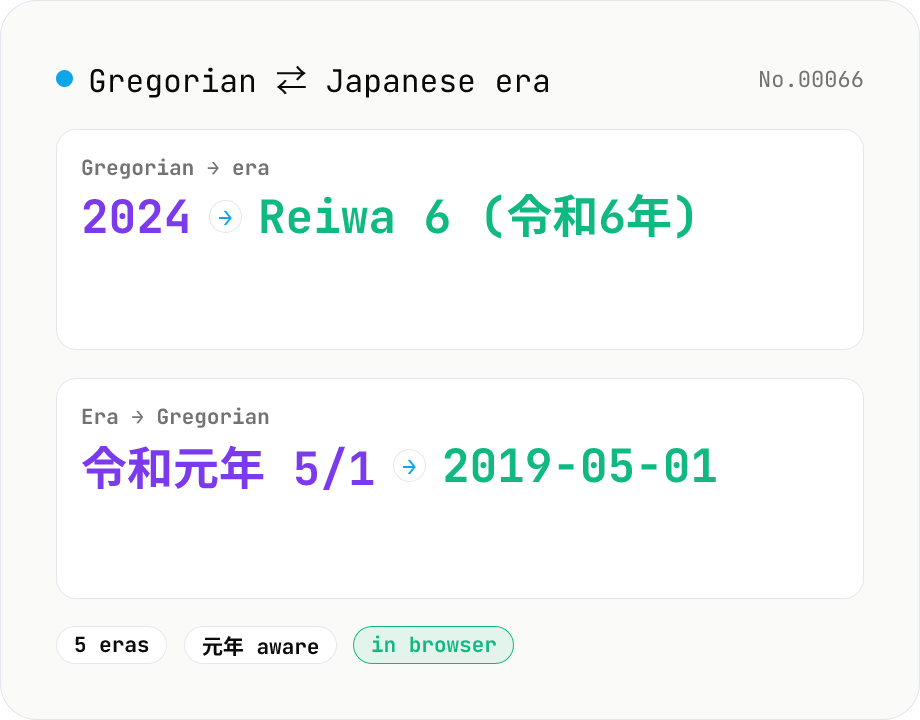
Japanese era ⇄ Gregorian year — Meiji to Reiwa converter
Convert between Gregorian years and Japanese eras (Meiji, Taishō, Shōwa, Heisei, Reiwa) with a mode toggle. Accepts year-only or full date input, handles 元年 (year 1) and era-boundary transitions like 2019-05-01 → Reiwa 1 (令和元年). No dictionary download required — runs entirely inside your browser.
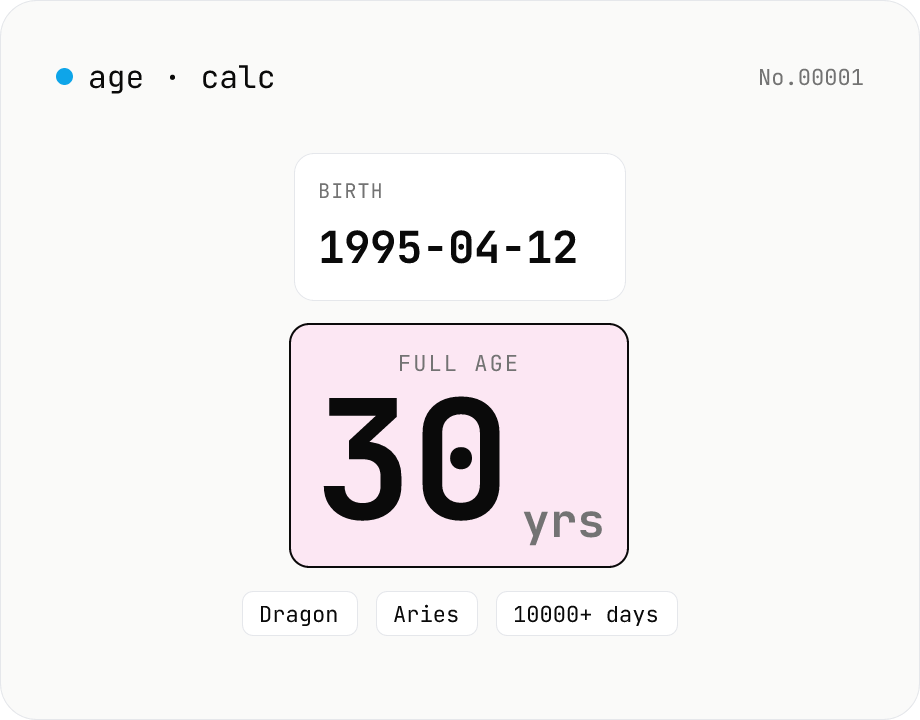
Age calculator — from birthday to years, zodiac & day count
Enter a birth date and a reference date to get the full age in years, days lived, Eastern zodiac (12 animals), and Western zodiac. Change the reference date to compute the age at any past or future point. Everything runs inside your browser — your birthday never leaves the page.