
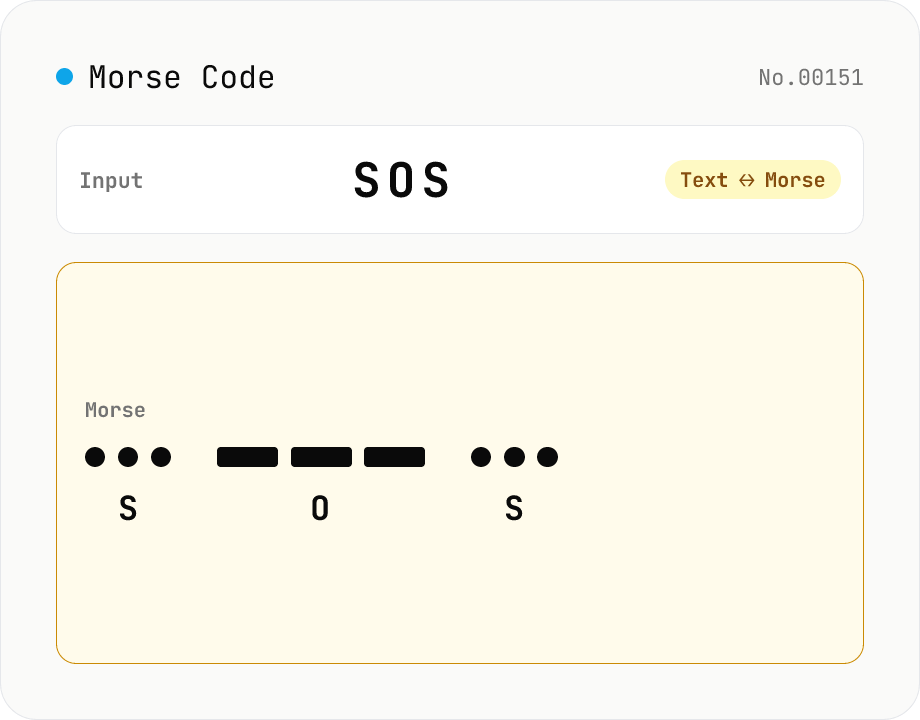
Morse Code Translator
Translate between text and Morse code. Pick a mode (text → Morse or Morse → text) and a character set: international (ITU: A-Z / 0-9 / punctuation) or Japanese wabun code (katakana with dakuten / handakuten / long vowel). Symbols are separated by a space and words by ' / '. Japanese voiced marks are split and recomposed via Unicode normalization (NFD/NFC). Everything runs in your browser — your text is never uploaded.
How to use
First pick a direction (Text → Morse or Morse → Text) and a character set (International or Japanese). Switching either updates the input placeholder and the sample. Then type your text or Morse into the input (the Sample button fills an example) and press Convert to see the result. Symbols are separated by a single space and words by ' / ' (slash). International uses ITU Morse (A-Z / 0-9 / punctuation); Japanese uses wabun code with dakuten / handakuten / long vowel support. Everything runs in your browser — your input is never uploaded.
FAQ
- Is my input uploaded?
- No. All conversion happens in browser JavaScript; your text and symbols never leave your device.
- What's the difference between International and Japanese?
- International is ITU Morse covering A-Z, 0-9, and common punctuation (. , ? / @ etc.). Japanese is wabun code covering katakana, dakuten (゛), handakuten (゜), long vowel (ー), and Japanese punctuation. The same dot/dash pattern means different things in each set, so choose the right set when decoding.
- Can I use hiragana or small kana (っ ゃ)?
- Hiragana is auto-converted to katakana first. Wabun code has no small-kana distinction, so っ→ツ, ゃ→ヤ, etc. are sent at full size. Decoded output therefore shows full-size katakana rather than small kana (this is inherent to wabun code).
- How are dakuten / handakuten handled?
- In wabun code, voiced marks are sent as independent symbols after the base character (e.g. ガ = カ + ゛). This tool uses Unicode normalization to split ガ into カ + voiced-mark on encode and recompose カ + voiced-mark into ガ on decode, so voiced sounds round-trip correctly.
- What are the separator rules?
- Separate each character (symbol) with a single space, and separate words with a slash ' / '. Follow this when decoding (extra or surrounding whitespace is ignored). Unknown characters or symbols are shown as ?.
Related tools
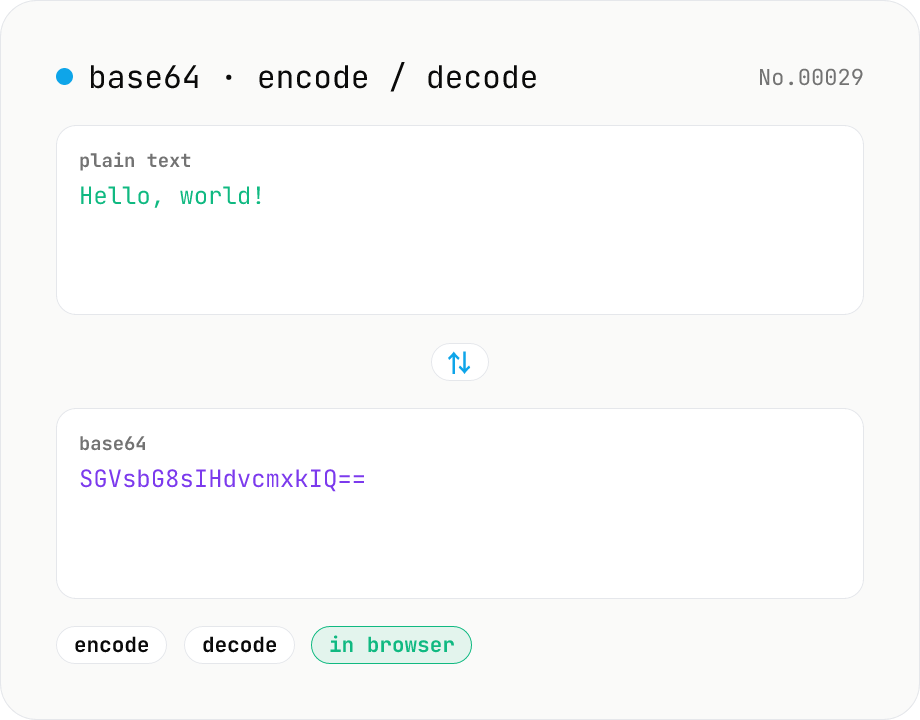
Base64 encode / decode — URL-safe variant supported
Convert between plain text and Base64. Encode with an optional URL-safe variant; decoding accepts URL-safe (- _, no padding) automatically. UTF-8 safe and runs entirely in your browser.
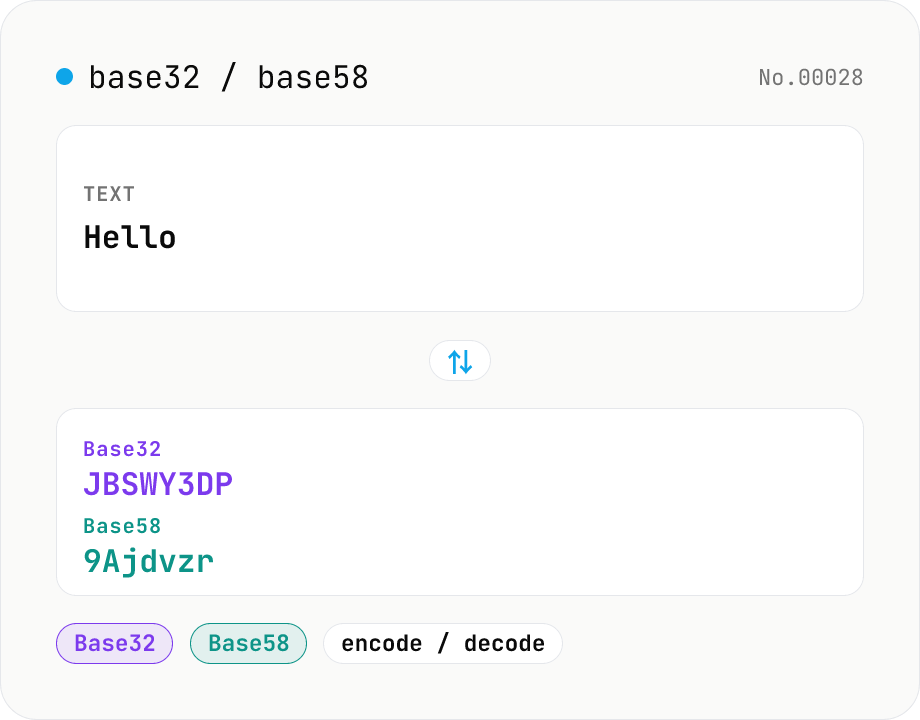
Base32 / Base58 encode & decode
Convert text to and from Base32 (RFC 4648 / TOTP 2FA secrets) and Base58 (Bitcoin addresses). Switch the variant (Base32 / Base58) and direction (encode / decode). UTF-8 byte based, so Japanese and emoji round-trip. Runs entirely in your browser.
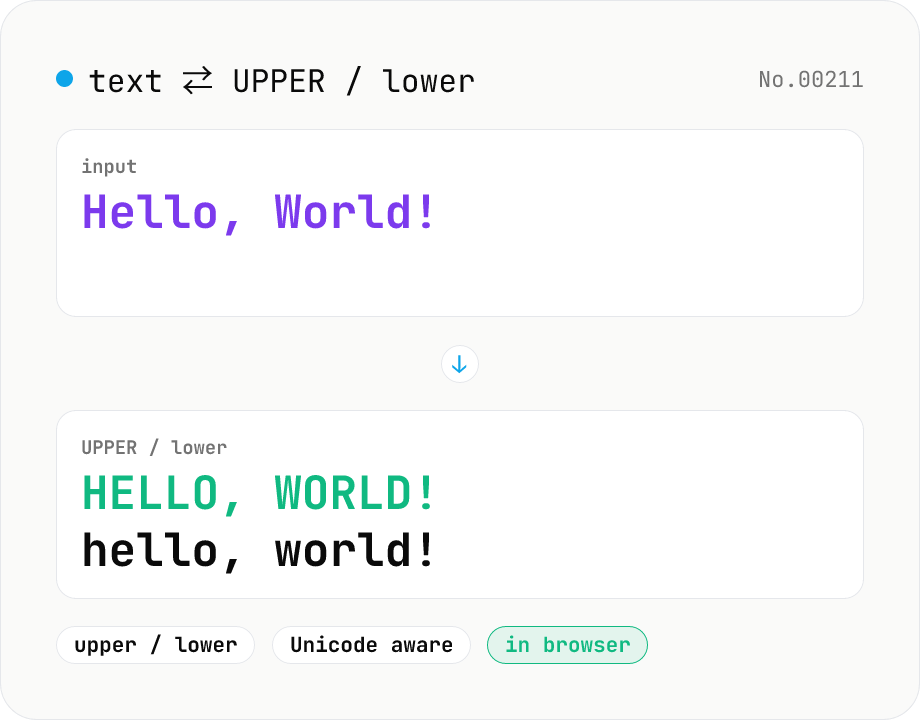
Text case — UPPERCASE / lowercase toggle
Convert text to all UPPERCASE or all lowercase, with a mode toggle. Unicode-aware so non-Latin scripts (Greek, Cyrillic, etc.) are handled correctly. Japanese, symbols, and digits pass through unchanged. Runs entirely in your browser.
Hiragana ⇄ Katakana converter — bulk character mapping
Convert between hiragana and katakana with a single mode toggle. A purely mechanical per-character mapping — no dictionary download, instant conversion. Long-vowel mark, punctuation, kanji, and alphanumerics are preserved as-is. Runs entirely in your browser.