
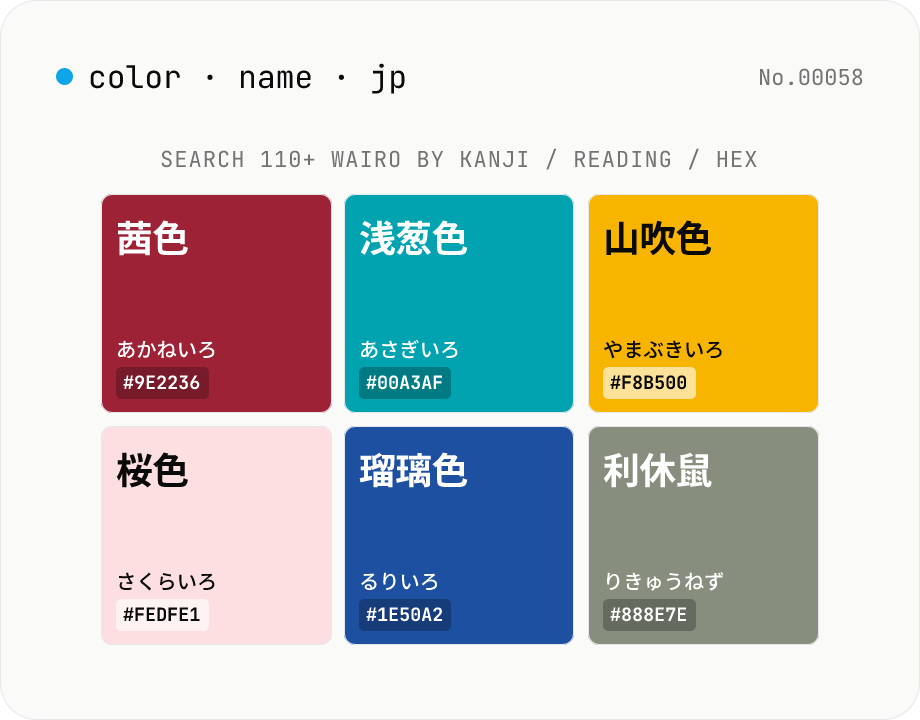
Japanese traditional color search (wairo) — name / reading / HEX bidirectional
Search 110+ **Japanese traditional colors** by kanji, reading, romaji, or HEX. Filter by family (red / yellow / green / blue / purple / brown / neutral). Each entry includes the kanji name, kana reading, hex value, and a short note (madder root, Shinsengumi haori, Sen-no-Rikyu's favourite, etc). Drop a HEX and the tool returns the 8 closest wairo by RGB distance. Useful for design, fiction writing, traditional crafts, and kimono colour planning.
How to use
Browse Japanese **traditional colours (wairo)** in three modes: (1) **Search by name** — match kanji (`茜色`), reading (`あかねいろ`), or romaji (`akane`). (2) **Closest to HEX** — drop `#C53D43` and get the 8 closest wairo by RGB distance. (3) **Browse by family** — pick from red / yellow / green / blue / purple / brown / neutral. Each entry shows the kanji name, kana reading, romaji, HEX value, and an etymological note (e.g. 'madder root', 'Shinsengumi haori', 'Sen-no-Rikyu's favourite'). **110+ colours** sourced from JIS Z 8102:2001 and the Nippon Color Index. Useful for design (web / poster), traditional crafts, kimono planning, fiction writing.
In depth
The information value of creative colour searches
When a designer searches for a traditional Japanese colour by name, the query itself reveals the project they are working on. Searching for asagi-iro (pale indigo-cyan) hints at a samurai or Meiji-era theme; rikyu-nezumi suggests a tea-ceremony or wabi aesthetic; sakura-iro points to spring marketing. Search history is therefore a readable record of creative direction — something that may be sensitive before a client campaign is public.
The ‘closest to HEX’ feature takes this one step further. Inputting a precise HEX to find the nearest wairo often means typing an unpublished brand colour or an unreleased product palette. Sending that value to a third-party server, even for a colour lookup, leaves a log of information that was not intended to be shared.
The structural risk of online colour lookup services
Free colour reference sites often fund themselves through ad targeting and analytics, giving them a business incentive to log what colours users search for and in what sequence. Some services include terms that allow them to use ‘user input for service improvement’, which can mean your brand palette becomes training data.
Even a well-intentioned service has server logs. Any network request is a potential disclosure — not because operators are malicious, but because logs exist and can be subpoenaed, breached, or sold with a business acquisition.
How this tool stays inside your browser
The entire wairo dataset — 110+ colours with kanji names, kana readings, romaji, HEX values, and etymological notes — is compiled into a static JSON file and bundled with the page. Keyword search, HEX nearest-neighbour lookup (Euclidean RGB distance Δ = √((R₁-R₂)² + (G₁-G₂)² + (B₁-B₂)²)), and family filter all run as in-browser JavaScript. Open DevTools Network tab while using the tool: after the initial page load no further requests fire, regardless of what you type or which HEX you enter.
The data itself is sourced from JIS Z 8102:2001 and the Nippon Color Index and is delivered with the JavaScript bundle — no API call is ever needed to retrieve or rank colours.
Using it as a colour-selection checklist
In practice, this tool fits naturally into two sensitive creative moments: picking wairo for a client presentation before the pitch, and finding traditional-colour complements for an unreleased product palette. Both involve confidential context you would not want logged externally. Keeping a browser-only colour reference in your workflow removes the need to reach for an online service each time you need a reading or HEX value.
If you regularly work with Japanese branding, a simple habit is worth building: before typing any brand HEX into a colour tool, check whether the lookup stays local. This tool does.
Standards behind the colour names and the limits of RGB distance
The term “Japanese traditional colours” actually covers several overlapping standards. This tool draws from JIS Z 8102:2001 (“Names of non-luminous object colours”), which defines 269 colour names — 147 of which are the traditional wairo subset. Alternative sources like Sachio Yoshioka’s “Nippon-no-Dento-iro” (2000) and book-format colour indices use slightly different hex values for the same names, so 浅葱色 may appear as #02A4A4 in one reference and #00A1A6 in another. The values bundled here sit between JIS Z 8102:2001 and the Nippon Color Index; for strict colour matching against printed swatches, consult Japan Color Research Institute (JCRI) chips or DIC Color Guide “Japanese Traditional Colours” series in parallel.
The Euclidean RGB formula Δ = √((R₁-R₂)² + (G₁-G₂)² + (B₁-B₂)²) measures distance in the sRGB cube, but that distance does not correspond to perceptual difference. Humans perceive blue–purple gaps as larger than green–yellow-green gaps of the same Euclidean magnitude. A perceptually accurate match would use Lab colour space with ΔE76 or ΔE2000. The tool sticks with Euclidean RGB for speed and bundle-size reasons; for brand-matching work where precision matters, treat the top 8 results as candidates to compare visually rather than as a ranked truth. For HEX / RGB / HSL conversion and palette generation, color-converter and color-harmony handle those steps locally.
Reproduction differences across web, print, kimono, and traditional crafts
The same colour name renders differently across output media. A web sRGB display of 藤色 (#C8A2D8) shifts in CMYK four-colour offset printing — purple, brown, and muted neutral tones lose saturation without DIC or PANTONE spot colours, and a vivid wairo like 浅葱色 (#02A4A4) flattens considerably. In dyeing, the substrate (silk, cotton, hemp) and the dye chemistry (紅花 safflower, 藍 indigo) drive ongoing colour shifts: indigo darkens with each dip, and safflower needs an acid wash to lock the colour. Same name, very different actual appearance.
For craft and printing workflows, treat the bundled hex as a target direction, not a guaranteed output. A tea-ceremony reference to 利休鼠 (#888E7E) on a ceramic glaze depends on the body composition, the slip, and the firing temperature — the hex tells the artisan which family of greys you want, not what comes out of the kiln. Pair the hex with the traditional name when communicating with designers and craftspeople: the name carries the cultural intent that pure numerics cannot.
FAQ
- Is my input uploaded?
- No. Everything is static JSON + in-browser filtering — no external API.
- What are 'wairo' (Japanese traditional colours)?
- **Wairo (和色)** or *dento-shoku (伝統色)* is the system of Japanese colour names handed down from antiquity. Madder-root **akane-iro** appears in the *Man'yoshu* (8th century); courtiers wore **murasaki** purple; samurai favoured **kon** navy; townspeople adopted **edo-murasaki** and **asagi-iro** in the Edo period. JIS Z 8102:2001 officially defines 269 such colours.
- Why do JIS and other sources disagree on hex?
- Traditional dyes vary by mordant, source, and era — the 'authentic' hex is fuzzy. We prefer JIS where defined; for colours added later (e.g. **Shinbashi-iro**, Meiji-era) we borrow from the Nippon Color Index and historical references. Treat them as approximations — your monitor's gamut also bends the answer.
- What's the 'Shinsengumi asagi-iro' story?
- The bakumatsu-era **Shinsengumi** unit adopted **asagi-iro** (pale indigo-cyan) haori coats — the colour traditionally worn by criminals and samurai about to commit ritual suicide — as a public statement of resolve. Frequently cited in historical drama and fiction.
- How are families defined?
- Seven families based on the modern colour wheel: red / yellow / green / blue / purple / brown / neutral. This is a rough modern grouping, not the classical five-colour cosmology. Some borderline colours (e.g. **mikan-iro** = mandarin orange) land in red rather than yellow because the JIS hex skews redder.
- How is 'closest to HEX' computed?
- Euclidean distance in RGB space (Δ = √((R₁-R₂)² + (G₁-G₂)² + (B₁-B₂)²)). Simple and good enough for 'find me an approximate wairo'. Perceptual accuracy would require CIE Lab ΔE 2000, but that's overkill here.
- How is romaji written?
- Modified Hepburn: `akane-iro`, `asagi-iro`, `rikyu-nezu`. Long vowels written as plain `o` / `u` (no macrons). Hyphenated. Prefix-matching works (`akane` finds `akane-iro`).
- How do I use these in CSS?
- Just use the HEX: `color: #9E2236; /* 茜色 */`. For Tailwind, add custom colours to `theme.extend.colors` in your config, or use arbitrary values like `text-[#9E2236]`. Common applications: kimono e-commerce sites, traditional-restaurant branding, tourism boards, Japanese game art.
- Can you add more colours?
- We carry ~110 well-known ones. The full JIS 269 list, finer Edo-period series like *48 browns and 100 mouses*, are on the wish list. File a feedback request with a reliable source (JIS, public records, academic) and we'll merge.
How to verify nothing is uploaded
This tool never sends your input outside your browser. The pages below explain how it works, how to audit it, and how the site is run.
Related tools
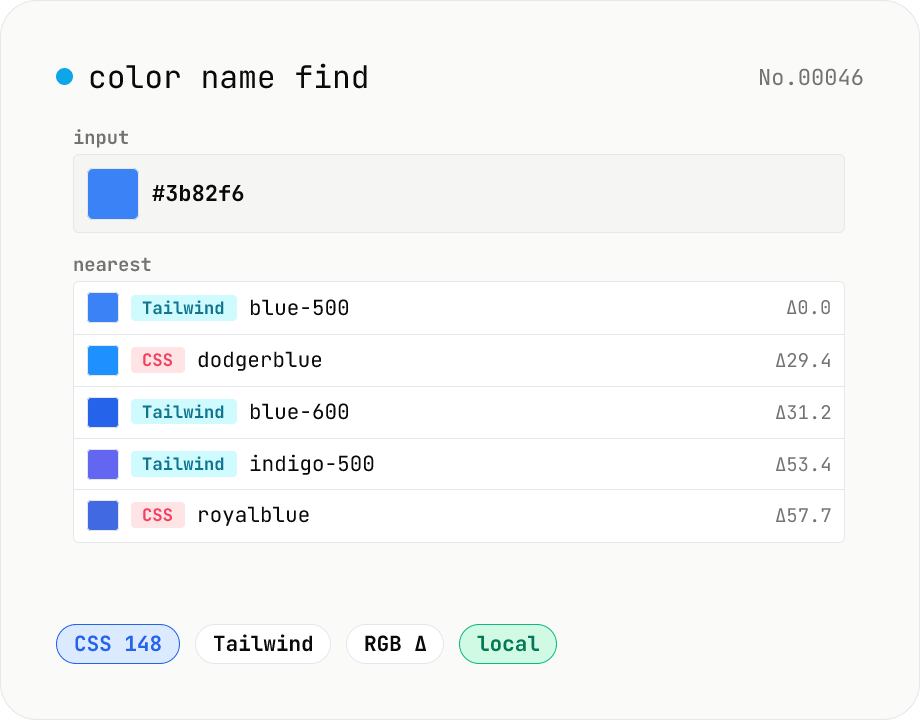
Color name find — match HEX / RGB to a CSS or Tailwind name
Type a HEX value (`#3b82f6`) or a CSS color name (`tomato`) to find the closest matches across CSS named colors (148) and the Tailwind palette (22 hues × 11 shades). Results are sorted by RGB distance with a swatch, name, HEX, and distance score. Perfect for naming design tokens, communicating colors verbally, or finding the nearest Tailwind class. Everything runs in your browser.
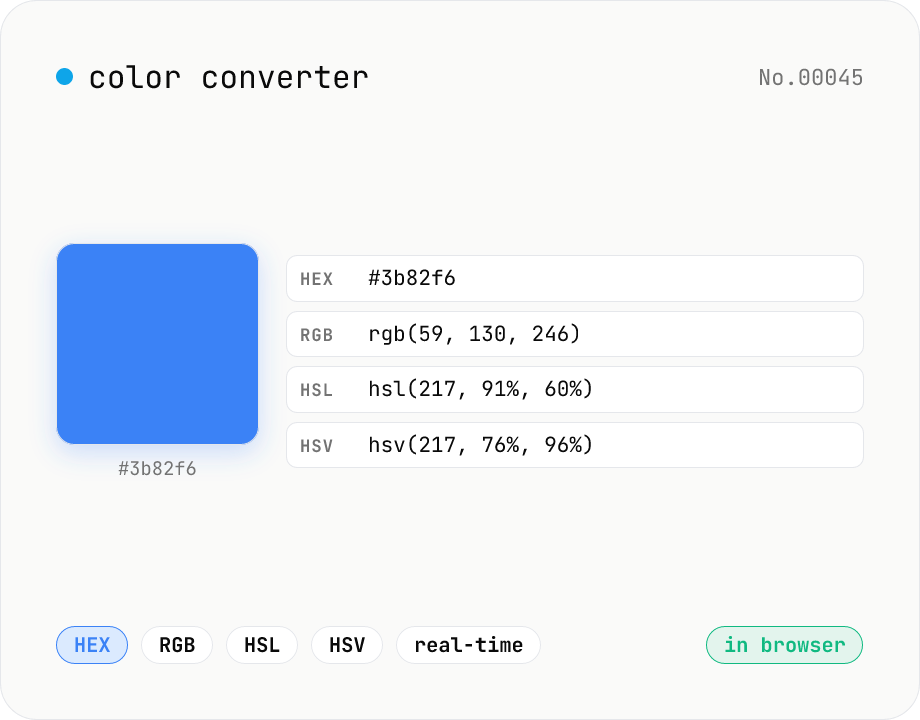
Color converter — HEX / RGB / HSL / HSV
Convert colors between HEX, RGB, HSL, and HSV in real time with a built-in color picker. Edit any field and the other three update instantly. Runs entirely in your browser — your color values never leave the page.
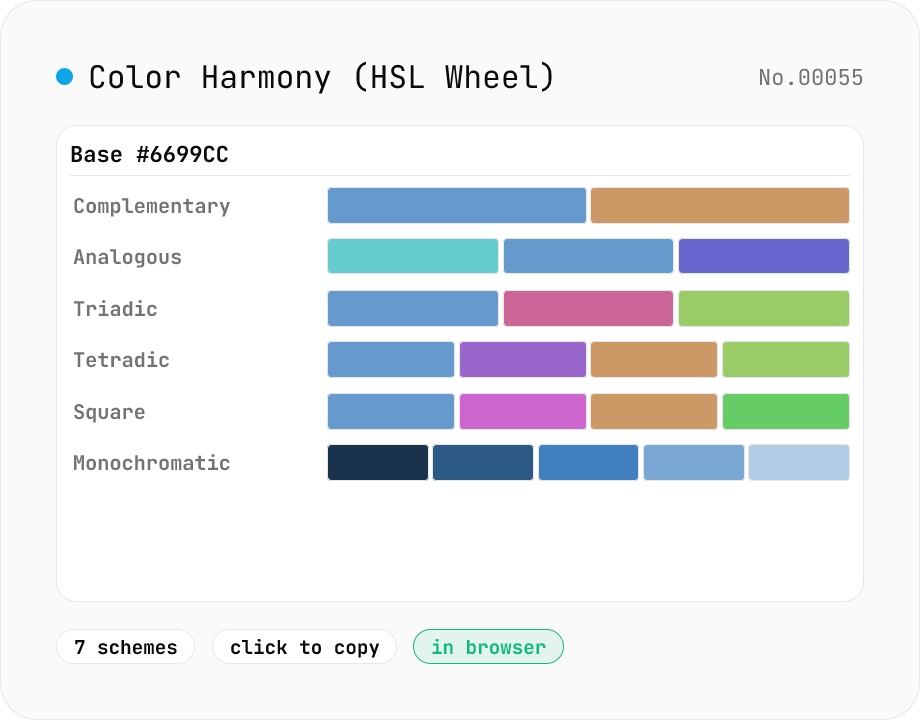
Color Harmony Generator (complementary / triadic / tetradic …)
Given a base color (HEX), the tool spins up seven classical color-theory palettes in one view: complementary, analogous, triadic, tetradic, split-complementary, square, and monochromatic (5-step lightness). Rotations happen on the HSL color wheel, and every swatch is one click to copy. Built for design systems, logos, and web theme colors.
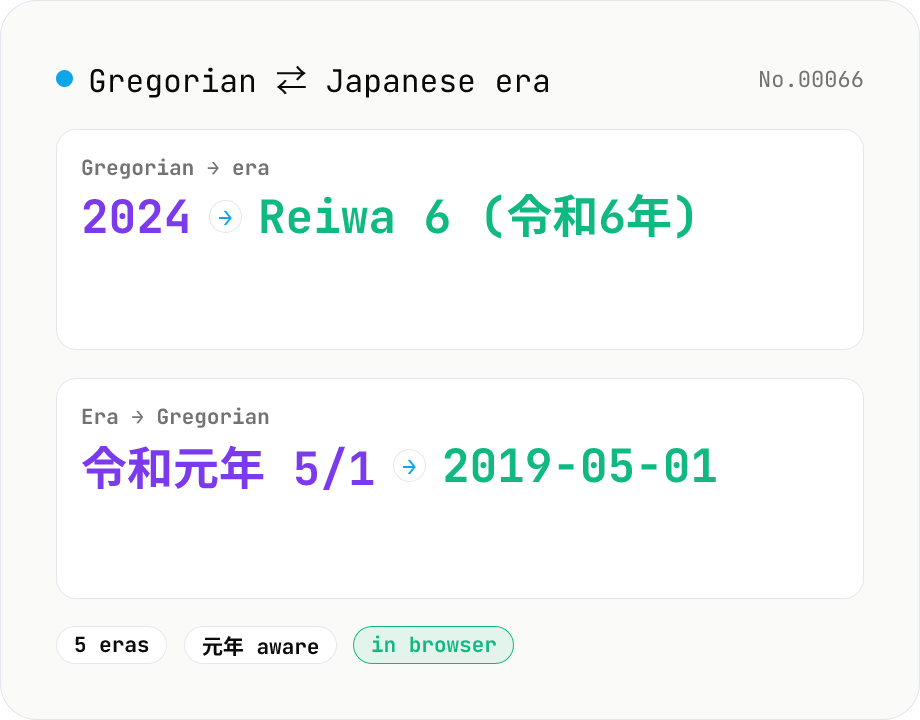
Japanese era ⇄ Gregorian year — Meiji to Reiwa converter
Convert between Gregorian years and Japanese eras (Meiji, Taishō, Shōwa, Heisei, Reiwa) with a mode toggle. Accepts year-only or full date input, handles 元年 (year 1) and era-boundary transitions like 2019-05-01 → Reiwa 1 (令和元年). No dictionary download required — runs entirely inside your browser.