
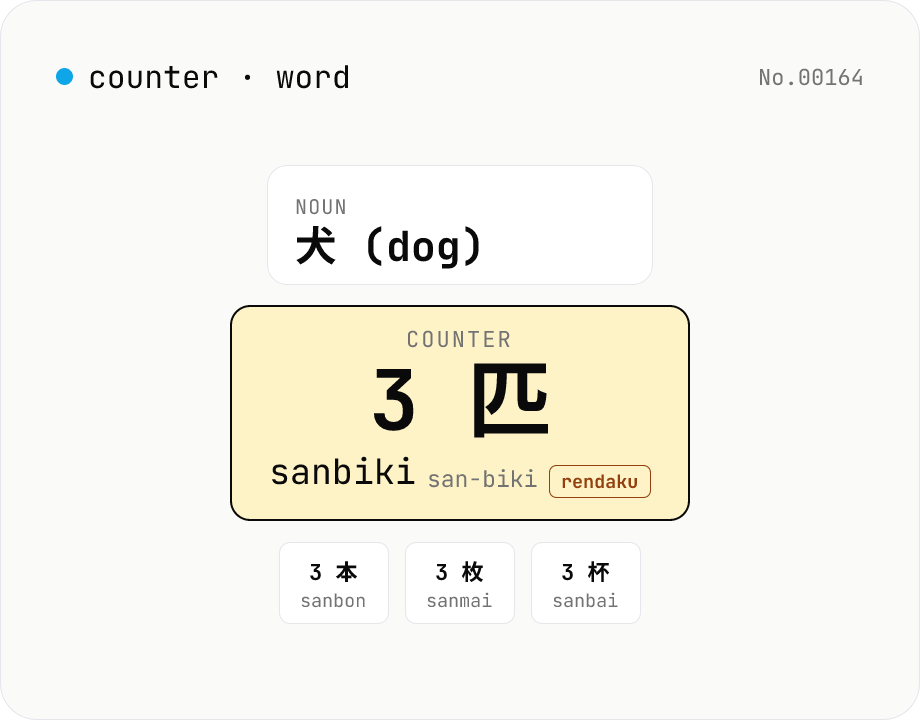
Japanese counter-word (josūshi) suggester & reading lookup
Enter a count and a noun, and the tool suggests the right Japanese **counter word** (本 hon, 枚 mai, 匹 hiki, 台 dai, 杯 hai, 冊 satsu — 30+ counters) and shows the correct reading with *rendaku* (sequential voicing): `3 本` → sanbon, `6 匹` → roppiki, `20 歳` → hatachi. Common nouns (dog, car, paper, cup, book — 200+) are recognised automatically; otherwise pick from the full counter list. Great for JLPT learners, second-language speakers, and Japanese copy-editing.
How to use
Enter a **count** (1–10 / 20 / 100) and a **noun**, and the tool suggests the right Japanese **counter word** (本 hon, 枚 mai, 匹 hiki, 台 dai, 杯 hai, 冊 satsu — 30+ counters) along with the correct reading, including *rendaku* (sequential voicing) and sokuon (`っ`). Examples: `3 + 犬` → **3 匹 (sanbiki)**, `6 + 鉛筆` → **6 本 (roppon)**, `20 + 歳` → **hatachi**. If your noun isn't in the built-in dictionary (~200 entries), pick a counter from the list below to look up the reading. Useful for JLPT prep, language teachers, and proof-reading Japanese copy.
In depth
Who checks counter words and what they are working on
Counter-word lookups are not just for language students. Translators verifying Japanese output, editors checking copy written by non-native speakers, curriculum designers building JLPT study materials, and localisation engineers writing test strings all use this type of tool. In those professional contexts, the text being verified may include draft copy that is not yet public — a product description for an unreleased item, a chapter from an unpublished textbook, a localised marketing headline.
Even a single noun input (‘犬’, ‘鉛筆’, ‘会議室’) carries implicit context about what someone is writing. A string of animal names might mean a children’s book draft; a series of business nouns might mean internal documentation. The noun alone is not sensitive, but the habit of sending all verification queries to an external server is worth reconsidering.
The risk when counter-word services use external NLP APIs
Some counter-word tools route input through a server-side morphological analyser — MeCab, kuromoji, or Sudachi running on a remote machine — to identify the noun category before returning the appropriate counter. That means every noun you submit travels over the network, is processed on hardware you do not control, and appears in a log.
Free NLP APIs frequently aggregate usage data for ad targeting or model training. A service that receives noun queries can build a picture of what content categories are most common among its users — useful for monetisation, but not something users typically expect when they are just checking if a dog is counted with 匹 or 頭.
Static dictionary lookup with no network dependency
This tool bundles a noun-to-counter mapping (~200 entries, 30 counter types) as a static JSON object compiled into the page at build time. When you enter a noun, the browser compares it against the local dictionary and returns the matching counter along with the complete reading table — including all irregular rendaku (連濁) and sokuon (促音化) forms for numbers 1 through 10, 20, and 100. No external NLP API is called at any point.
The irregular reading table (e.g. 3本 → sanbon, 6本 → roppon, 10本 → juppon) is also embedded locally. Even if your noun is not in the dictionary, the fallback flow — picking a counter manually from the full list and looking up its reading — runs entirely in the browser. Open DevTools → Network while using the tool: no requests fire in response to noun input.
Practical workflow for editors and language learners
Bookmark this tool alongside your Japanese writing environment. When you hit a counter word you are unsure about, type the noun here, confirm the counter and its reading, then return to your draft. The round-trip takes seconds, and the noun you checked never leaves your browser.
For JLPT preparation, running through the counter table for common nouns (animals → 匹/頭/羽, thin flat things → 枚, long thin things → 本, machines → 台) gives you a compact drill that works offline after the first page load. The irregular-reading section — which is the part learners consistently find hardest — is where this kind of reference is most useful.
The phonology behind rendaku, sokuon, and handakuon shifts
Counter readings that change with the number (3 本 sanbon, 6 本 roppon, 1 本 ippon) are not arbitrary memorisation: they follow regular Japanese phonological rules. 3 + 本 shifts the /h/ to /b/ because the moraic nasal ん triggers rendaku (連濁, sequential voicing) on the following voiceless stop. 6 本 roppon shows sokuon-ka (促音化, gemination) where /k/ at the end of roku becomes a small tsu, with the following ho shifting to handakuon po. 1 本 ippon follows the same pattern: ichi + hon → ip + pon.
The shift is predictable from the counter’s initial consonant. h- counters (本 hon, 匹 hiki, 分 fun, 票 hyō) shift to rendaku b- and handakuon p-. s- counters (冊 satsu, 歳 sai, 才 sai) shift to z- under voicing. k- counters (個 ko, 回 kai, 階 kai) take sokuon but generally not rendaku. t- counters (頭 tō, 通 tsū) take sokuon only. This tool stores the irregular forms explicitly, but understanding the rule means you can guess correctly for counters not yet in the dictionary. To convert between kanji numerals like 三本 and Arabic 3本, kansuji-convert pairs naturally with this tool.
Industry and regional variation in counter usage
The same rabbit is counted 1 匹 in everyday speech but 1 羽 in zoology and rabbit-farming contexts — a quirk attributed to either the rabbit’s hopping motion or to Edo-period taboos around four-legged animal consumption (categorising them as birds dodged the taboo). Modern usage still splits along these industry lines: the Japanese Society for Laboratory Animal Sciences uses 匹 in its journals, while the Japan Rabbit Breeders Association uses 羽. Commercial usage varies too: たい焼き (fish-shaped pastry) appears as 1 匹, 1 個, or 1 枚 depending on the shop, with Tokyo favouring 個 and Osaka leaning toward 枚.
Contemporary Japanese has been simplifying counter usage by falling back on native-Japanese counting (1 つ hitotsu, 2 つ futatsu) for situations where the right counter is unclear. In business and polite speech this is sometimes considered safer than guessing wrong. Newspapers and official documents still enforce precise distinctions — イカ (squid) is 1 杯 ippai, 牛 (cow) is 1 頭 ittō, 豆腐 (tofu) is 1 丁 itchō — but daily speech increasingly uses the universal 1 つ. This tool surfaces the traditional counter; how strictly to apply it depends on register and audience. To extract candidate nouns from a longer draft, wakati-tokenize runs the same kuromoji POS tagger locally.
FAQ
- Is my input uploaded?
- No. Everything runs in your browser, with a static dictionary and no external API.
- What's a *counter word* (josūshi)?
- A counter word is a suffix that attaches to a number to count things of a specific category — similar to `2 sheets of paper` in English. Japanese famously has hundreds of these; everyday usage covers 30–50. `2 hon` alone can mean two pencils, two phone calls, two home runs, two movies, or two video calls depending on context.
- What's *rendaku*?
- *Rendaku* (連濁) is sequential voicing — the unvoiced consonant of the second element becomes voiced when combined with a number. The counter **本 (hon)** is the classic case: 1本 = **ippon** (sokuon + h→p), 3本 = **sanbon** (h→b), 6本 = **roppon** (h→p), 10本 = **juppon** (h→p). The rules are irregular per number × counter pair, so a lookup table like this is the easiest reference.
- What about *sokuon* (small っ) and half-voicing (h→p)?
- *Sokuon* — the small `っ` that doubles the next consonant — appears after 1, 6, 8, 10: 1本 = ippon, 6匹 = roppiki, 10階 = jukkai. Half-voicing (h → p) is what makes `ippon` instead of `ihhon`. Both phenomena combine on the same numbers, which is why every (number × counter) combo has its own reading.
- Why does `ひとつ・ふたつ・みっつ` (with つ) only go up to 9?
- The `つ` series uses the native Yamato vocabulary and runs 1–9 only (10 = `とお`). For 11+, switch to `個 (ko)` or another category-specific counter. Children's books and casual speech lean on `つ`; formal writing prefers `個`.
- Why are 1人 and 2人 read as *hitori* and *futari*?
- 1 人 (hitori) and 2 人 (futari) are surviving native Yamato readings — by 3 we switch to the Sino-Japanese **nin**, with 4 人 = **yonin** as the irregular case (shichinin is also accepted). The same pattern shows up with 4 and 7 in many other counters: 4 月 = shigatsu, 7 月 = shichigatsu, but 4 つ = yottsu.
- How many counters are in the database?
- Roughly 30 counters — general (個 / つ), people, animal sub-categories (匹 hiki / 頭 tō / 羽 wa), long things (本), flat things (枚), machines (台), cups (杯), books (冊), buildings (軒), floors (階), abstract (回 / 歳 / 番 / 号) and more. The noun-to-counter dictionary holds ~200 entries. Suggestions for more nouns are welcome via the feedback form at the bottom of every page.
- Are `6 階` and `6 回` read the same?
- Yes, both `6階` and `6回` read **rokkai**. But `3階` = **sangai** (with rendaku) while `3回` = **sankai** (no rendaku) — they're different kanji with different rules. The tool stores each counter separately so the right reading comes back either way.
- Does it cover Chinese measure words or other languages?
- No — Japanese only. Chinese `量词 liàngcí` (本 / 张 / 头 etc.) follows a different system with different readings, and would need its own tool.
How to verify nothing is uploaded
This tool never sends your input outside your browser. The pages below explain how it works, how to audit it, and how the site is run.
Related tools
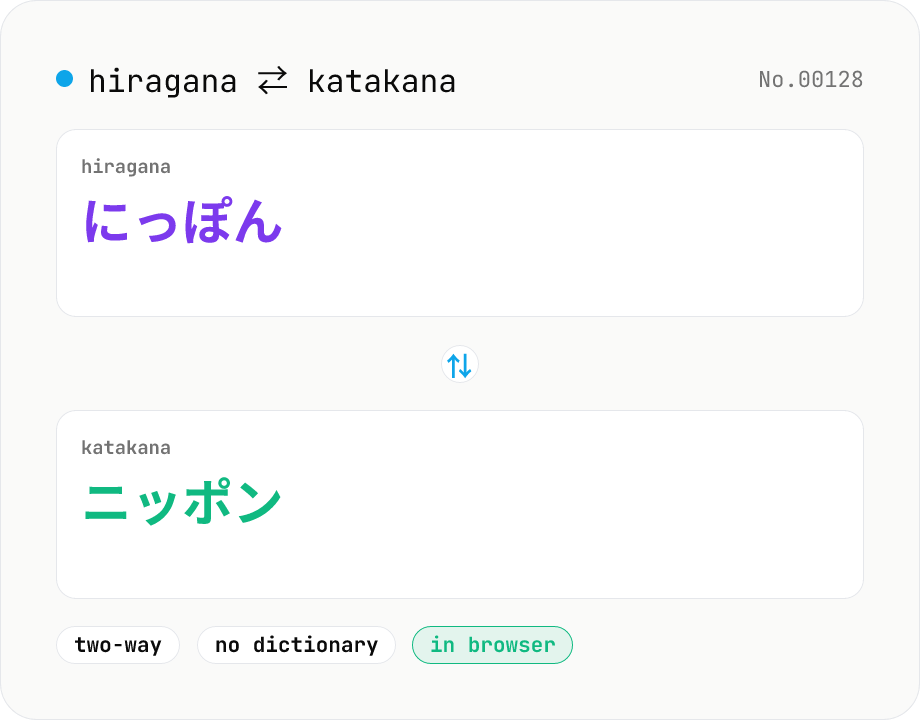
Hiragana ⇄ Katakana converter — bulk character mapping
Convert between hiragana and katakana with a single mode toggle. A purely mechanical per-character mapping — no dictionary download, instant conversion. Long-vowel mark, punctuation, kanji, and alphanumerics are preserved as-is. Runs entirely in your browser.
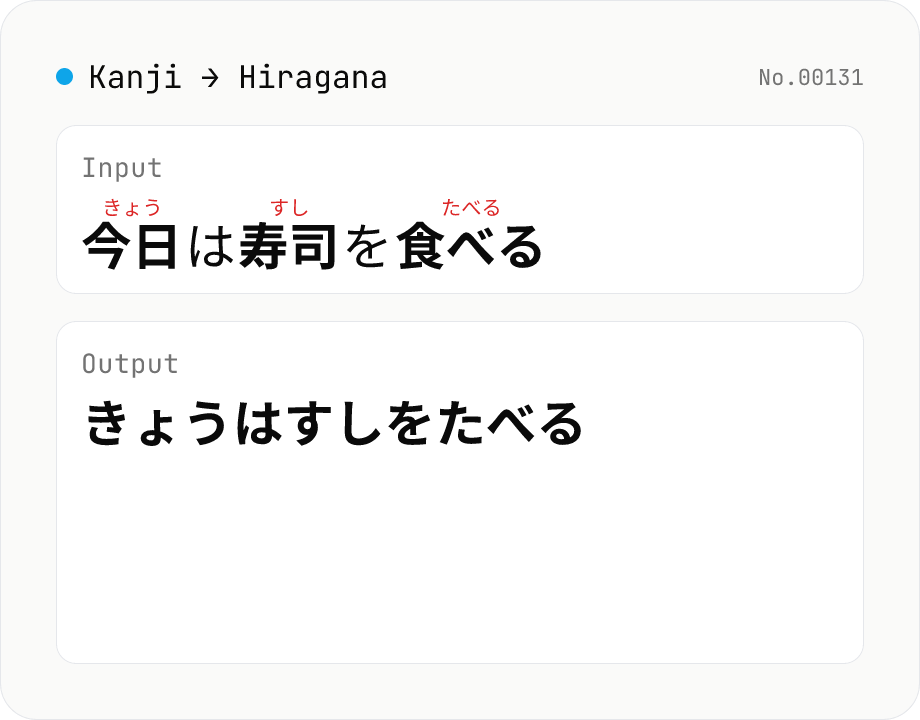
Kanji → Hiragana converter — kuromoji morphological reading
Convert Japanese text to hiragana using kuromoji morphological analysis. Choose between fully hiragana output, or a furigana mode that keeps kanji and adds hiragana ruby above. The dictionary downloads once and is then offline. Runs entirely in your browser.
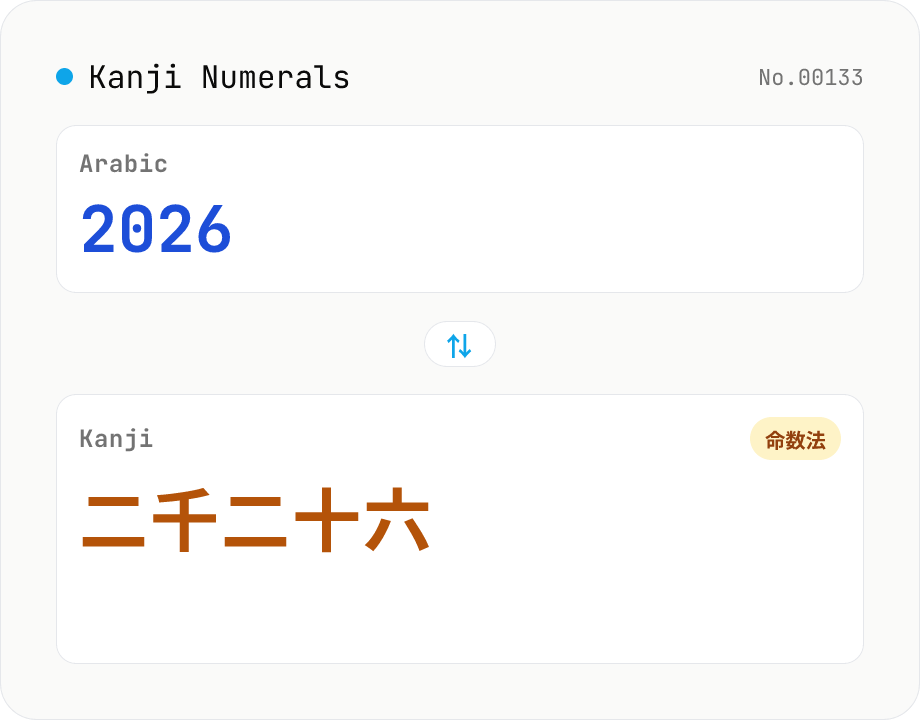
Kanji Numeral Converter
Convert between kanji numerals and Arabic digits. Supports place-value form (千二百三十四), daiji (壱弐参拾 — the tamper-resistant form used on contracts and promissory notes), and positional form (二〇二六). Handles up to 垓 (10^20), recognizes daiji, full-width digits, and thousands commas. Runs entirely in your browser — no uploads.
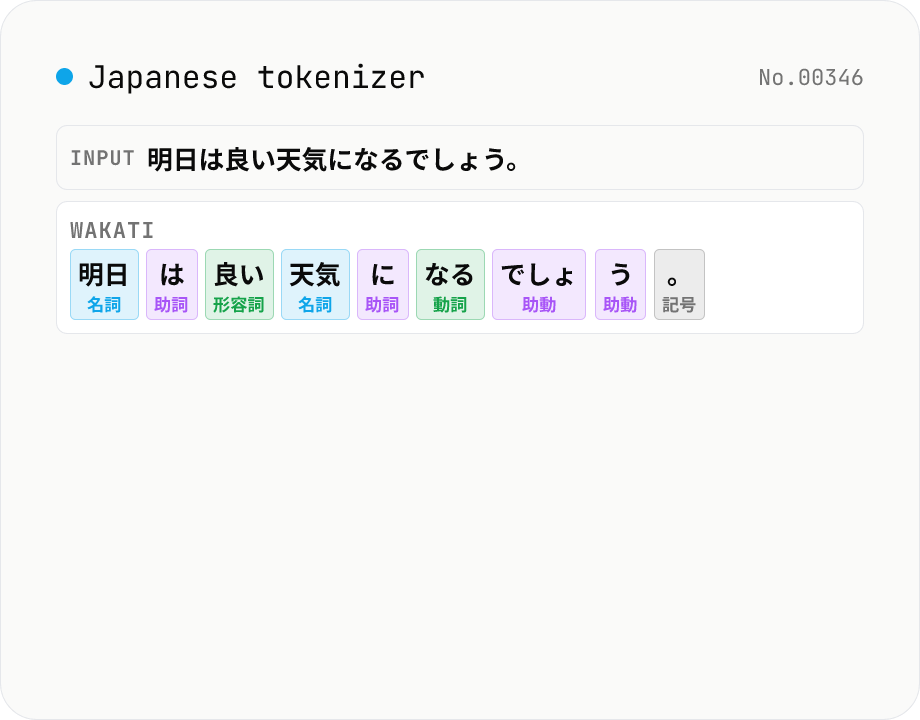
Japanese wakati / tokenizer — kuromoji morphological analysis with POS tags
Tokenize Japanese text with kuromoji (MIT) and produce **space-separated wakati** output. Useful for NLP preprocessing, search-index tokenization (Elasticsearch / Algolia / Meilisearch), training-data preparation for Word2Vec / fastText, or just debugging differences between GiNZA / MeCab / Sudachi. A detailed token table accompanies the wakati output with **surface form / POS (13 categories: noun, verb, particle, etc.) / POS subtype / conjugation / base form / reading / pronunciation**. Filter to keep only nouns, drop particles and symbols, or deduplicate tokens. Dictionary downloads once (~12 MB) and works offline after. Everything runs in your browser; text is never uploaded.