
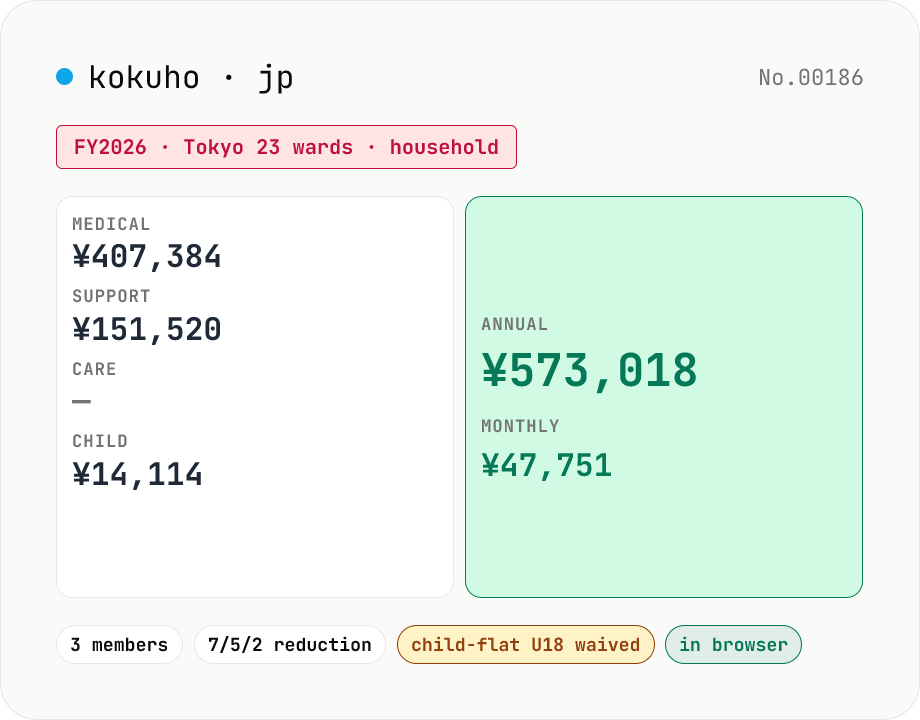
JP National Health Insurance simulator — household + reductions
Estimate Japan's National Health Insurance (kokuho) premium for FY2026 across the 4 categories (medical / support / care / child-care). Auto-applies 7/5/2 reductions and pre-school / under-18 carve-outs. Tokyo 23-ward preset + custom municipal rates. Runs entirely in your browser.
How to use
Pick a preset (Tokyo 23 wards FY2026 or Custom). Add household members with their age group and gross income (JPY, before basic deduction). Specify the salary-earner count (members with salary > ¥550k or pension > ¥600k/¥1.1M). Click Estimate premium — the tool auto-applies 7/5/2 reductions on the flat portion, halves it for pre-school children, and zeroes out the child-care category for everyone under 18 (FY2026 rule). You'll see annual amounts per category (medical / support / care / child-care) plus the monthly average.
In depth
Household NHI data reveals income structure across all family members
National Health Insurance is calculated per household. Entering every member’s income, age group, and employment type means disclosing the financial structure of an entire family at once: who earns what, how old they are, and whether income is salary or self-employment. That is more information than a single tax return, and it covers a household rather than an individual.
NHI covers the self-employed, freelancers, and retirees — groups whose income is more variable and who are prime targets for financial products such as whole-life insurance, investment trusts, and income-protection plans. Tools that collect household income data in this segment have clear commercial uses.
Why household income belongs in your browser, not on a server
The 7/5/2 reduction threshold uses household total income (before the basic deduction). That aggregate figure is a direct proxy for household wealth level and tax status. Insurance comparison sites, FP portals, and household-budget apps that offer NHI calculators have an incentive to associate that income level with a user account for product targeting.
The NHI premium formula — income levy (old 旧ただし書き method: total income minus ¥430k) × rate, plus per-member flat — is static arithmetic on publicly available municipal rates. It does not require a server.
FY2026 four-category calculation with reduction logic in browser
The tool computes all four categories — medical (¥670k cap), late-elder support (¥260k), nursing care for ages 40–64 (¥170k), and child-care support (¥30k, under-18 flat waived per FY2026) — as income levy plus per-member flat for each household member. The 7/5/2 reduction is applied to the flat portion based on household total income and salary-earner count. Pre-school children get an additional 50% flat reduction. All steps run in JavaScript; the Network tab stays empty.
The Tokyo 23-ward preset embeds the FY2026 unified rates. The custom panel lets you enter your municipality’s actual rates if they differ.
Reconciling this estimate against the annual premium notice
Common sources of discrepancy between this tool and the actual notice: (1) the 65+ pension ¥150k deduction in the reduction threshold (this tool skips it — subtract ¥150k manually from that member’s income); (2) a household-flat (平等割) component if your city uses the three-pronged formula (add the flat amount to the per-member field as a workaround); (3) municipal-specific rate adjustments for tiers above the standard. Enter the correct custom rates from your July premium notice to narrow the gap. To see the NHI premium in context with full annual income and resident tax, freelance-tax-jp covers the headline figure; for the monthly due-date calendar, freelance-tax-calendar-jp handles that view — both stay browser-only.
Old 旧ただし書き method, the four-component structure, and 7/5/2 reduction thresholds
NHI premiums are assessed under Local Tax Act Article 703 and NHI Act Article 76 as a combination of up to four components: (1) income levy (each member’s total income minus the JPY 430k basic deduction × rate), (2) per-member flat (定額 per insured), (3) household flat (平等割, not used by all municipalities), (4) asset levy (property-tax base × rate, increasingly dropped). Tokyo’s 23 wards use a two-component model (income levy + per-member) with no household flat or asset levy. Many designated cities (Osaka, Nagoya, Fukuoka) use a three-component model adding the household flat.
The 7/5/2 reduction (Local Tax Act Article 703 paragraph 7) cuts the per-member and household-flat portions when household total income falls below tiered thresholds. The FY2026 thresholds are: 70% reduction at household total income ≤ JPY 430k; 50% reduction at JPY 430k + 305k × insured count; 20% reduction at JPY 430k + 560k × insured count (source: MHLW NHI premium overview). The thresholds scale with the count of salary-earner / pension-earner household members, which this tool implements. Note: the reduction test uses the pre-deduction income figure, not the post-blue-return or post-deduction taxable income — entering the wrong basis here misreports the reduction tier.
The four-category caps (medical / late-elder support / care / child-care) and FY2026 changes
NHI premiums split into four categories — medical (JPY 670k cap), late-elder support (JPY 260k cap), nursing care for ages 40–64 only (JPY 170k cap), and child-care support (JPY 30k cap, added FY2024). Total ceiling is JPY 1.13M including the child-care line. High-income households hit these caps and pay the same regardless of further income increases, so this tool’s estimate converges with actual notices once household taxable income exceeds roughly JPY 12–15M.
Notable FY2026 points: (1) the child-care support levy of 0.23% (from Children and Families Agency policy) applies to all households regardless of whether they have children, billed separately from the medical levy; (2) the 50% additional reduction for pre-school children’s per-member levy continues (since FY2022); (3) age 70–74 ‘pre-elder’ members pay only a single-tier medical levy (vs the standard two-tier) and are exempt from the late-elder support and care levies. All three rules are implemented here. At age 75, members move out of NHI to the Late-Elder Medical System (後期高齢者医療制度) and pay a separate premium under that scheme (not covered by this tool). For a member who reaches age 75 mid-year, the NHI premium covers only the months before the transition; the late-elder system covers the remainder of the year on its own rate sheet.
FAQ
- How does it differ from freelance-tax-jp?
- freelance-tax-jp covers the full annual tax stack (income / resident / business / consumption) and only roughs out NHI with a single-person Tokyo assumption. This tool zooms in on NHI: multi-member household, automatic 7/5/2 reduction + pre-school / under-18 carve-outs, and custom municipal rates if you're not in the 23 wards.
- What income figure do I enter?
- Enter 'total income' (総所得金額) BEFORE the basic deduction. For salary: the post-employment-income-deduction figure on your withholding slip. For self-employment: revenue − expenses. For pensions: post-pension-deduction figure. The tool subtracts the ¥430k basic deduction internally (旧ただし書き method).
- What are the FY2026 ceilings?
- Medical ¥670k (raised from ¥660k) + late-elder support ¥260k + care ¥170k + child-care ¥30k (new in FY2026) = ¥1.13M household total. The tool applies each category's ceiling independently.
- How do the 7/5/2 reductions work?
- FY2026 thresholds: 7/10 = ¥430k + ¥100k × (salary earners − 1). 5/10 = ¥430k + ¥310k × (insured + specified same-household) + ¥100k × …. 2/10 = ¥430k + ¥570k × … + ¥100k × …. If your household total income (before basic deduction) falls under the threshold, the corresponding reduction applies to the per-person flat portion only — the income-based portion is unaffected.
- Pre-school and under-18 carve-outs?
- Pre-school children (born 2020-04-02 to 2027-04-01): an additional 50% reduction on the medical/support/care flat portion after the 7/5/2 reduction. Under 18 (incl. pre-school): the child-care-support category flat portion is fully waived (new in FY2026). Pick the right age group in the member row and the tool applies both automatically.
- Age-65+ pension ¥150k deduction?
- Not modelled. The reduction-threshold check uses pension income minus ¥150k for members 65+. As a workaround, subtract ¥150k from the income field before entering it.
- Where is the household-flat (平等割)?
- Not modelled — Tokyo 23 wards skip it (income + per-person only), but Osaka, Nagoya, and many others use a three-pronged formula (income + per-person + household-flat). If your city uses 平等割, add the per-household amount to the per-person flat in the custom panel, or rely on your city's official simulator for precision.
- Who is in scope for the care category?
- Ages 40–64 only (the 'second-class insured' under the long-term care insurance system). Pick 'Adult (40-64, care)' for those members — their incomes are summed separately for the care category's income-rate calc, plus a per-person flat. From age 65, care premiums are billed separately (often deducted from pension), not via NHI.
- What about members aged 75+?
- They leave NHI and join the late-elder medical system. Do NOT add them as members. If the household head moved over but others remain in NHI, set 'specified same-household count' to include them — they count toward the reduction thresholds but no premium is charged.
- Is my input uploaded?
- No. Incomes, ages, counts, and custom rates all stay in your browser.
How to verify nothing is uploaded
This tool never sends your input outside your browser. The pages below explain how it works, how to audit it, and how the site is run.
Related tools
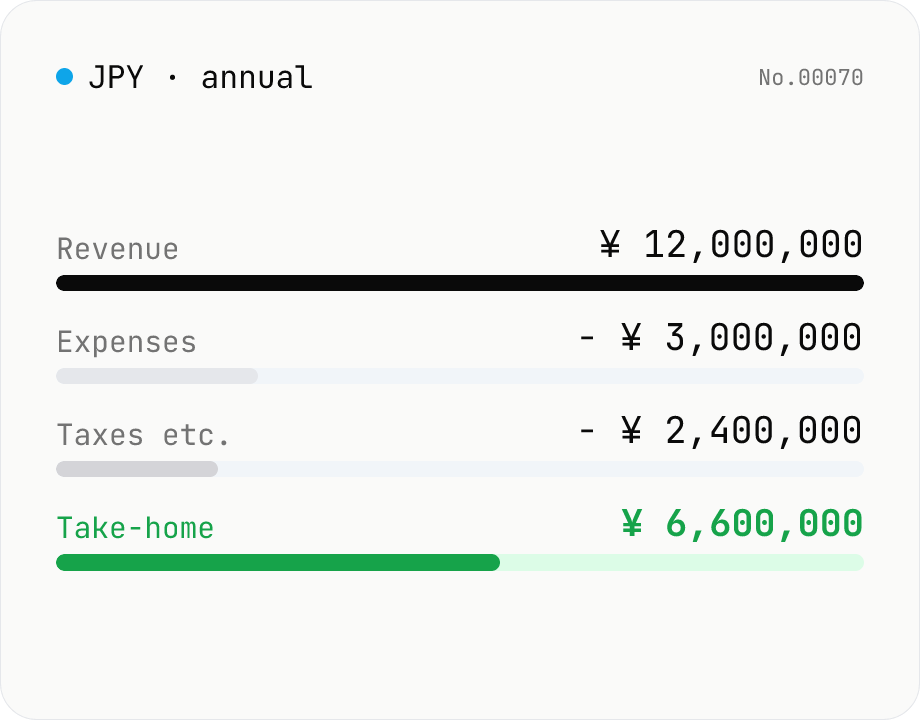
Japan Freelance Tax Calculator — Income, Resident, Health, Business Tax
Free online Japan freelance / sole-proprietor tax calculator. Annual estimator covering income tax, resident tax, consumption tax, national health insurance, business tax, and furusato-nozei cap. Useful for kojin jigyō nushi planning their year-end provisional tax. Runs entirely in your browser — figures never leave your device.
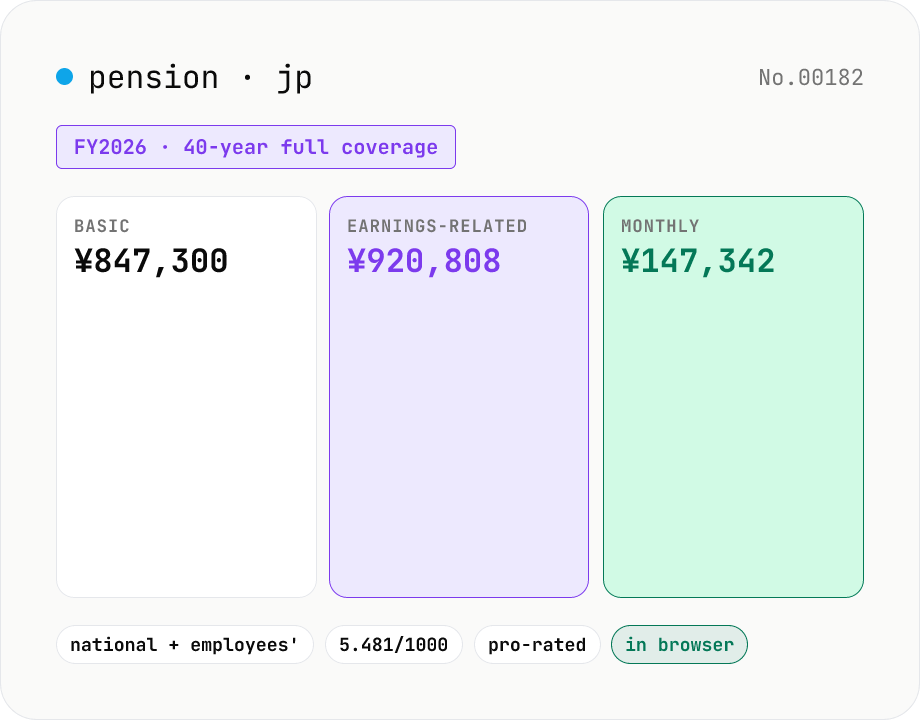
Japan pension estimator — basic + earnings-related (FY2026 figures)
Enter your accumulated months in the National Pension and the Employees' Pension, plus your average standard remuneration during the employees' pension period, to estimate the annual / monthly public pension you'll receive in retirement. Uses the FY2026 (令和 8 年度) full basic-pension figure of JPY 847,300/year (JPY 70,608/month) and the 5.481/1000 earnings-related multiplier (Heisei-15-and-later formula). Pro-rates by contributing months so partial careers (20–60 years of age, 25 / 30 / 35 years of coverage) work too. Runs entirely in your browser — salary figures never leave the device.
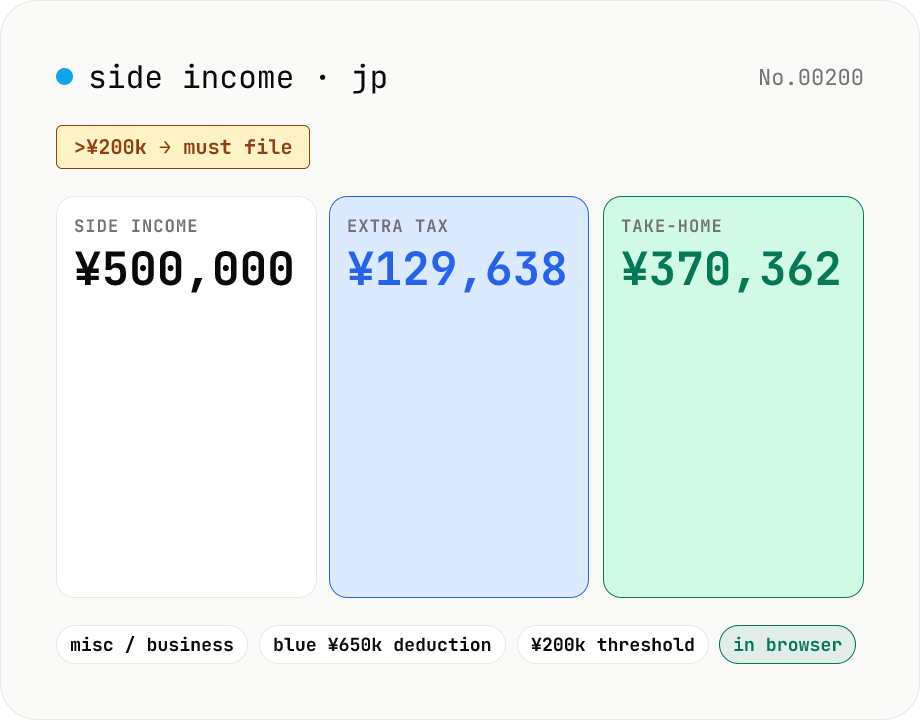
Japan side-income tax estimator — the 200k-yen filing threshold
Plug in your salary, side-job revenue and expenses to estimate the extra income tax, reconstruction surtax and resident tax — plus net take-home — that the side gig adds on top of a salaried job. Detects the JPY 200,000/year filing threshold (no income tax under it, but resident tax filing is still required). Switch between miscellaneous and business income; business + blue-return adds the JPY 650,000 deduction. Runs entirely in your browser — figures never leave the device.
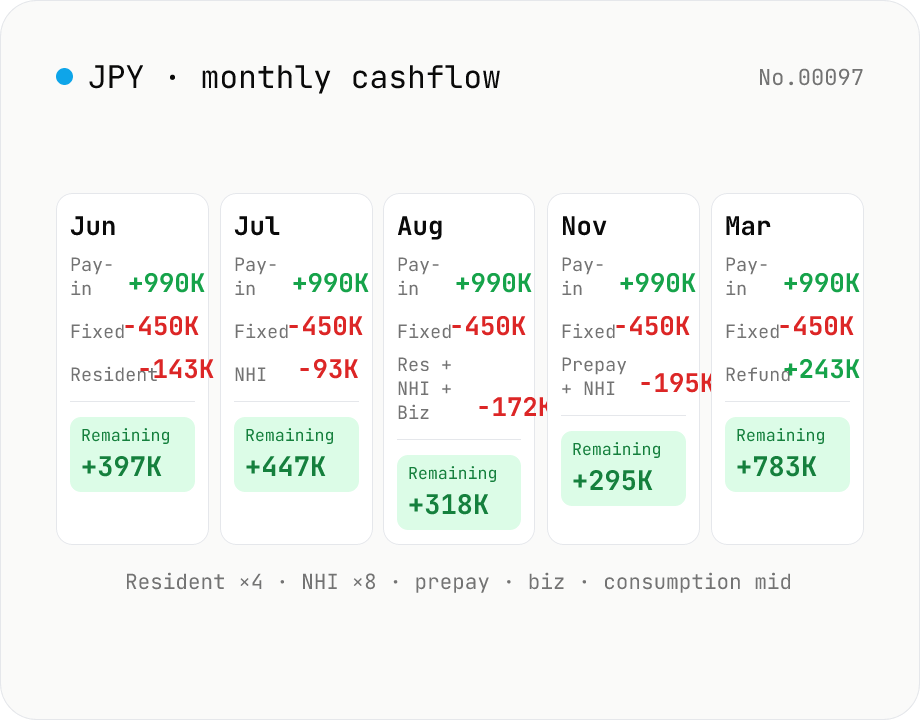
JP freelancer tax & cash-left simulator — monthly cashflow
Lays out monthly income, expenses, fixed costs, and every tax due date (income tax prepayments, resident tax 4 instalments, NHI 8 instalments, business tax, consumption tax mid-year) on a per-month calendar for Japanese sole proprietors. Shows how much you can put toward investments or savings each month, refunds included. Runs entirely in your browser.