
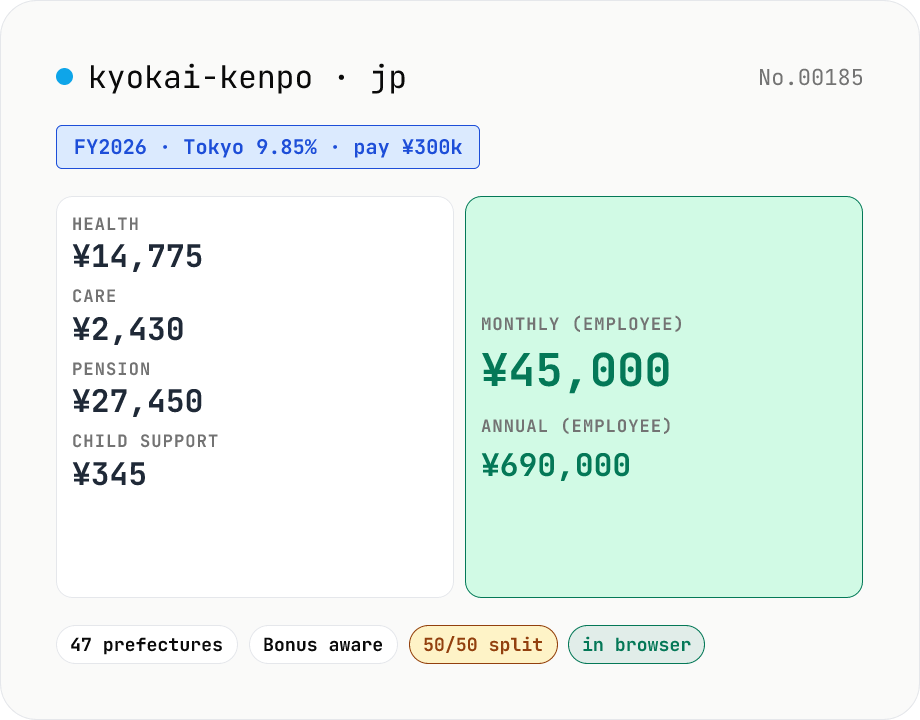
JP Kyokai-kenpo social-insurance simulator — prefecture-level + bonus
Estimate Japan's Kyokai-kenpo (national health insurance association) health + long-term care + welfare pension + the new FY2026 child-care support levy from monthly pay and bonuses, split 50/50. Covers all 47 prefecture rates and both 50-tier health / 32-tier pension grade tables. Runs entirely in your browser.
How to use
Pick a prefecture, enter monthly pay (gross) and bonus (per payout + payouts/year). Toggle 'age 40-64 (care)', 'pension eligible (under 70)', and 'child-care support' (auto-ON, applies to April 2026 onward). Click Estimate premium to see four categories (health / care / pension / child-support) for both monthly and per-bonus, with Full / Employee / Employer columns. Annual totals at the bottom.
In depth
Health insurance and pension calculations expose salary and employment profile
The Kyokai-kenpo premium calculation requires monthly pay, bonus amount, age bracket (for nursing-care), and prefecture. Monthly pay plus bonus reconstructs annual gross salary. Age bracket reveals whether the employee is in the nursing-care premium zone (40–64). Prefecture signals which regional branch of Kyokai-kenpo the employer uses — and implicitly, that the employer is not a large corporation with its own health-insurance union.
Taken together, these inputs constitute an employment and income profile: approximate annual salary, age range, and insurance tier. Financial institutions and insurers use exactly this kind of profile for product targeting, and tools that send it to a server create an exposure that has no technical justification.
Why a payroll deduction check should not need a server
Computing standard remuneration grade → premium = grade × rate × 1/2 is table lookup followed by multiplication. All the data needed — the 50-tier health insurance table, the 32-tier pension table, and the prefecture-by-prefecture rate table — are static, published publicly by MHLW, and small enough to embed directly in a browser page.
This tool bundles every prefecture’s FY2026 Kyokai-kenpo rate alongside the care-insurance (1.62%), pension (18.3%), and child-care support (0.23%) rates into the page itself. Nothing is fetched from a server during calculation. Check the DevTools Network tab to confirm.
47-prefecture rate table, embedded in browser
Rates range from Niigata at 9.21% to Saga at 10.55% for FY2026 (the first national average cut in 34 years, from 10.0% to 9.9%). The tool maps your prefecture selection to the correct rate, applies the standard remuneration grade table to your monthly pay (rounded to the nearest grade), and separately applies the bonus premium calculation (annual health-cap ¥5.73M, pension per-bonus cap ¥1.5M). All three output columns — full / employee half / employer half — update live with no network call.
Cross-checking your payslip after the September grade revision
The most common reason for a payslip deduction to differ from this tool’s estimate is a grade mismatch: your standard remuneration grade is fixed at the September 定時決定 and may lag a pay raise or cut until the next annual reset or 随時改定. The second common cause is rounding: your employer may use floor rather than round-half-up for the employee half. Check the September and October payslips against this tool to identify the source of any discrepancy. For the post-employment switch to National Health Insurance, kokuho-hoken-jp handles that side; if you also have side income on top of salary, side-income-tax-jp covers the combined income-tax estimate — both stay browser-only.
Mid-year pay changes and the on-demand grade revision (随時改定)
When fixed monthly pay changes by enough to shift the standard remuneration grade by two or more levels, an employer must file a grade-change notice (月額変更届) with the Japan Pension Service (日本年金機構). The trigger is based on the average of three consecutive months of actual pay after the fixed-pay change — not a single month’s figure. Only changes to fixed compensation (base pay, fixed allowances) trigger this process; fluctuating components such as overtime or commissions alone do not.
Use this tool to compare your pre-raise and post-raise grade estimates side by side. If the grade shifts under these criteria, the new premium takes effect from the second month after the three-month assessment window closes. Knowing the upcoming premium change in advance is useful for household budget planning after a job change or promotion.
The child-care support levy added in April 2026 (令和8年度)
Starting with April 2026 premiums, a new child-care and child-rearing support levy (子ども・子育て支援金) at 0.23% was introduced, split equally between employee and employer. It is collected alongside Kyokai-kenpo health insurance but is a separate line item on payslips (see こども家庭庁 official guidance). For a standard remuneration of 300,000 JPY, the employee share is approximately 345 JPY per month (300,000 x 0.23% / 2).
The health-insurance rate cut from 10.0% to 9.9% in the same period partially offsets the new levy for most employees, so the net effect on take-home pay is typically small. This tool enables the child-care support calculation by default, reflecting current FY2026 rates. Toggle it off to model the pre-April 2026 premium structure for historical reference.
FAQ
- How does it differ from kokuho-hoken-jp?
- kokuho-hoken-jp targets the National Health Insurance program for freelancers and self-employed (per household). This tool targets Kyokai-kenpo, the national health-insurance association for company employees (per individual, split 50/50 with employer). Health-insurance unions used by large corporations have their own rates and are out of scope.
- What changed in FY2026?
- Average health rate: 10.0% → 9.9% (first drop in 34 years), with 40 prefectures cut and 7 held (none raised). Care rate: 1.59% → 1.62%. Pension: locked at 18.3% (since Sep 2017). New: child-care support 0.23% from April 2026 (split 50/50). Highest: Saga 10.55%; lowest: Niigata 9.21%.
- How is the standard remuneration grade decided?
- Monthly gross (incl. commuting allowance) is mapped to a grade: 50 tiers (¥58k to ¥1.39M) for health, 32 tiers (¥88k to ¥650k) for pension. Example: ¥300k pay → health grade 22 / pension grade 19 (both standard ¥300k). Grade is reset once a year in September (定時決定) plus when pay shifts significantly (随時改定).
- How do bonus caps work?
- Health: ¥5.73M/year accumulated. Pension: ¥1.5M per single bonus. The tool approximates the yearly cap as ¥5.73M ÷ payouts/year (= ¥2.865M per bonus if twice a year). Above the cap is excluded from premium calc.
- Half-yen rounding?
- Strictly: ≤50 sen rounds down, >50 sen rounds up. Payroll software / company policy varies (some round full÷2 with banker's rounding, some apply employee-side floor). The tool uses 'round(full ÷ 2)', matching the official table. Real payroll may differ by ¥1.
- Why is welfare pension 18.3%?
- The 2004 pension reform set a glide path: +0.354pt per year, terminating at 18.3% in September 2017. Locked since. Split 50/50 means each side pays 9.15%.
- What about ages 70 and 75?
- Welfare pension: removed from the month after turning 70 — switch off 'pension eligible'. Health: 70-74 still enrolled. At 75 you leave Kyokai-kenpo for the late-elder medical system (not covered here).
- Which prefecture: workplace or residence?
- The workplace (the business location enrolled with that branch). Not your home address. A single company can mix rates across branches (e.g. Tokyo HQ + Osaka office).
- Is unemployment insurance included?
- No. Unemployment insurance (雇用保険) is a separate program with separate rates (FY2025: general 0.9% / construction 1.05%, with a 7:7 or 11:11.5 split). This tool focuses on social insurance only (health + pension).
- Is my input uploaded?
- No. Pay, bonus, age, and prefecture all stay in your browser.
How to verify nothing is uploaded
This tool never sends your input outside your browser. The pages below explain how it works, how to audit it, and how the site is run.
Related tools
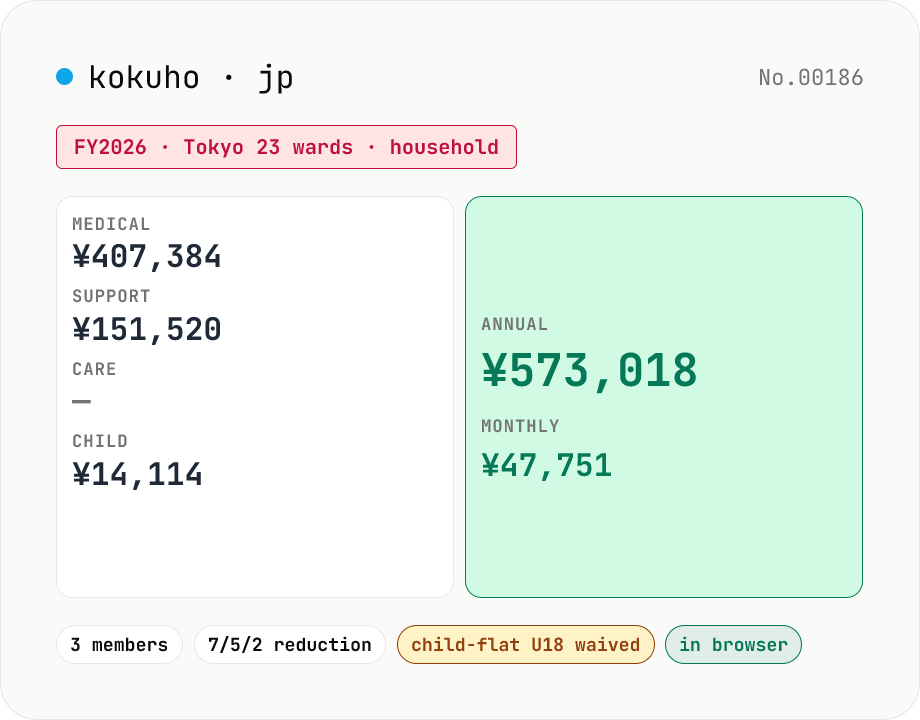
JP National Health Insurance simulator — household + reductions
Estimate Japan's National Health Insurance (kokuho) premium for FY2026 across the 4 categories (medical / support / care / child-care). Auto-applies 7/5/2 reductions and pre-school / under-18 carve-outs. Tokyo 23-ward preset + custom municipal rates. Runs entirely in your browser.
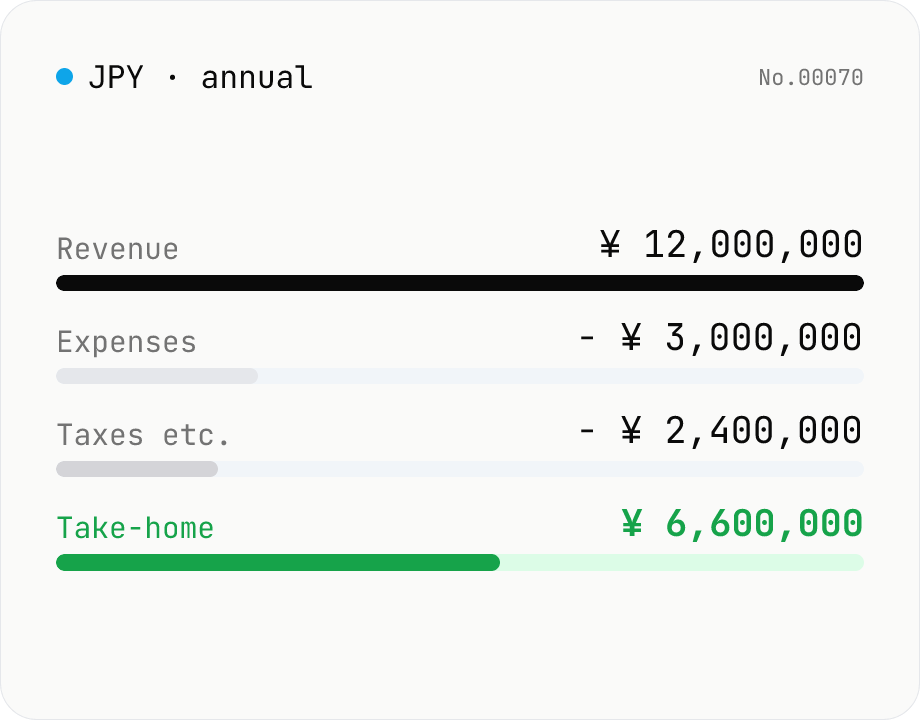
Japan Freelance Tax Calculator — Income, Resident, Health, Business Tax
Free online Japan freelance / sole-proprietor tax calculator. Annual estimator covering income tax, resident tax, consumption tax, national health insurance, business tax, and furusato-nozei cap. Useful for kojin jigyō nushi planning their year-end provisional tax. Runs entirely in your browser — figures never leave your device.
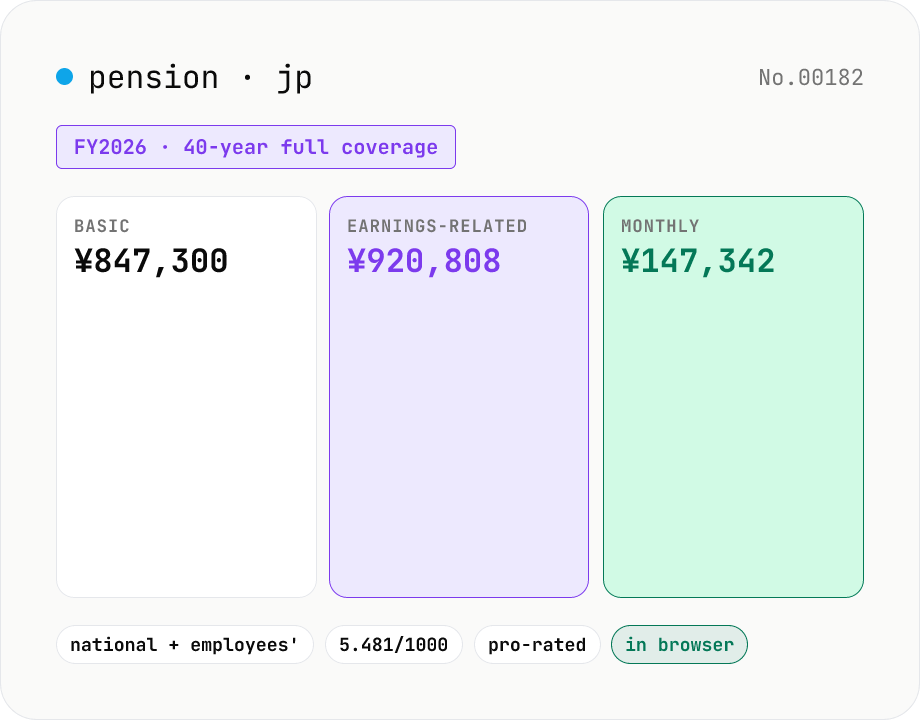
Japan pension estimator — basic + earnings-related (FY2026 figures)
Enter your accumulated months in the National Pension and the Employees' Pension, plus your average standard remuneration during the employees' pension period, to estimate the annual / monthly public pension you'll receive in retirement. Uses the FY2026 (令和 8 年度) full basic-pension figure of JPY 847,300/year (JPY 70,608/month) and the 5.481/1000 earnings-related multiplier (Heisei-15-and-later formula). Pro-rates by contributing months so partial careers (20–60 years of age, 25 / 30 / 35 years of coverage) work too. Runs entirely in your browser — salary figures never leave the device.
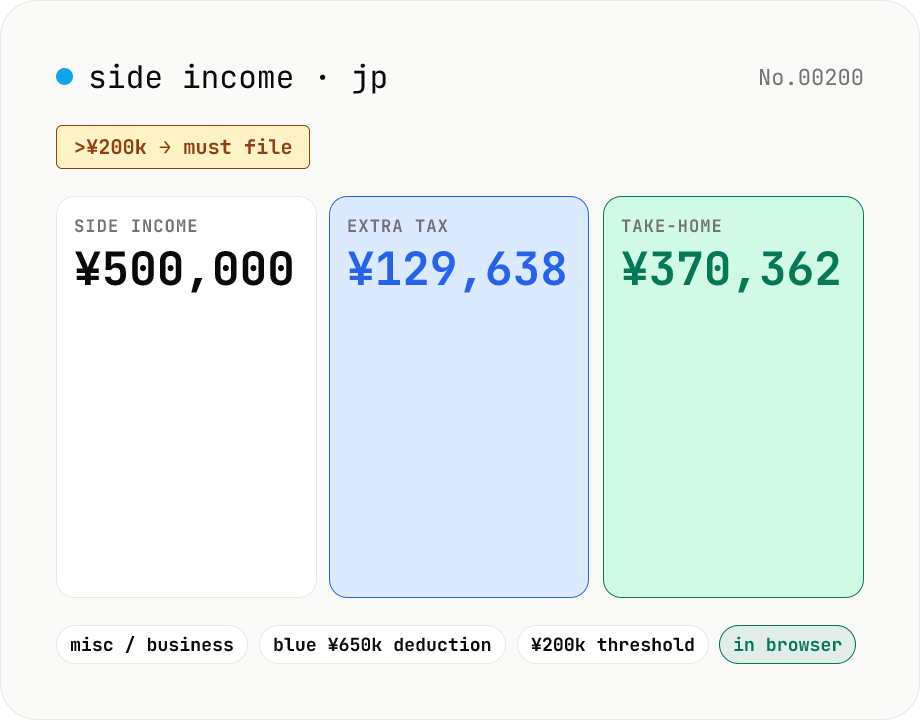
Japan side-income tax estimator — the 200k-yen filing threshold
Plug in your salary, side-job revenue and expenses to estimate the extra income tax, reconstruction surtax and resident tax — plus net take-home — that the side gig adds on top of a salaried job. Detects the JPY 200,000/year filing threshold (no income tax under it, but resident tax filing is still required). Switch between miscellaneous and business income; business + blue-return adds the JPY 650,000 deduction. Runs entirely in your browser — figures never leave the device.