
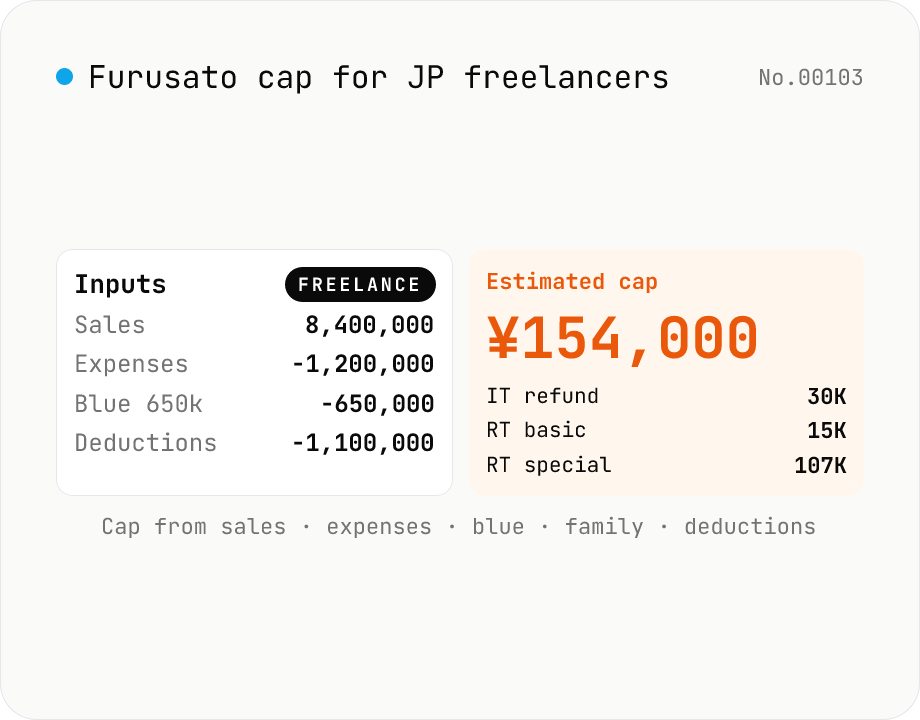
Furusato-nozei limit for JP sole proprietors — from sales, expenses, deductions
Furusato-nozei (hometown tax) cap calculator for Japanese sole proprietors and freelancers. Enter annual sales, business expenses, blue-return deduction, family composition, and other deductions to see the donation amount where your out-of-pocket stays at the standard ¥2,000. Shows the income-tax refund, resident-tax basic, and resident-tax special breakdown. Runs entirely in your browser. Salaried workers should use furusato-calc instead.
How to use
Pick family composition (single / spouse — general / spouse — special). Spouse deduction is applied automatically; do not include it in the other-deductions total. Pick the blue-return deduction tier: 650k if you e-file + keep electronic ledgers, 550k otherwise, or none for white return. Enter annual sales (tax-exclusive), expenses, and the other-deductions total (excluding basic and spouse). Click Calculate to see the furusato-nozei cap and, for a donation at that cap, the income-tax refund + resident-tax basic + resident-tax special breakdown.
In depth
Why sole-proprietor furusato-nozei data is especially sensitive
This tool’s inputs — annual sales, business expenses, blue-return deduction tier, other deductions total, and family structure — collectively describe a freelancer’s financial position in detail. The combination of sales and expenses reveals net profit margin. The blue-return deduction tier (¥650k vs ¥550k) signals whether the business uses double-entry bookkeeping and e-Tax filing — a proxy for financial discipline. Family structure affects disposable income.
Furusato-nozei portal simulators built for sole proprietors have the same commercial incentive as salaried-worker simulators: capturing high-intent donors who are about to spend money. The business-income inputs are richer data, which makes them more commercially valuable and more worth protecting.
Business income figures and the risk of server-side processing
Annual sales and expenses are the figures a bank or investor would request first when evaluating a sole proprietorship. Submitting them to a web service connects them to a session that may be associated with your browser fingerprint, email address, or loyalty account. Even aggregated ‘usage statistics’ can carry the distribution of revenue ranges across a platform’s freelance user base — information with commercial applications.
The calculation needed here involves only arithmetic and table lookups on public tax data. No server is required. This tool performs every step inside your browser tab.
Business-income cap formula, running entirely in browser
The furusato-nozei cap is (resident-tax income levy × 0.2) / (1 − 0.1 − marginal rate × 1.021) + ¥2,000. Business income is computed as sales − expenses − blue-return deduction. The resident-tax income levy is (business income − basic deduction ¥430k) × 10%. The marginal income-tax rate is looked up from the progressive table after applying the basic deduction and spouse deduction in JavaScript. All steps run locally; the Network tab stays silent after page load.
The × 1.021 factor on the income-tax refund reflects the 2.1% reconstruction surtax applied on top of the base income tax — a detail that matters for accurate refund estimation.
Timing your donation decision against your actual income
Freelance income is variable, so the cap calculated mid-year is based on a projection, not a confirmed figure. For the most accurate cap, run this tool after the year-end close when you know your full-year revenue and expenses. If you have side or miscellaneous income in addition to business income, the combined total affects the resident-tax income levy and the marginal rate — use freelance-tax-jp to model the combined income first, then bring the resulting deduction figures here. Salaried workers without business income should use furusato-calc instead — both stay browser-only.
How blue-return tier choice (JPY 650k / 550k / 100k) affects the cap
Business income is revenue − expenses − blue-return deduction, so the chosen tier directly affects the cap. The JPY 650k tier requires double-entry bookkeeping, attached balance sheet and income statement, and e-Tax electronic filing (or electronic ledger storage) — all three (source: NTA Tax Answer No.2072). Without electronic filing the tier drops to JPY 550k. The JPY 100k tier is open to single-entry bookkeeping as long as the blue-return application was filed (within two months of opening, or by March 15 for an existing business). White returns get no special deduction.
A practical example: a sole proprietor with JPY 6M revenue and JPY 2M expenses. JPY 650k blue-return = business income JPY 3.35M → cap roughly JPY 44k. JPY 550k blue-return = JPY 3.45M → JPY 45k. JPY 100k blue-return = JPY 3.9M → JPY 55k. White return = JPY 4M → JPY 58k (no spouse, no dependants, FY2026 special basic deduction applied, approximate figures). Counter-intuitively, the cap is higher with a smaller deduction because the higher business income produces a higher resident-tax income levy and pushes the marginal rate up. But the income-tax and resident-tax themselves are also higher under white returns, so the realised tax savings from furusato-nozei are larger under the blue return — the cap difference is not a real benefit, just a redistribution.
Stacking NHI premiums, iDeCo, and other deductions to compute the final cap
Sole proprietors stack several income deductions: social insurance premiums (full amount of NHI and National Pension contributions), small-enterprise mutual-aid premium deduction (iDeCo + 小規模企業共済 + 心身障害者扶養共済), life insurance premium deduction (up to JPY 120k), and the medical expense deduction. Each one reduces taxable income, which proportionally reduces the resident-tax income levy and therefore the cap.
A concrete case: business income JPY 4M, NHI JPY 300k, National Pension JPY 198k, monthly iDeCo JPY 68k (annual JPY 816k). Social insurance deduction (498k) + small-enterprise mutual-aid (816k) = JPY 1.314M of additional deductions. Taxable income falls to roughly 4M − 1.314M − 600k (FY2026 special basic deduction) = JPY 2.086M. Resident-tax income levy ≈ JPY 170k (10% flat rate), cap drops to about JPY 34k. The ‘other income deductions’ field in this tool is where you enter the total of these stacked deductions. The blue-return income statement (青色申告決算書) shows social insurance, mutual-aid, and life insurance deduction totals — copy the combined figure into the field. Missing deductions overstates the cap, and donating above the actual ceiling turns the excess into pure out-of-pocket expense.
FAQ
- I'm a salaried worker — which tool should I use?
- Use ‘furusato-calc’ (annual gross salary input). This tool is for sole proprietors / freelancers — its inputs are sales / expenses / blue-return.
- I have side or miscellaneous income too.
- This tool treats business income as your total income (simple mode). To combine multiple income types, use freelance-tax-jp.
- What goes into the deductions total?
- Social-insurance, shokibo / iDeCo, life insurance, earthquake insurance, dependents, medical expenses, other donations etc. — everything except the basic and spouse deductions which this tool computes automatically.
- Requirements for the 650k blue-return tier?
- (1) Approved blue-return application on file, (2) double-entry bookkeeping, (3) balance sheet + P/L attached to the return, (4) e-Tax filing OR ‘qualified’ electronic ledger keeping. Otherwise it's the 550k tier.
- Is anything I enter uploaded?
- No. Calculation runs in your browser and inputs are saved in localStorage so they restore next time.
- Why × 1.021 on the income-tax refund?
- Furusato-nozei's income-tax deduction is (donation − 2,000) × marginal rate, plus the 2.1% reconstruction surtax. The tool includes the surtax in the refund figure.
How to verify nothing is uploaded
This tool never sends your input outside your browser. The pages below explain how it works, how to audit it, and how the site is run.
Related tools
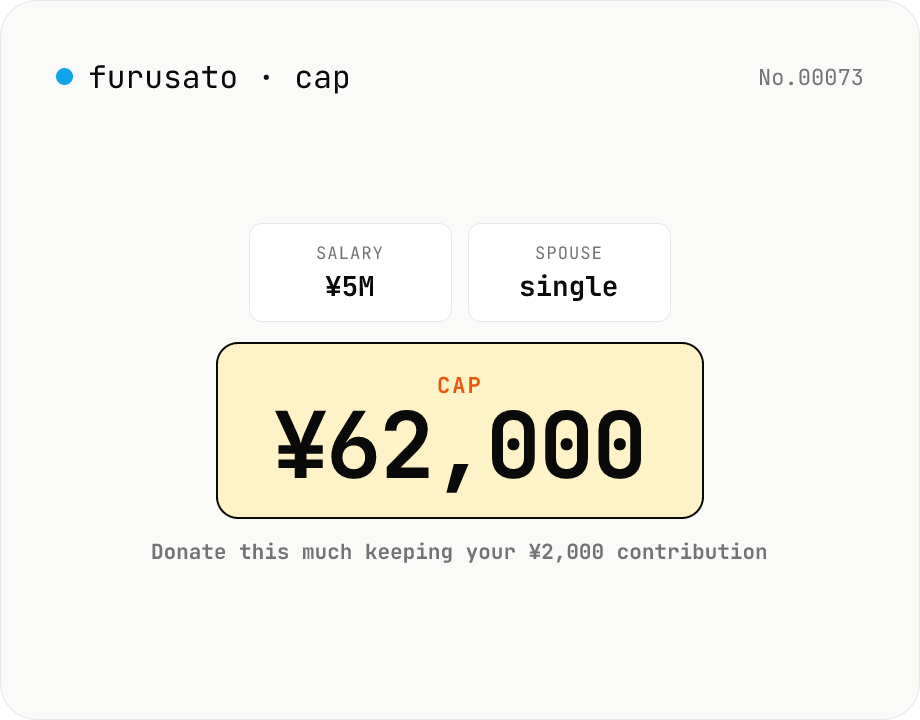
Furusato-nozei limit calculator — donation cap by salary & family
Estimate the furusato-nozei cap (the donation amount where your own contribution stays at the standard ¥2,000) from annual gross salary, family composition, and social-insurance premium. Shows the income-tax and resident-tax deduction breakdown. Runs entirely in your browser. For sole proprietors, use the freelance-tax-jp tool instead.
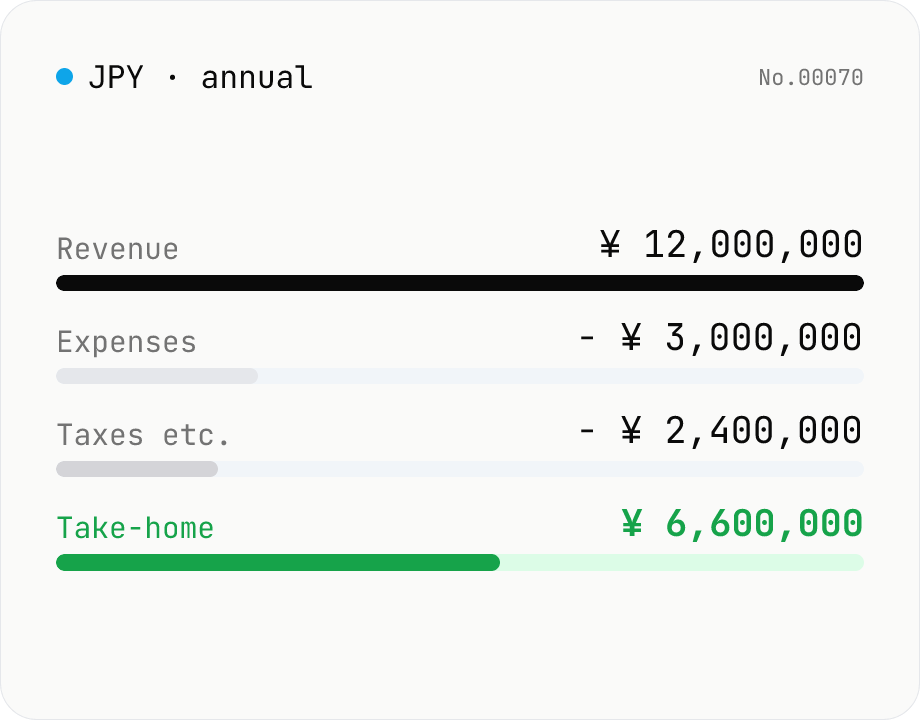
Japan Freelance Tax Calculator — Income, Resident, Health, Business Tax
Free online Japan freelance / sole-proprietor tax calculator. Annual estimator covering income tax, resident tax, consumption tax, national health insurance, business tax, and furusato-nozei cap. Useful for kojin jigyō nushi planning their year-end provisional tax. Runs entirely in your browser — figures never leave your device.
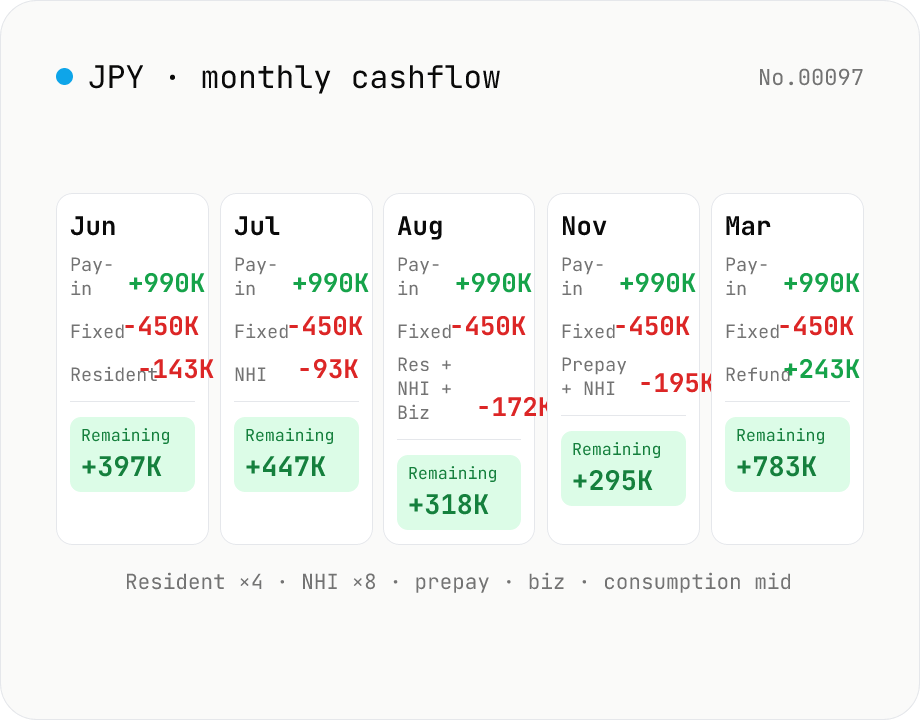
JP freelancer tax & cash-left simulator — monthly cashflow
Lays out monthly income, expenses, fixed costs, and every tax due date (income tax prepayments, resident tax 4 instalments, NHI 8 instalments, business tax, consumption tax mid-year) on a per-month calendar for Japanese sole proprietors. Shows how much you can put toward investments or savings each month, refunds included. Runs entirely in your browser.
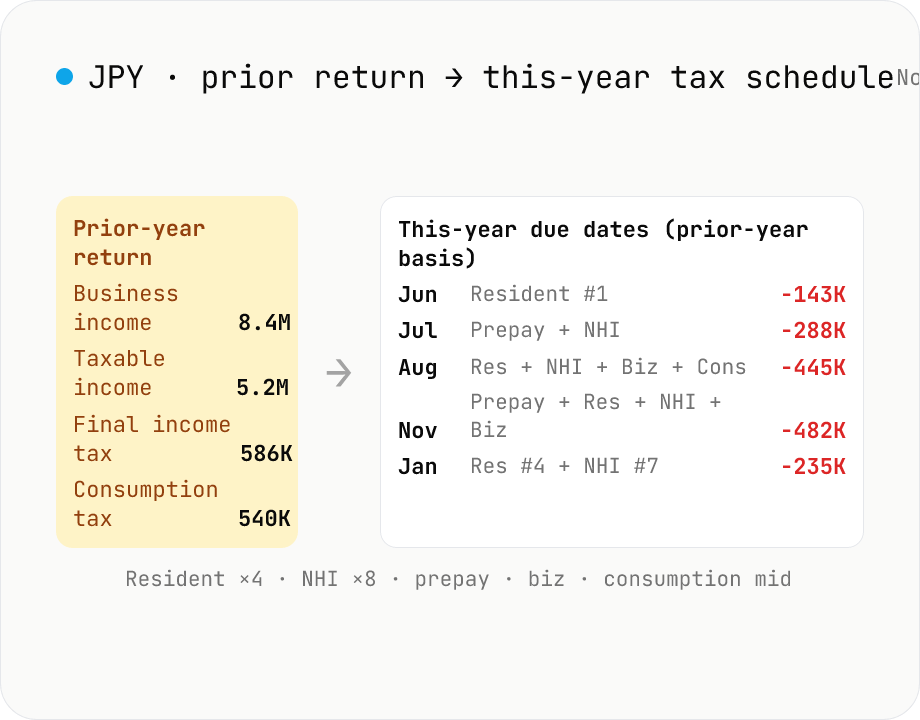
JP freelancer this-year tax schedule (from prior return) — monthly cashflow
Builds a per-month calendar of this year's tax due dates and amounts (resident 4×, NHI 8×, business tax, income-tax prepay 2×, consumption mid-year) directly from your prior-year return (business income, taxable income, final income tax, consumption tax). Add this year's income, expenses, and fixed costs to see how much cash is left each month. Runs entirely in your browser.