
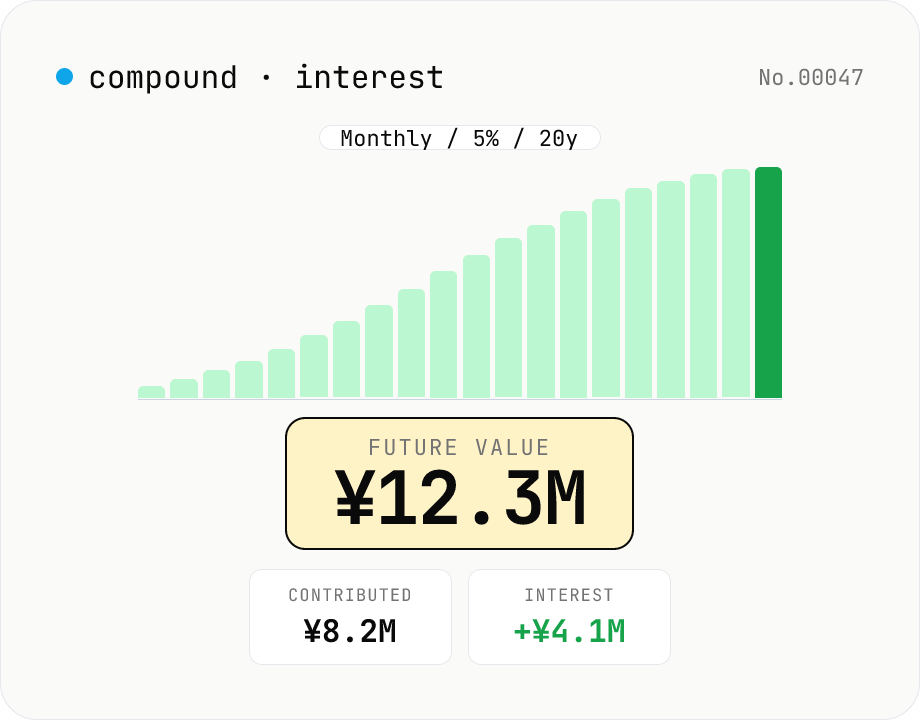
Compound interest calculator — lump-sum & monthly contribution
Project the future value of an investment compounded over time. Supports three modes: principal only, monthly contributions, or annual contributions. Great for simulating Tsumitate NISA / iDeCo / certificates of deposit. Year-by-year balances can be exported as CSV. Principal, rate, and term stay in your browser — nothing is uploaded.
How to use
Pick a contribution style (principal only, monthly, or annual), then enter the principal, annual rate, and term (and contribution amount for the contribution modes). Press Calculate to see the future value, total contributed, and interest earned. Toggle the yearly breakdown to inspect each year's balance, or download it as CSV. The Sample button fills in a typical Tsumitate NISA scenario (¥1M lump sum + ¥30K/month @ 5% / 20 years). All values stay on your device — nothing is uploaded.
FAQ
- Is the principal amount uploaded?
- No. Principal, rate, term, and contribution are all processed by JavaScript in your browser; nothing leaves your device. Safe for personal financial planning.
- What's the formula for monthly contributions?
- Principal: P × (1 + r)^n. Contribution part (ordinary annuity): PMT × ((1+i)^N − 1) / i, where i = r/12 and N = 12n. The future value is the sum of those two. Annual contributions are the same formula with i = r and N = n.
- Are contributions modeled as start-of-period or end-of-period?
- End of period (ordinary annuity). The result is slightly smaller than an annuity-due model, but matches the timing of most automatic monthly investments like Tsumitate NISA and iDeCo.
- What rate should I use?
- Common long-term references: ~7% for the S&P 500, 5–6% for global stocks, and 3–5% for Japanese stocks. Past performance is not a guarantee — try a conservative scenario at 3–4% and an optimistic one at 7–8%.
- Are taxes and fees included?
- No. We don't subtract capital gains tax (20.315% in Japan), trust fees, or trading costs. For tax-advantaged accounts (Tsumitate NISA, iDeCo) the future value is the take-home figure. For taxable accounts, approximate the take-home as principal + interest × (1 − 0.20315).
- Can I adjust for inflation?
- Not directly. Enter a 'real rate' (nominal rate − expected inflation, e.g. 5% − 2% = 3%) to see results in today's purchasing power.
Related tools
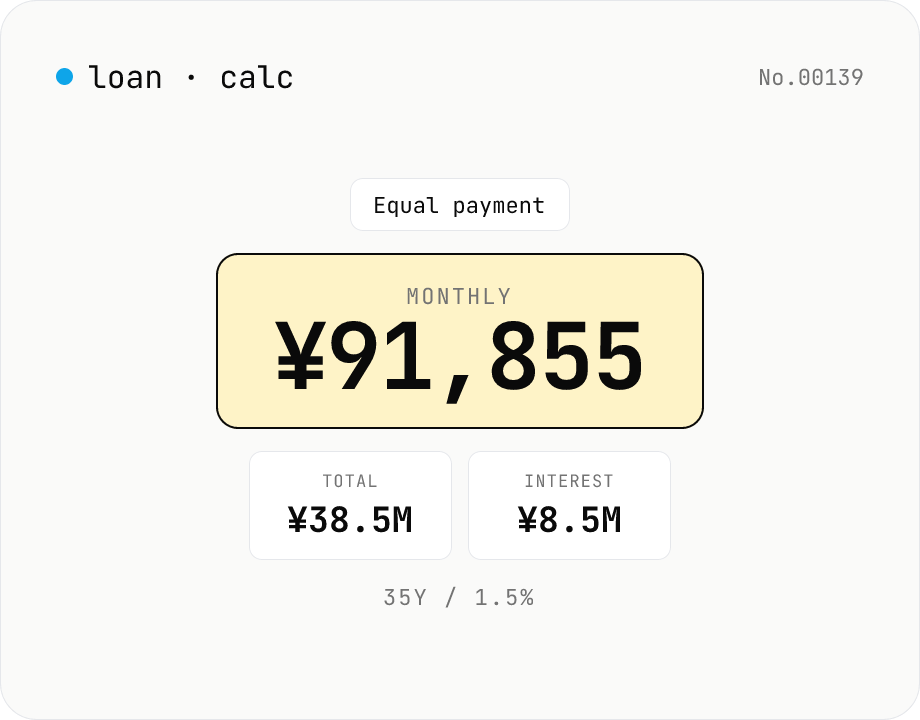
Loan repayment calculator — equal payment & equal principal table
Simulate mortgage, auto, and student-loan repayments under both equal-payment and equal-principal schedules. Enter principal, annual rate, and term to see the monthly payment, total interest, total paid, and a full amortization table. Everything runs in your browser — no loan or income data is uploaded.
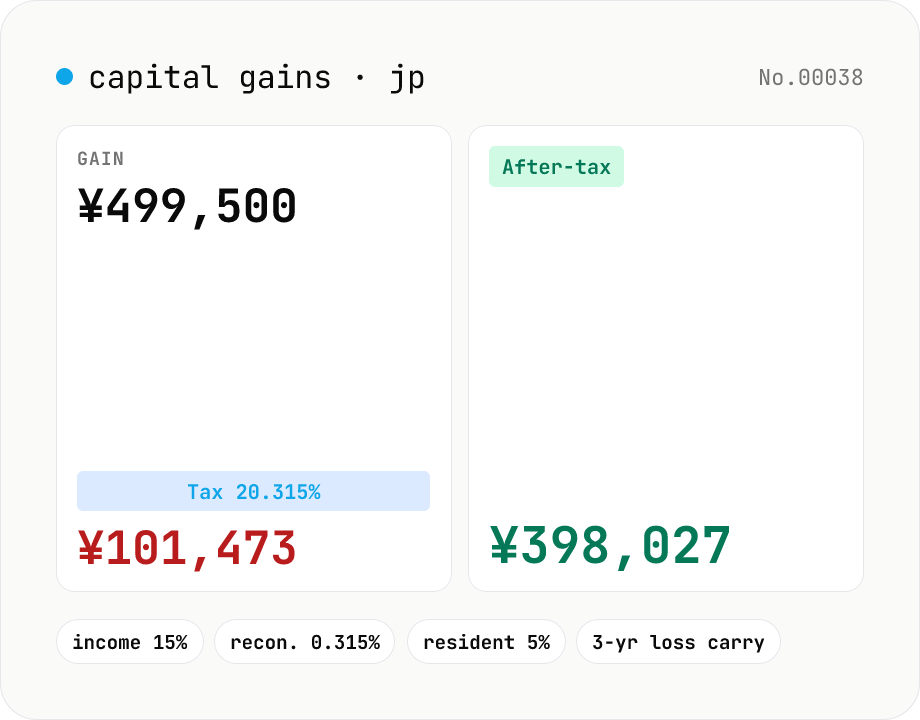
Japanese capital-gains tax (20.315%) — stock-sale net calculator
Estimate the 20.315% Japanese tax on listed-stock and mutual-fund capital gains (income tax 15% + 0.315% reconstruction surtax + 5% resident tax). Enter sale proceeds, acquisition cost (incl. buy-side fees) and sell-side expenses; the tool returns the gain, each tax line and the after-tax take-home. Losses display zero tax and a note about the 3-year carry-over deduction. Excludes NISA / iDeCo tax-free balances. Runs entirely in your browser — your figures never leave the device.
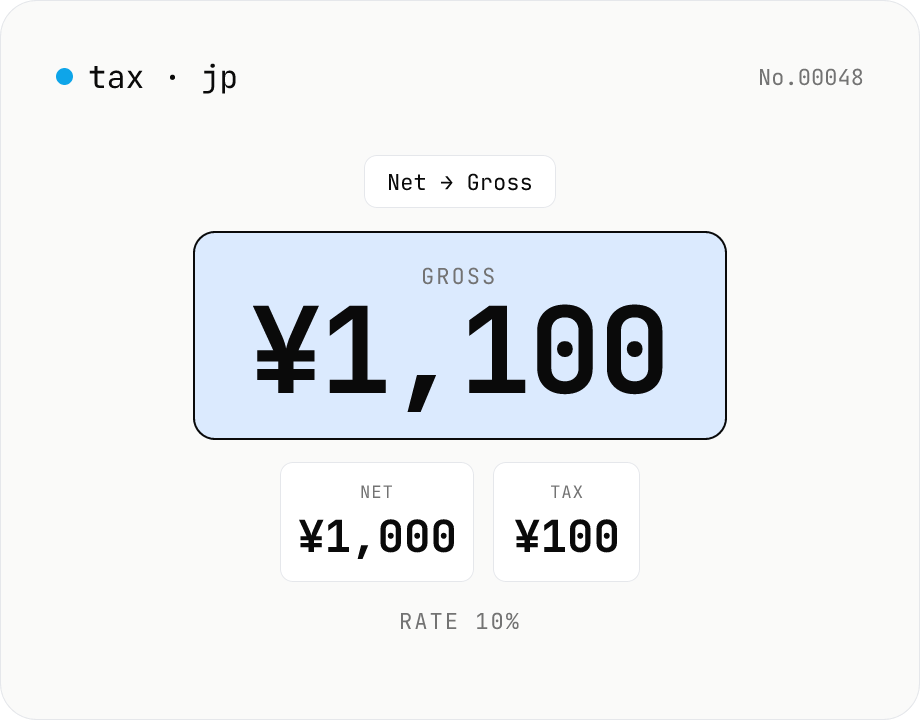
Japanese consumption tax calculator — net ⇄ gross at 10% / 8% rate
Convert Japanese consumption tax both ways (net→gross or gross→net) at 10% standard, 8% reduced, or a custom rate. Shows net, tax, and gross amounts together with selectable rounding (floor / round / ceiling). Runs entirely in your browser — no amounts are uploaded.
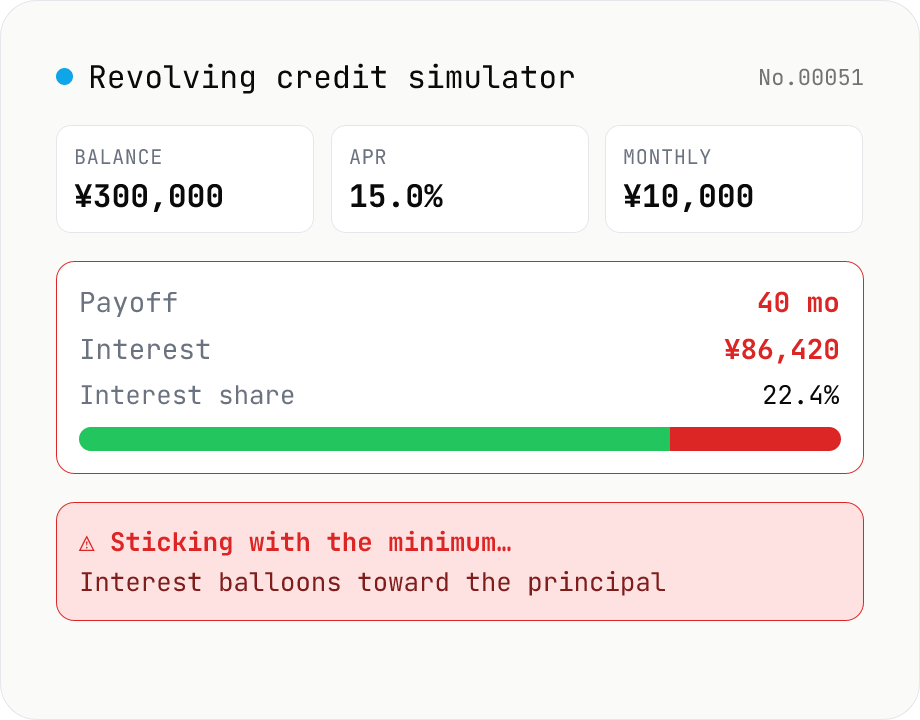
Credit-card revolving simulator — months to payoff, total interest
Simulate Japanese credit-card revolving (リボ払い) repayments month-by-month from the current balance, fixed monthly payment, and APR. Visualize months-to-payoff, total interest paid, and the principal vs interest split over time. Supports three Japanese-style methods: balance-slide (残高スライド), equal-payment (元利定額), and equal-principal (元金定額). Most card issuers charge 15.0–18.0% APR — keeping the minimum payment low usually grows the balance instead of paying it down, so the tool also lets you compare an extra-payment scenario. Nothing leaves your browser.