
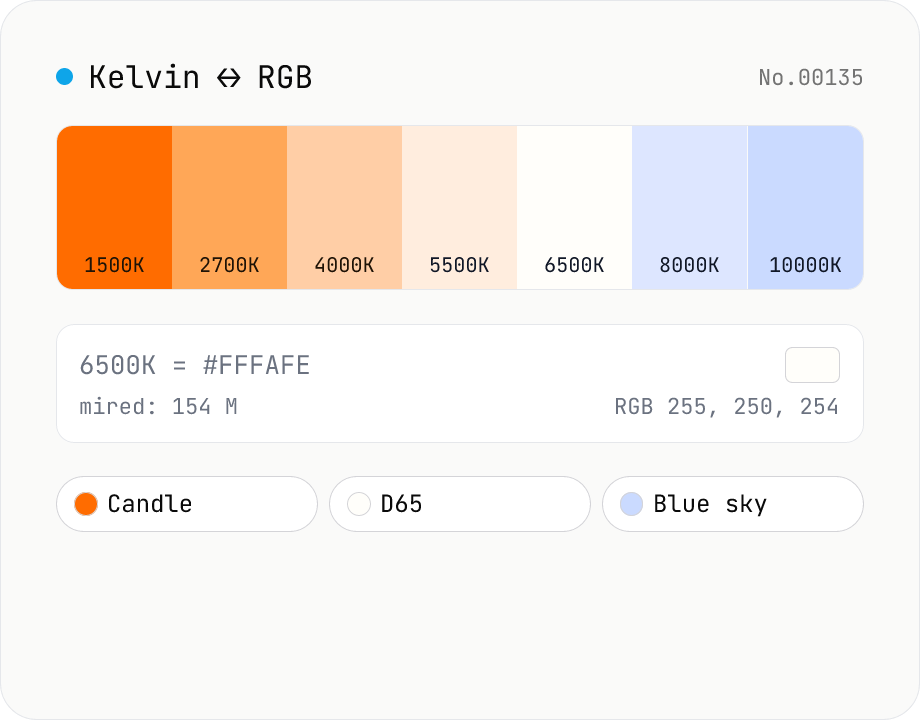
Color temperature (Kelvin) ↔ RGB / mired converter
Convert a color temperature (Kelvin, 1000K–40000K) into RGB / HEX / mired and inspect how a light source would render — ideal for white-balance, white-point, or interior-lighting workflows. Powered by Tanner Helland's sRGB approximation, with one-click presets for candlelight (1500K), tungsten (2700K), warm fluorescent (3000K), daylight 5000K, standard D65 (6500K), overcast (8000K), and blue sky (10000K). Mired (1,000,000 / K) and a coarse reverse lookup from RGB are also provided. Nothing leaves your browser.
How to use
Enter a Kelvin value and the tool renders an sRGB approximation (HEX + RGB) and the mired (M) equivalent. Drag the slider through 1000K–40000K or click a preset (Candle 1500K / Tungsten 2700K / Warm fluorescent 3000K / Daylight 5000K / D65 6500K / Overcast 8000K / Blue sky 10000K). The reverse direction takes a HEX or RGB sample and returns the closest matching color temperature (approximate). Real-world light is non-blackbody, so treat the output as a white-balance / mockup reference rather than a precise color match.
FAQ
- Which formula is used?
- Tanner Helland's blackbody fit (http://www.tannerhelland.com/4435/convert-temperature-rgb-algorithm-code/). It's the standard fast, browser-friendly approximation that works across 1000K–40000K in sRGB.
- What is mired?
- Reciprocal megakelvin — 1,000,000 / K. Photo filter packs (CTO / CTB) and white-balance offsets are usually specified in mired because the differences map linearly to perceived color shift. 5000K = 200M; 6500K ≈ 154M; 3000K ≈ 333M.
- Why does the on-screen color sometimes look different from the real light?
- Real light sources (LEDs, tungsten, fluorescent) aren't ideal blackbodies — their CRI and green/magenta tints aren't captured by this approximation. For pro work, measure with a color meter.
- Is the reverse (RGB → Kelvin) lookup accurate?
- Approximate. The forward curve isn't bijective so multiple HEX values can map to similar Kelvin temperatures. The tool sweeps the whole range at a 5 K granularity and reports the closest match — fine for ballpark white-balance work, not for tight color matching.
- What range does it cover?
- 1000K (warm, near candlelight) to 40000K (extreme blue sky / UV-leaning). Values outside the range are clamped. Photographic and interior work usually lives between 2000K and 10000K.
- Is my input sent anywhere?
- No. All conversions run in browser JavaScript; inputs and outputs never leave the page.
Related tools
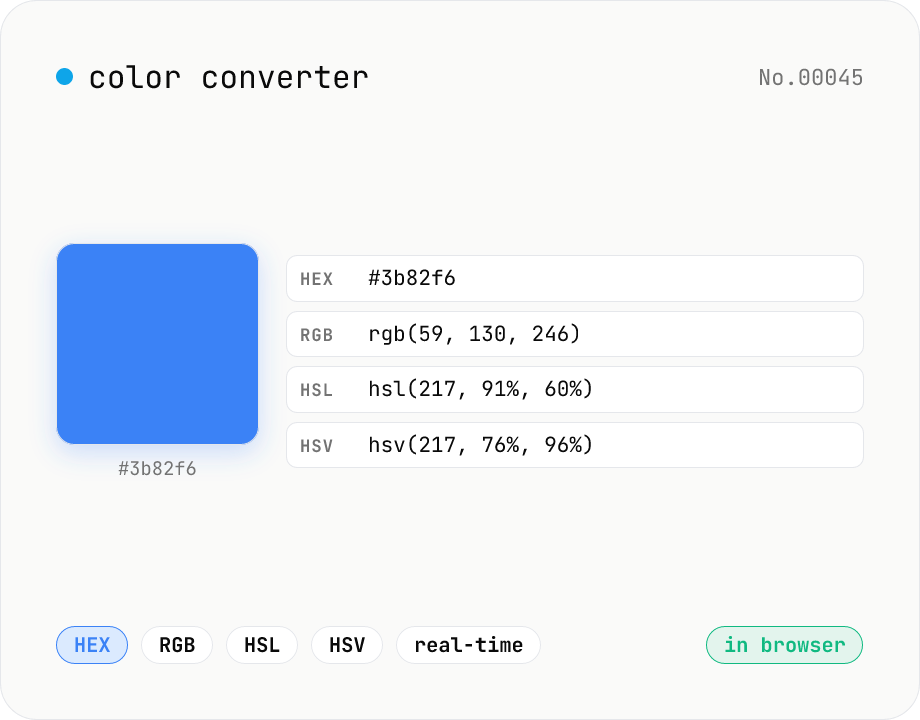
Color converter — HEX / RGB / HSL / HSV
Convert colors between HEX, RGB, HSL, and HSV in real time with a built-in color picker. Edit any field and the other three update instantly. Runs entirely in your browser — your color values never leave the page.
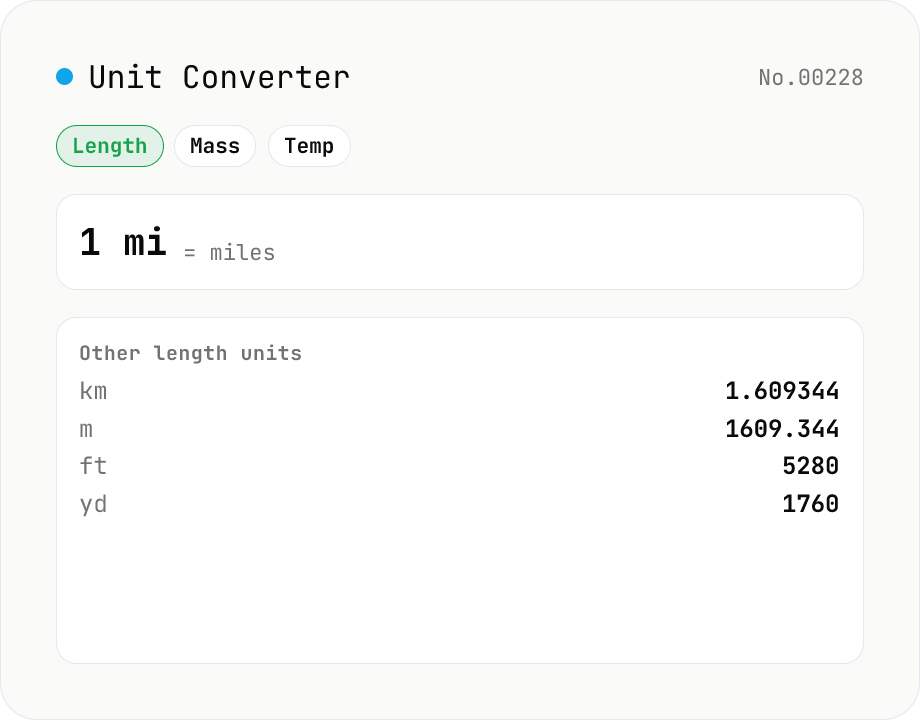
Unit Converter
Convert between length, weight, temperature, volume, area, speed, data size, and time units. Enter one value and see equivalents in every supported unit at once. Runs entirely in your browser — no uploads.
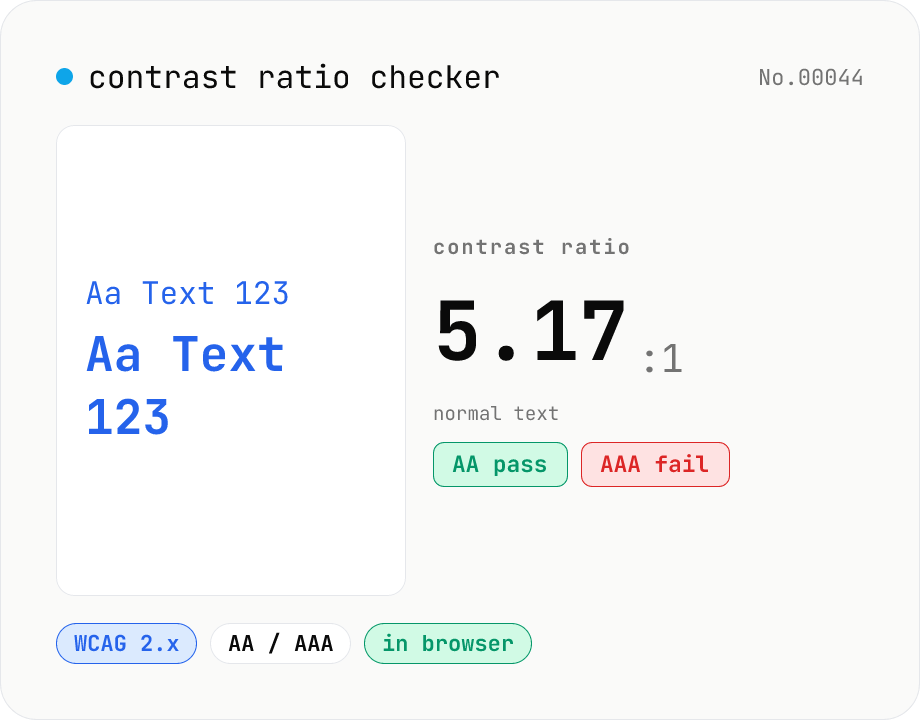
Contrast ratio checker — WCAG AA / AAA
Pick a foreground (text) and background color to compute the WCAG 2.x contrast ratio and instantly see whether it passes AA / AAA for normal text, large text, and UI components. Accepts HEX and rgb(), with a color picker and live preview. Everything runs in your browser — your colors never leave the page.
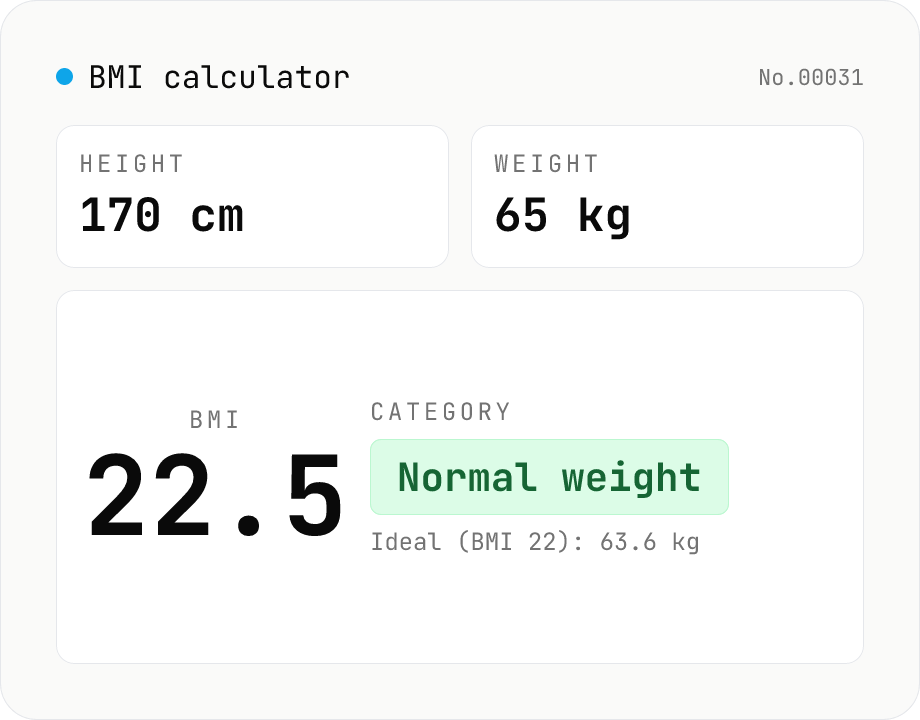
BMI calculator — with ideal weight and healthy range
Calculate your Body Mass Index from height and weight, with the classification under either the Japan Society for the Study of Obesity (JASSO) standard or the WHO standard. The result includes the ideal weight (BMI 22), the healthy weight range (BMI 18.5–25), and the difference from the ideal. Toggle the standard with a Mode, and the unit system between metric (cm / kg) and imperial (inch / lb) with an Option. Live computation as you type — everything stays inside your browser.