
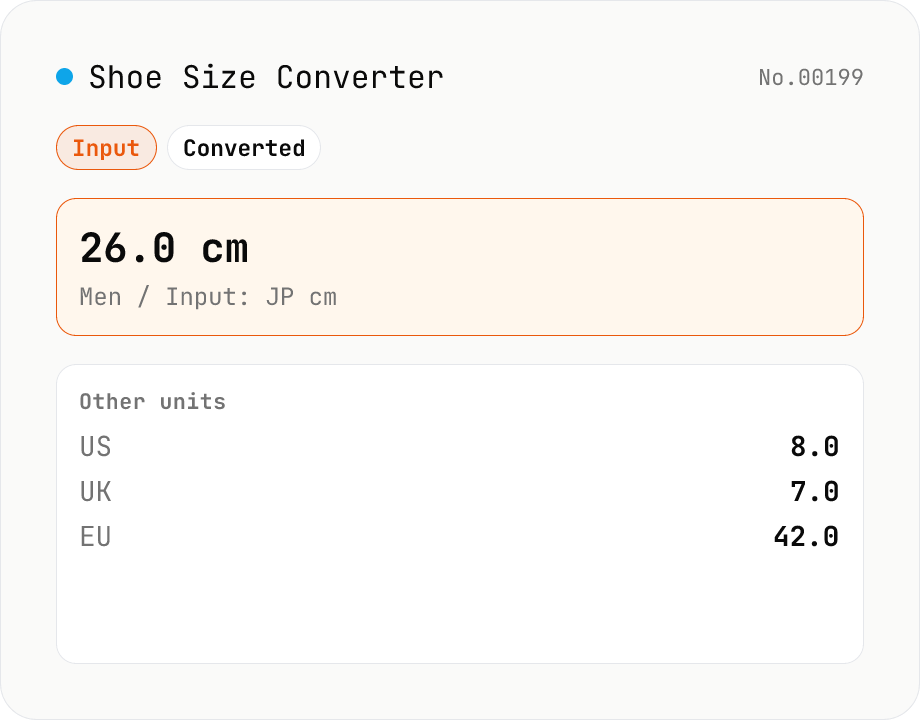
Shoe Size Converter (JP cm ⇄ US ⇄ UK ⇄ EU)
Convert shoe sizes between Japan (cm, Mondopoint), US, UK and EU. Handy when buying Nike, Adidas, New Balance, Vans, Dr. Martens or Birkenstock from overseas shops, or sanity-checking a gift bought abroad. Choose Men / Women / Kids with the radio buttons — the conversion table follows the Brannock device and major brand charts, but individual brands vary by ~0.5 sizes, so always double-check with the maker's own chart for a critical fit. Runs entirely in your browser — no uploads.
How to use
1) Pick the audience radio (Men / Women / Kids) — each uses a different chart. 2) Pick the input unit (JP cm / US / UK / EU) and type a size value. 3) The other three units appear in the table instantly. Use the Copy button on any row to grab a single value. There is no run button; everything is live.
FAQ
- Why is JP cm the canonical unit?
- Japanese sizing is the Mondopoint system (foot length in cm), which is also the basis of ISO/TS 19407. Even US/UK Brannock devices ultimately measure in mm, so we normalise to JP cm first and derive the other regions from there.
- Why are US and UK sizes different?
- Both use the historical barleycorn (≈ 8.46 mm) step, but they start at different points. Roughly, US men ≈ UK + 1, so the same foot reads about one size larger in US. For women the offset is bigger (US ≈ UK + 2).
- How is the EU size calculated?
- The EU (Paris point) scale uses ≈ 6.67 mm per size and a typical formula (foot length cm + 1.5) × 3 / 2. We use a discrete chart aligned with major brand charts (Nike / Adidas / New Balance) and linearly interpolate by foot length.
- How do Kids' US sizes work?
- US kids' sizing goes through Toddler (T), Little Kid (US K 4–13) and Big Kid (US Y 1–7), and Big Kid 7 lines up with Men's 7 (≈ 25 cm). This tool uses a continuous numbering (US 5.5–15.5) without K/Y labels — JP cm ≥ 20.0 corresponds to the Big Kid range.
- Why do brands feel different at the same labelled size?
- Each brand uses its own last (width, instep height, toe spring), so an US 8 from one brand differs from another. Nike tends to run ~0.5 small, New Balance and ASICS are about standard, Vans and Converse run large. Always check the brand's own chart in cm for a critical purchase.
- Is my input uploaded?
- No. All computation runs in your browser and the values never leave the page.
Related tools
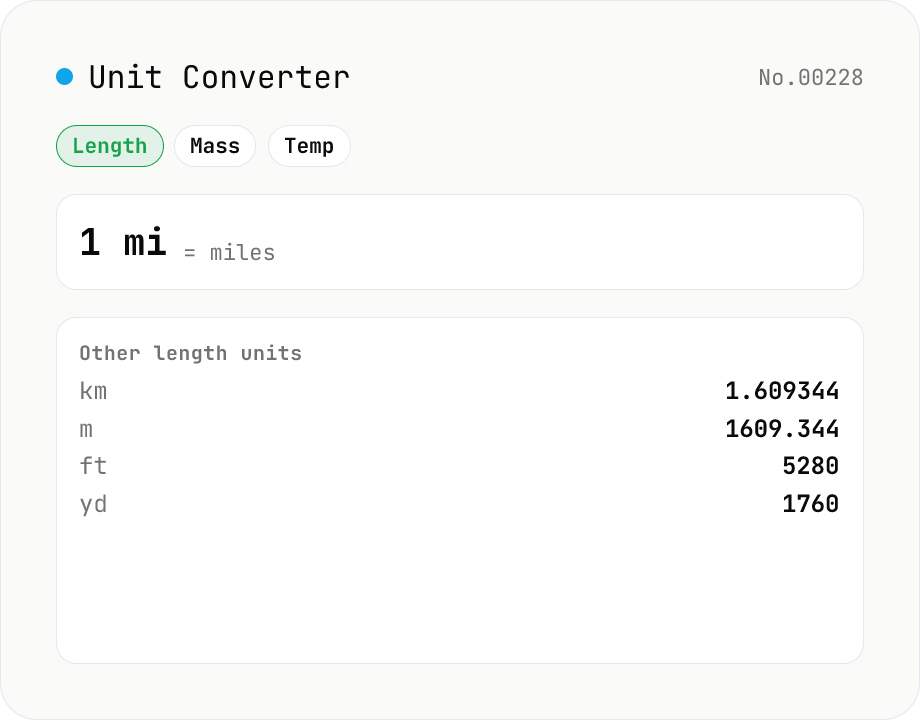
Unit Converter
Convert between length, weight, temperature, volume, area, speed, data size, and time units. Enter one value and see equivalents in every supported unit at once. Runs entirely in your browser — no uploads.
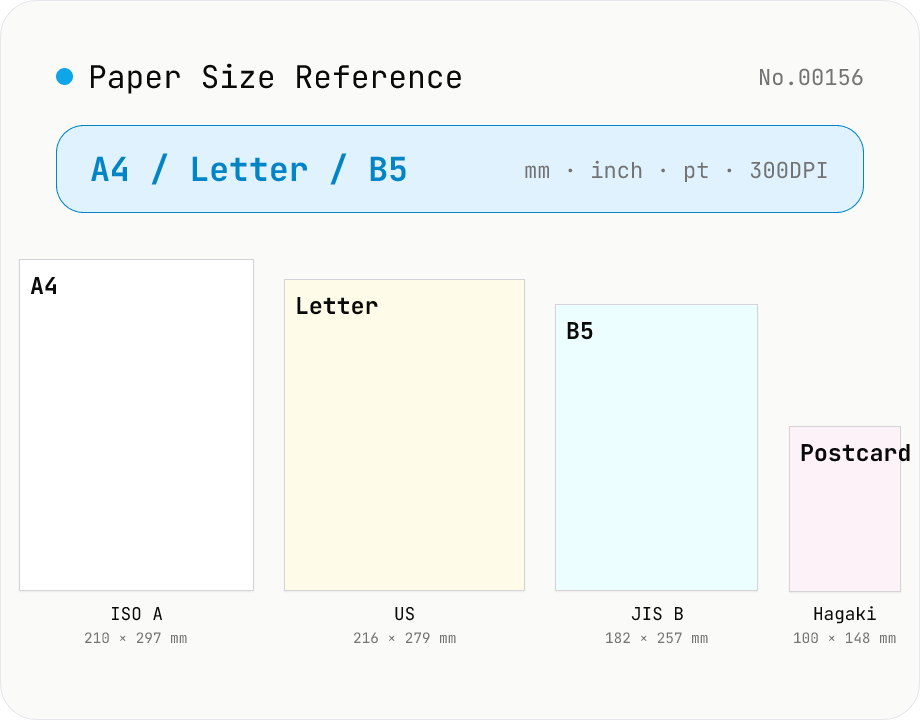
Paper Size Reference
Look up paper sizes (A4 / B5 / Letter / Legal / postcard / business card / envelopes) with millimetres, centimetres, inches, points, and pixel dimensions at 72 / 96 / 150 / 300 / 600 DPI. Distinguishes ISO 216 (A / B / C series) from JIS B; includes Japanese photo formats (L / 2L / KG) and postal envelope standards. Search across names, aliases, and notes with a series filter. Useful for print, DTP, PDF export, and image sizing decisions.
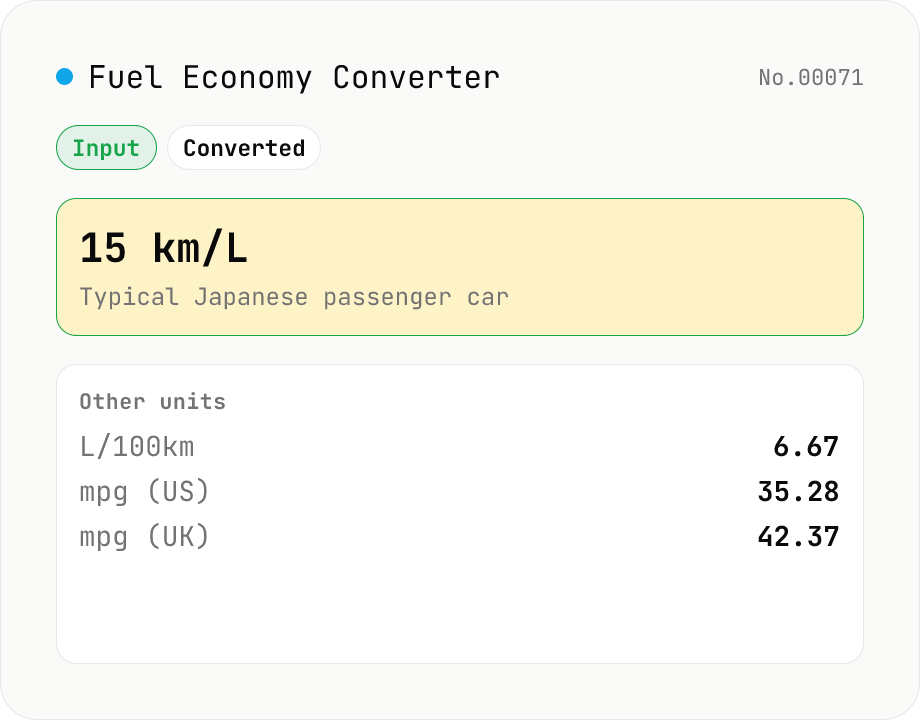
Fuel Economy Converter (km/L ⇄ L/100km ⇄ mpg)
Convert vehicle fuel economy between km/L (Japan, Nordic), L/100km (Europe, China, Australia), mpg US, and mpg UK. Handy when comparing a Japanese spec sheet against an EU/US one, or translating a rental car's mpg dashboard into km/L. Uses exact NIST factors (1 mile = 1.609344 km, 1 US gal = 3.785411784 L, 1 UK gal = 4.54609 L). Runs entirely in your browser — no uploads.
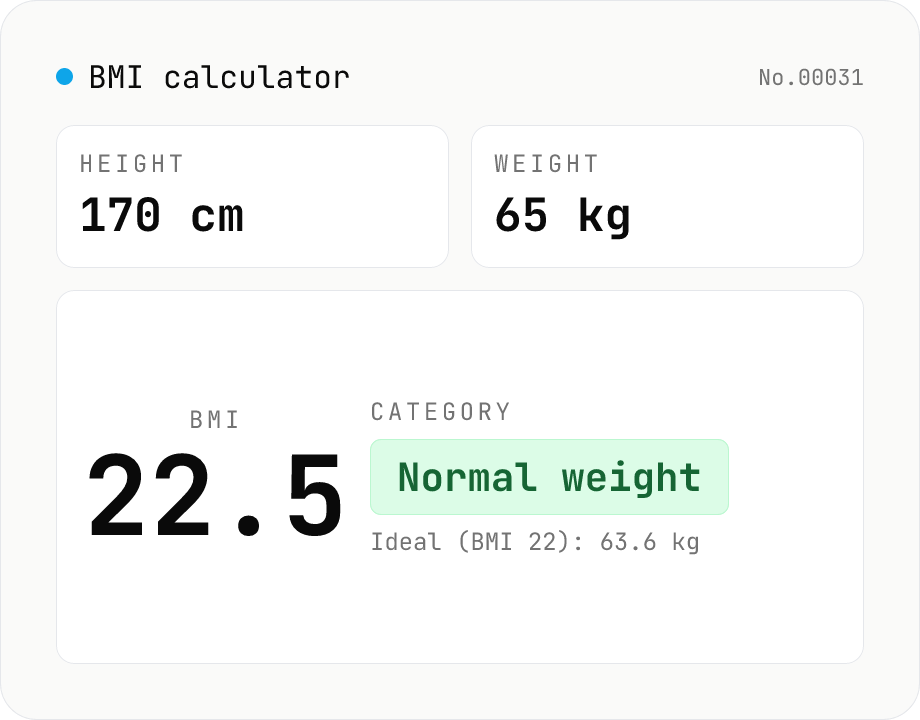
BMI calculator — with ideal weight and healthy range
Calculate your Body Mass Index from height and weight, with the classification under either the Japan Society for the Study of Obesity (JASSO) standard or the WHO standard. The result includes the ideal weight (BMI 22), the healthy weight range (BMI 18.5–25), and the difference from the ideal. Toggle the standard with a Mode, and the unit system between metric (cm / kg) and imperial (inch / lb) with an Option. Live computation as you type — everything stays inside your browser.